In less than an hour Tuesday, Boca Raton City Council members blocked out the noise of the last year and summarized the arguments for and against the proposed Terra/Frisbie downtown redevelopment project when they approved the master partnership agreement.
Let’s first acknowledge the reality of those 30 acres around City Hall. Channeling his inner Gertrude Stein, Mayor Scott Singer said, “There is not much there, there.” He’s right.
City Hall is outdated by decades. So is the community center. The police station is dead space. The two softball fields north of City Hall need upgrades.
Only the downtown library west of the Brightline station draws people throughout the day. The playground and basketball court near the community center can get crowded after school. And for all the concern about tennis, only one person regularly speaks on the subject at council meetings.
Supporters and critics of the plan generally agree on the need for redevelopment. The debate is over what approach the city should use and to what extent.
Here is the argument for the Terra/Frisbie project:
Revenue from the private development—apartments and condos, offices, a hotel, shops and restaurants—would more than pay for the public cost of a new city hall, community center, police substation and infrastructure work that must happen anyway. In addition, the city would get 15.6 acres of recreation and park space—double the current amount.
As former City Manager George Brown said, the project would create “a place where people want to be.” It would be active day and night. It would draw residents and outsiders. It would revive aging private property on the edges of the project that Singer called “almost blighted.”
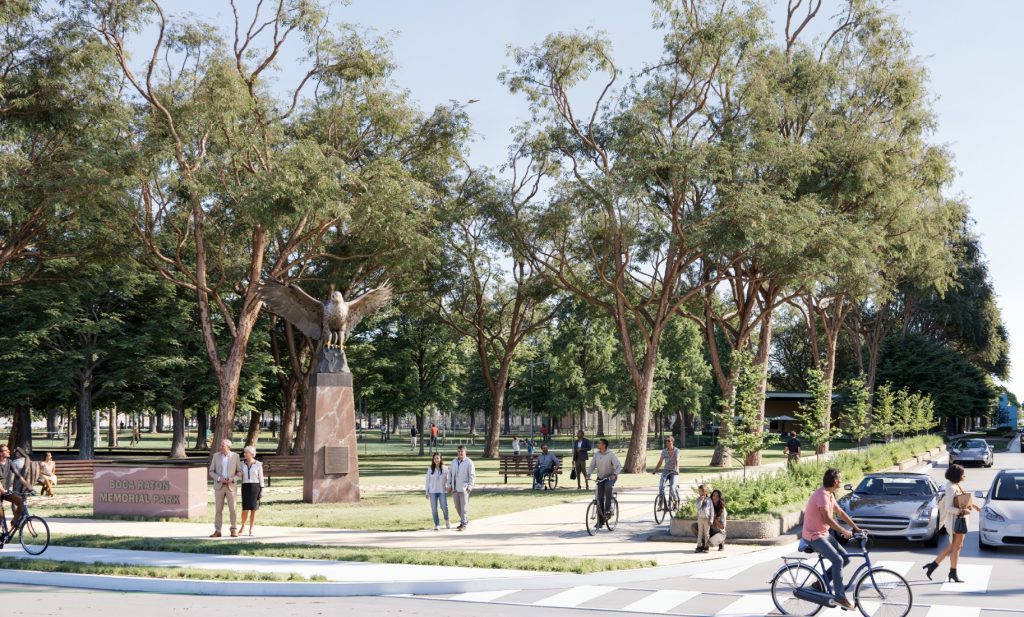
Part of that public space would be a “reimagined” Memorial Park with a “welcoming fountain,” a “Flag Plaza,” an eagle statue, a promenade and a “Dandelion Park” to honor veterans. The dandelion, the staff report notes, is the flower of the military child.
Here is the argument against the project:
Rather than have Terra/Frisbie pay those public costs directly, the city would issue a revenue bond. Because Boca Raton’s credit rating is so high, the city essentially would subsidize Terra/Frisbie. The developer would need less private financing. Its tenants would reimburse the city.
But adequate revenue might not come for 10 years. And if the private development doesn’t happen, the city would have to eat those costs.
In addition, 1.1 million square feet of development would overwhelm the area, not enhance it. The city would have to change rules to accommodate buildings up to 140 feet tall. The city also would pay for a $30 million parking garage that would benefit the private development and take perhaps all remaining surface parking spaces for the library.
Given all that, critics say, Boca Raton should ditch the public-private partnership and make the improvements itself.
Who’s right? Before the election, I’ll examine all key aspects of the plan, especially finances. As I wrote Tuesday, the numbers are key to how residents perceive the project.
The numbers changed significantly in the last two weeks, in ways favorable to the city. Councilman Andy Thomson, the only no vote Tuesday on the master partnership agreement and lease, called the change “suspicious.” Thomson believes that the “structure” of the deal puts too much risk on the city.
On the other hand, Councilman Marc Wigder—a real estate lawyer—noted correctly that local governments sometimes use these partnerships just for the economic benefits and get no revenue. Example: Vanderbilt University’s graduate school campus in downtown West Palm Beach.
The Terra/Frisbie project, Wigder said, would monetize “underutilized land.” He called it “imperative for the fiscal health of our city.”
There’s no doubt that the vote is happening because of Save Boca. Though Singer speaks often of a years-long discussion, he and others on the council were rushing to a quick decision.
I wrote about Terra/Frisbie’s first proposal in November 2024. It included more than 1,000 apartments. Yet not until just before the first key vote last spring did the city make clear the scope of the council’s ambition. That failure allowed for no public outreach and hurt public trust.
At the same time, even critics must acknowledge that Terra/Frisbie has made major changes after hearing from the public, especially on Memorial Park. The original lease was for all 31 acres. It’s now for 7.8 acres.
Tuesday featured many of the same critics saying the same things. But there also was a larger sample of supporters. Expect Terra/Frisbie to intensify a campaign that has featured mailers and now includes a political action committee.
I will do my best—including some fact-checking—to sort things out before March 10.
Delray Beach City Commission falls into chaos trying to fill vacant seat
The Delray Beach City Commission has descended to a lot of new lows. Another one came Tuesday.
On the agenda was a second attempt to fill the seat of Rob Long, who resigned in December after winning election to the Florida House. Residents had packed the chamber to support Yvonne Odom, one of five applicants.
As before, Mayor Tom Carney nominated Odom, saying, “She has been an icon.” The grandmother of Coco Gauff, Odom integrated Seacrest High School in 1961. With her husband, she started Delray Beach’s first Little League team for Black players. She taught school for 45 years. Through her activism, Carney said, Odom has “developed 300 homes.”
Unlike before, no commissioner nominated anyone else. Applause and cheering followed. No-brainer, right?
Wrong.
Commissioner Juli Casale asked to speak. “I can’t sit here,” she said, “with this charade.” To the audience, Casale said, “You deserve to know what’s going on.”
Casale then accused Carney of sending people to Casale in December asking her not to support Odom. The mayor, Casale said, wanted to nominate Odom but not have her chosen. To make this happen, Casale said, “Things were offered to me.”
Carney exploded, calling it a “bald-faced untruth.” When Casale said she reported her accusation to the city, Carney said, “I look forward to getting that person under oath.”
With Carney and Vice Mayor Angela Burns—acting as mayor so Carney could make the nomination—set to vote for Odom, Commissioner Thomas Markert could have saved the commission. Instead, he said, “The best thing to do is nothing.”
Agreeing with Casale, Markert now said he worried about having an unelected person be the swing vote until after the March election. Yet Markert in December had voted for a Casale ally to fill the seat. And the city charter lays out this procedure for choosing an interim commissioner.
When the vote came, Markert tried to abstain. City Attorney Lynn Gelin told him that he couldn’t, since he had no conflict. So Markert voted no, creating another 2-2 deadlock and passing on the chance to give Odom the symbolic honor her supporters correctly believed she deserved.
“Shame on y’all!” one audience member shouted. Burns said she was “highly disappointed.” As Casale tried to interrupt, Burns said the action had “diminished” the commission’s and the city’s “integrity.”
Delray Beach City Commission and DDA to discuss management of OSS

The city commission and Delray Beach Downtown Development Authority will meet today at 3 p.m. to discuss Atlantic Avenue and “management and operation of the Old School Square campus.”
The meeting comes one month after Carney used his complaints about DDA spending to secure a state audit of this local agency. Discussion of Old School Square should be especially interesting.
Speaking to that legislative committee last month, DDA Chairman Jim Knight said he wanted the agency to end its involvement with Old School Square “sooner rather than later.” Since late 2022, the DDA has had a contract with the city to run parts of the cultural complex—the Cornell Museum, the Field House and the amphitheater.
The contract was a last resort after the commission in 2021—with Casale’s support—voted to end the lease with Old School Square’s founding group. Despite advertising for a replacement, the city could find no suitable organization.
Though the city now operates art classes in part of the Crest Theater, the performance stage remains closed. In last week’s information letter, City Manager Terrence Moore said a consultant is “finalizing renovation scope options.”
Florida House votes to allow long gun sales to those under 21
Last week, for the fourth time, the Florida House voted to allow the sale of long guns in Florida to people under 21.
The Legislature and then-Gov. Rick Scott imposed the ban after the 2018 Marjory Stoneman Douglas shooting, which a 19-year-old carried out with a military-style rifle. Self-described guns-right groups have demanded that the state rescind it.
As before, it appears that the Senate has no interest in joining House. Rep. Peggy Gossett-Seidman, who represents Boca Raton and was one of five Republicans who voted no.