Is there anything more ubiquitous and multicultural than junk? Junk is everywhere, so much that we can no longer contain it in our landfills, banishing it instead to islands of oozing waste in the middle of our oceans. And as we learned from the prophesies of “Wall-E,” junk is going to outlive us.
But at least while we’re here on this blue dot, some creative people are doing some interesting things with yesterday’s garbage, resurrecting it from the oblivion of Waste Management and turning it into world-class art that is playful, pointed and sometimes unsettling. The environmental impact of upcycling may or may not be the ultimate mission statement of the Cornell Museum’s astounding new exhibition “Reimagined,” which features 16 internationally recognized artists who work with unorthodox materials. But it’s a theme that resounds through much of its finest work.

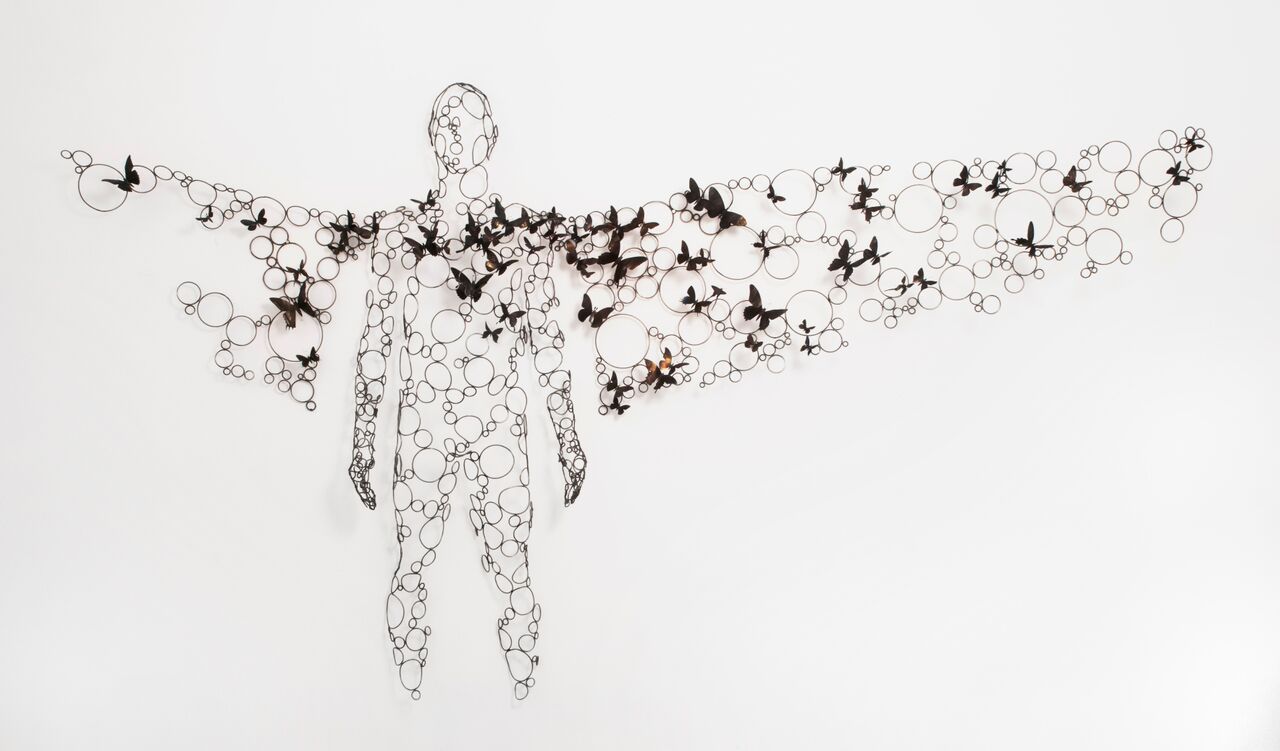
Paul Villinski, for instance, is a regular Wall-E himself, suctioning up the litter of others. His mixed-media sculptures depict kaleidoscopes of butterflies, all of them fashioned from crushed beer cans—“every one of them once raised to someone’s lips,” as he describes in his artist statement. Indeed, Villinski doesn’t try to paint over his materials’ secondhand nature. In “For Senna,” a wall sculpture that was used in the fourth season of “Gossip Girl,” the butterflies scatter from a central vortex, some parts of their wings still retaining heterogeneous crinkles of crushed aluminum.
Villinski also values recycled gloves, most of which he finds abandoned in his industrial neighborhood. “Comforter” is an impressive collage of hand-stitched gloves, some frayed and nearly coming apart, alive with both their previous functionality and their current one.

For Sayaka Ganz, a Japanese artist whose belief in animism imbues her soulful sculptures, the hard, unartistic garbage of plastic kitchen utensils receives an astonishing second life, repurposed to create birds swooping from the air and felines prepared to pounce. Steve Blackwood, in works like “My First Rocket,” “Inertial Velocity Machine” and “Wall Flower,” reinvents wheels (literally), along with used toolboxes, old propellers and other junkyard scraps, to conjure totems of wonder and bygone imagination—beautiful objects of striking uselessness that resemble the creations of a mad inventor in a ‘50s sci-fi series. A similar sense of retro futurism permeates one of my favorite pieces in the exhibition, Pepe Calderin’s “Linux Tower,” a kinetic sculpture made from recovered computer hardware: the microprocessors and circuit boards and tiny light bulbs and spinning objects that once heralded a revolution in computing power.

Calderin isn’t the only artist in the show to rhapsodize antiquated technology. Nick Gentry’s discarded medium of choice is celluloid film, now the decaying antecedent of digital photography. In “1978” and “Once,” he creates a patchwork of film negatives, their images imprinted like ghosts onto portraits and encased, like ancient specimens, in LED light boxes. Brian Demeter’s brilliant “Americana 54” is a triptych of “cloud formations” comprised of disemboweled encyclopedias, their guts filled with illustrations of yesterday’s maps, factories and buildings, innovations long replaced or upgraded; the project is a sly, physical reference to the digital cloud that houses all of the world’s nonphysical information.

While many of the artists in “Reimagined” work with materials found or discarded by others, Tina LaPorta transforms personal objects—pills she has taken for her own mental illness—into disquieting art that comments on our overmedicated populace. In her brightly dangerous “Sweet Madness,” mandala-like pill formations rest against a sparkly backdrop. The drugs look like candy—surely the intention of their makers—and if you tilt the frame on its side, the three pill spheres resemble Mickey Mouse.
But some of the best pieces in “Reimagined” eschew seriousness. Donna Rosenthal repurposes printed materials, from financial newspapers to comic books and maps, into laminated suits and dresses for dolls, then prints text onto the chests of the clothes. She gives her “Superheroes” more achievable, down-to-earth powers: He’s “Mindful Man” and she’s “Worthy Woman.”

But no artist will grab your attention quite like Jason Mecier, a mosaic portraitist who creates faces of celebrities using what he believes would be found in their trash. Thus, the accumulation of detritus that makes up “Lindsay Lohan” includes vodka bottles, Band-Aids, lighters, Nicorette packages, pill bottles and other physical evidence of his subject’s hedonistic lifestyle.
Mecier’s “Tori Spelling” is awash in ‘90s nostalgia, from “90210” wallpaper to toys and trinkets of the era. And his “Amy Schumer” smiles dementedly, surrounded by the remnants of her oversexualized persona—liquor bottles, condoms and vaginal moisturizer. Mecier even found a cardboard box containing a blunt direction to “push in finger hole” that Schumer would no doubt find hilarious.
We may be overwhelmed with more junk than we can ever properly dispose of, but it’s nice to know that some of us our doing our part to make a bit more room in the increasing pile—and make us laugh in the process.
“Reimagined” runs through Oct. 18 at Delray Center for the Arts’ Cornell Museum, 51 N. Swinton Ave., Delray Beach. Admission costs $5. For information, call 561/243-7922 or visit delraycenterforthearts.org.