
Courts call out the gerrymandering
Ted Deutch and Lois Frankel were luckier last week than some of their colleagues in the Florida congressional delegation, but maybe not lucky enough.
In ruling that the Republican-led Florida Legislature—surprise!—drew the state’s congressional districts three years ago to favor Republicans, the Florida Supreme Court identified eight problematic districts that should be redrawn. Of those eight, the court was least concerned about District 21, which Deutch represents, and District 22, which Frankel represents. Still, the districts could look much different very soon.
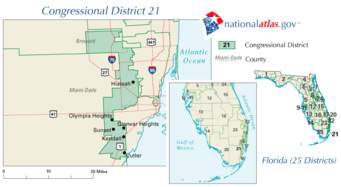
District 22 includes most of southeast Palm Beach County but also runs north to take in parts of West Palm Beach, where Frankel lives. The district also includes northeast Broward County. District 21 (above) covers most of southwest Palm Beach County and a portion of northwest Broward. Deutch and Frankel are Democrats. Frankel’s district is Democratic-leaning, while Deutch’s is one of the safest Democratic seats in the country.
Why, you might ask, would Republican political operatives seemingly be helping Democrats if their goal was to help the GOP? Because the overall plan was to pack certain districts with lots of Democrats, thus diluting their power statewide. Though Barack Obama won Florida in 2008 and 2012, Republicans hold 17 congressional seats to just 10 for Democrats.
The GOP has applied the same principle to legislative maps. During the redistrictings of 1992, 2002 and 2012, Republicans cut deals with African-American Democrats. They would get safe seats, and Republicans could say that they were drawing maps with bipartisan support. Republicans also could say that they were protecting minorities, because the number of Hispanic GOP legislators was increasing.
The obvious problem is that this amounts to politicians picking their voters, not the other way around. It also reduces the number of swing districts that have more of a partisan balance and produce moderates, not ideologues.When the Legislature was drawing congressional districts 21 and 22, it made them run roughly parallel. The House had wanted to stack them. That configuration would have put all of District 21 in Palm Beach County and given Deutch most of the coastal areas now in Frankel’s district. Frankel would have picked up Deutch’s Broward constituents, kept the rest of her Broward constituents, and retained only Boca Raton and Delray Beach in Palm Beach County. Frankel no longer would live in the district, though she is not required to be a resident. Members of Congress in Florida only must be registered voters here.
The Fair Districts Amendment, which voters passed in 2010 to reduce gerrymandering—drawing the lines to favor parties and/or incumbents—required that the Legislature try to create districts that are as compact as possible and respect geographic boundaries. Districts 21 and 22 favor Palm Beach voters over Broward voters. The stacked map could make it easier for a Broward candidate to challenge Frankel, who has held the District 22 seat since 2012. The stacked map might make District 21 more competitive.
In a statement, Deutch said, “The Supreme Court’s ruling was good for democracy.” The Legislature has 100 days to draw new maps that satisfy the court. The new maps will take effect for next years’s election. “I look forward to continuing working hard on behalf of the people on Palm Beach and Broward counties.” If Deutch is still in Congress in 2017, only half of that statement may be true.
Atlantic Crossing blues
Where is Delray Beach when it comes to Atlantic Crossing? “Confused,” in the mind of City Commissioner Mitch Katz.
Seeking to have the developers put back into the site plan a road entering the project from Federal Highway—and with the developers apparently willing to do so—the commission hired a traffic consultant. Last month, he presented two options for the road, with the commission supposedly willing to follow his recommendation. The consultant concluded that more traffic relief would come from a one-way road eastbound from Federal, not the two-way road first envisioned for the mixed-use project.
Last week, the commission had been set to confirm that option. Instead, the commission took no action. Granted, Shelly Petrolia and Jordana Jarjura weren’t at the meeting. But Mayor Cary Glickstein had hoped to get the road back into the site plan, and then have the new site plan and a development agreement approved by September.
A new issue arose when the developers filed a lawsuit. That action came after Glickstein had been meeting with the developers to work out a compromise. As the developers’ representatives regularly state, Atlantic Crossing has an approved site plan that doesn’t include the road, but they want to respect community sentiment. The litigation thus came as a surprise, even if it read more like an attempt to hedge against surprises from the commission.
Katz, however, said there may not be a lawsuit. According to the city attorney’s office, the litigation was not properly served. City Attorney Noel Pfeffer is on vacation, which only increases the uncertainty. The issue of the road is “up in the air,” Petrolia said.
In an email, though, City Manager Don Cooper said he expects that Atlantic Crossing “will try to get on” the agenda for the Aug. 17 Planning and Zoning Board meeting to seek approval for a site plan that includes the road.
All Aboard intent uncertain
All Aboard Florida isn’t on the agenda for today’s meeting of the Palm Beach Metropolitan Planning Organization, but it will be in the air.
The MPO board, which sets transportation priorities for the county, will get an update on the plan to divert trains from the Florida East Coast Railway tracks nearer the coast to the CSX tracks that Tri-Rail uses. The switch away from the FEC would occur in Miami, and the switch back to the CSX would occur in the north end of West Palm Beach, after the trains clear the downtown. By 2018, as many as a dozen long freight trains could be out of the many downtowns between Miami and West Palm.
According to the Florida Department of Transportation, the two projects “will accommodate existing freight traffic, potential future passenger service and the projected growth in freight rail operations following the Panama Canal expansion” and upgrades at the Port of Palm Beach, Port Everglades and the Port of Miami to take some of the added cargo from that expansion of the Panama Canal.
Critics of All Aboard Florida, the Miami-to-Orlando passenger service that plans to begin running in 2017, claim that the program is a subterfuge. They say that the real intent of Florida East Coast Industries, All Aboard Florida’s parent company, is to upgrade the tracks not for 32 new passenger trains each day but for new, longer freight trains.
For all the debate, there’s no way to tell. Counties and cities along the FEC have taken real and symbolic votes against All Aboard Florida, but because the company owns the rail right-of-way there is no regulatory role for local governments. Safety improvements at crossings supposedly will remove the need for trains on the FEC tracks to blow their whistles. The crossover in the Northwood neighborhood of West Palm Beach could allow Tri-Rail service as far north as Jupiter. Commuter service also could begin on the FEC tracks. All Aboard Florida remains one of the most discussed projects in South Florida history. At this point, it also is one of the least certain.
Randy Schultz was born in Hartford, Conn., and graduated from the University of Tennessee in 1974. He has lived in South Florida since then, and in Boca Raton since 1985. Schultz spent nearly 40 years in daily journalism at the Miami Herald and Palm Beach Post, most recently as editorial page editor at the Post. His wife, Shelley, is director of The Learning Network at Pine Crest School. His son, an attorney, and daughter-in-law and three grandchildren also live in Boca Raton. His daughter is a veterinarian who lives in Baltimore.