Like it or not, surrealism and magic are safe words. The latter has devolved into unpredictable explorations of the unknown to well-practiced sleight of hand performed at children’s parties and on cruise ships. The former has mutated from an avant-garde art movement to the stuff of commercials and Muppets movies, culminating in the 1998 exhibition “Pop Surrealism,” in which 73 artists toiled in the once-unfathomable marriage of surrealist art and popular culture.

There was a time when surrealism and magic were the antithesis of popular culture, when they challenged the status quo rather than played into it, when their ideas were too radical to be understood, let alone appreciated, by the masses. This is the era celebrated in the revealing, if overly bookish, exhibition “Surrealism and Magic,” organized by Cornell University’s Herbert F. Johnson Museum of Art, and opening this week at the Boca Raton Museum of Art.
The exhibit amasses some 100 objects, drawn largely from the library of surrealist artist and engraver Kurt Seligmann, and encompassing drawings, collages, books, prints, paintings, photography and video, most of them from surrealism’s early to mid-20th century heyday. Cramming what feels like an entire course syllabus into one small exhibition space, the show examines the links between the art and the magical beliefs that fascinated its creators, from occultism, alchemy and shamanic philosophies to Mexican, Native American and vodou practices.
“Surrealism and Magic” brims with a spirit of openness to new ideas, new paradigms of (il)logic, new portals of consciousness explored without heed to their results. Its introductory wall text includes a quote from Russian esotericist Peter Ouspensky that transcends the exhibition’s subject and speaks to the role of the artist then and now: “The artist must be a clairvoyant: He must see that which others do not see.”

In our jaded times, where nothing shocks us, it’s difficult to comprehend just how much these works upended their establishments—politically, religiously, artistically. “Surrealism and Magic” extends its reach all the way to Albrecht Durer’s early 16th century woodcut “Adam and Eve/Small Passion,” a provocative surrealist antecedent that imagines the first Biblical couple as muscular, equine figures, arm in arm and feeding an apple to a serpent. The exhibition traces a line from this piece to Victor Brauner’s “Woman With Serpent’s Body in a Tree,” which plays with perception, identity and especially theocratic precepts.
As the surrealist movement gained traction and absorbed forbidden fruits of influence, the works in this show become fascinatingly obscure and open to interpretation. A painting like Leonara Carrington’s “El Nigromante” is driven by dense symbolism, while Wilfredo Lam’s “Motherhood” seems inspired more by Freudian psychology, with its signature image of a maternal figure with a horned horse-head cradling a crazed baby. Others, like Man Ray’s “Fortress and Eggs,” are simply playful disruptions, existing for seemingly no other reason than to shatter all notions of perspective in art.

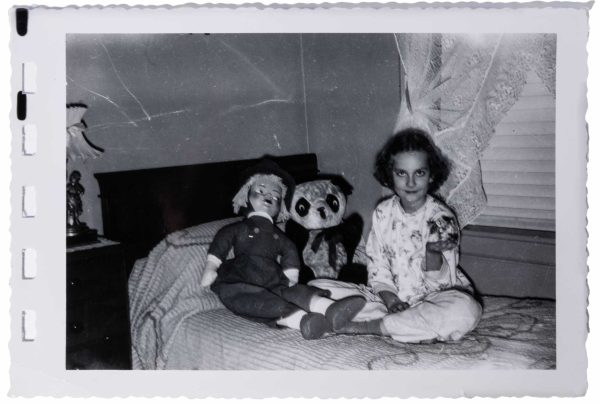
Seligmann himself (pictured above) is the most represented artist in the exhibition, and his work defines the surrealist ethos of reimagining reality as we know it, forcing us, in “La Sorciere,” to see a witch in a humanoid collection of objects: a flag, a spoon, a giant leaf, a capital dome, a saddle. Similar works such as “The First Aviator” and “Marathon” are veritable Rube Goldberg machines of random but connected objects, subverting dimensionality (I’m betraying my politics here, but the first thing I saw in Seligmann’s “Vampyre” was Dick Cheney). Seligmann’s famous cyclonic, semi-abstract paintings are represented as well, along with such large-scale mind-blowers as Roberto Matta Echaurren’s vision of machine-age menace, “Oeufficiency,” with its phallic, totemic figures engaged in mysteriously threatening behavior.
Before you know it, pop-culture already infringes on the movement. A still from a Disney cartoon accompanies a quote from Salvador Dali, who stated after a trip to the U.S. that Harpo Marx, Walt Disney and Cecil B. DeMille were surrealists. It is perhaps no surprise that the most popular work in this exhibit during my visit was its most pop-cultural selection: Mark Wallinger’s 10-minute video “The Magic of Things,” which isolates scenes of self-moving objects from episodes of “Bewitched.” Divorced from the presence of human will, these brief shots of self-running vacuums, falling chairs and hovering china have more sinister implications than intended in their original, candy-colored sitcom form, suggesting a world in metaphysical anarchy.

The Wallinger video is the most popular item in the exhibition because it’s nostalgic and funny, but also because it doesn’t have much show-stopping competition. The problem with “Surrealism and Magic” is that so much of its most intriguing work is presented in the single pages of books spread open under glass, small in size and out of our reach. Moreover, many of the works only illuminate when accompanied by the context of voluminous wall text. There is arguably more to read than to see in this exhibition, which is an exceptional study guide but perhaps not the perfect art show.
For an exhibition that is all about seeing, you can always stick around for “The Wandering Veil,” the Boca Museum’s exhibit of Israeli-born artist Izhar Patkin’s paintings, sculptures and tulle fabric murals, the latter of which take up entire walls of the museum’s first-floor gallery. It’s an outstanding achievement, and one that probably deserves its own separate column here.
“Surrealism and Magic” and “The Wandering Veil” run through April 5 at Boca Raton Museum of Art, 501 Plaza Real, Boca Raton. Admission costs $10-$12. For information, call 561/392-2500 or visit bocamuseum.org.