It didn’t take long for Judi Larkin to find her niche in Boca Raton when she and her husband, Mark Larkin, moved here from Minnesota in 2016. Mark had accepted the big job as president of the Boca Raton Regional Hospital Foundation—and was charged immediately with launching a capital campaign of $250 million to expand the hospital. It was a crash course on the Boca social season from day one.
“The first couple of years we were out five times a week meeting people. Keeping up with the clothing alone was a challenge … just the pace,” she says. “For me personally, it was cultural adjustment.”
But South Florida had been on the radar for years.
“Being from Minnesota, we had spent a lot of time in Naples, the Midwestern side [of Florida]. I knew I loved the climate in Florida, I knew I loved access to golf, access to tennis, access to pickleball. We kind of thought we’d retire here at some point in time. Then Boca came up. My husband came down for an interview. He called and said, ‘You know, it’s kind of a special place.’ We both came down for a second interview and just fell in love with the community and the people. They are very gracious and very warm. It took me a few years to sort through and find my own set of friends through golf and things like that, and [I] was able to find a nice niche for myself.”
Golf is central to that niche, and to Larkin, who, following the sale of the successful computer company where she worked, was a golf coach at St. Cloud State University for 15 years before moving here. But it wasn’t always golf; Larkin was a tennis phenom before that, all through high school and college, where she played competitively. (Her record at St. Cloud State includes numerous Northern Sun Conference team championships, State No. 1 doubles title, competition in the NCAA National Championships, No. 1 Singles Consolation title in the NCC, and NSC All-Conference honors.)
Her first foray into golf was also in those days, when her father suggested she give it a try, and she says she “fell in love with the game.”
“My dad [who was president of the University of Nebraska at Kearney for 10 years and then at St. Cloud State for 10 years] came from a huge line of athletes. His family is all from Canada, they are all Olympic volleyball players, Olympic swimmers, figure skaters, dancers. … The beautiful thing was I was kind of the boy my dad never had. He had two girls, and he was looking for somebody to play with, so … I got to play with him, which was incredible.”
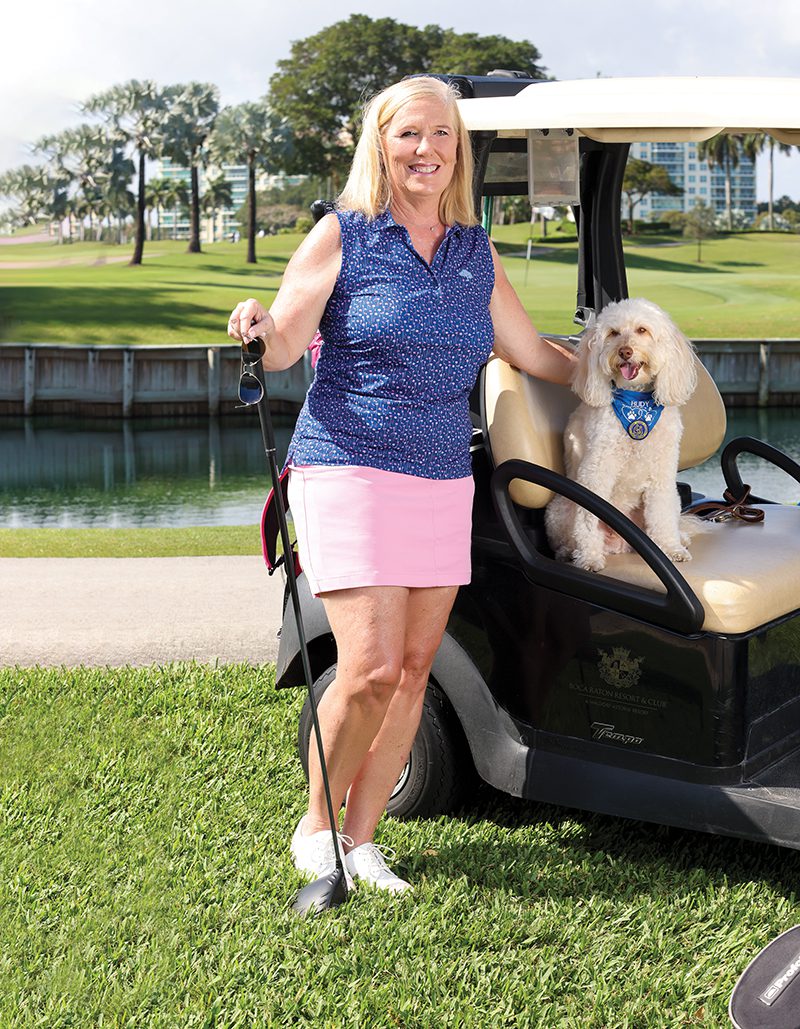
Larkin said she really got into it after college, when a series of tennis injuries led her to apply her talents to golf instead. Since she moved here, she’s joined the Executive Women’s Golf Association, which became the LPGA Amateur Golf Association, and joined one of its competitive teams. She’s helped organize some tournaments. And she won’t come out and say it, but she’s really good, admitting to a handicap between 6 and 7. (According to the U.S. Golf Association, a 7 handicap puts her in the top 3 percent of women players.)
“The thing I love about golf is that it’s a game you can never master. So you’re constantly learning. … You can’t start over in golf; you have to be focused for four and a half hours—it’s a very strong mental game. That’s the challenge—especially with women. They get so intimidated by the game. Once you learn to be part of the course and not be competing with the person next to you, that’s when it becomes fun.”
Although the pandemic has upended her life for the past two years, Larkin is looking forward to getting back out there, to seeing friends and family, to once again taking the family’s therapy dog—an Australian labradoodle named Rudy—to visit patients at the Lynn Cancer Center, and just generally picking up where life left off.
And we had to ask: Where did she meet Mark?
“It’s kind of embarrassing,” she says. “I met Mark when I was working in Minneapolis at one of these startup companies, and he was working for the Boy Scouts of America. A friend of mine had asked me to go to an opening of a big bar in downtown St. Paul, and we walked in there and ironically, he walked in with a group of five Boy Scouts. And I said to my friend, ‘You know, the tall guy with the mustache kind of looks like the boy next door you would marry.’ I can’t believe I said that. At one point we ended up on the dance floor, and we’ve been together ever since. And it was called the Heartthrob Café.”
This story is from the April 2022 issue of Boca magazine. For more like this, click here to subscribe to the magazine.