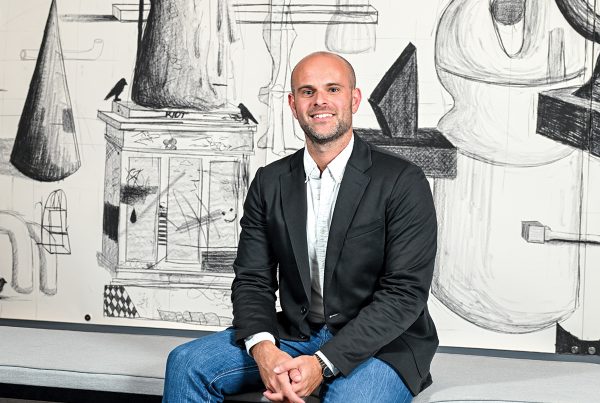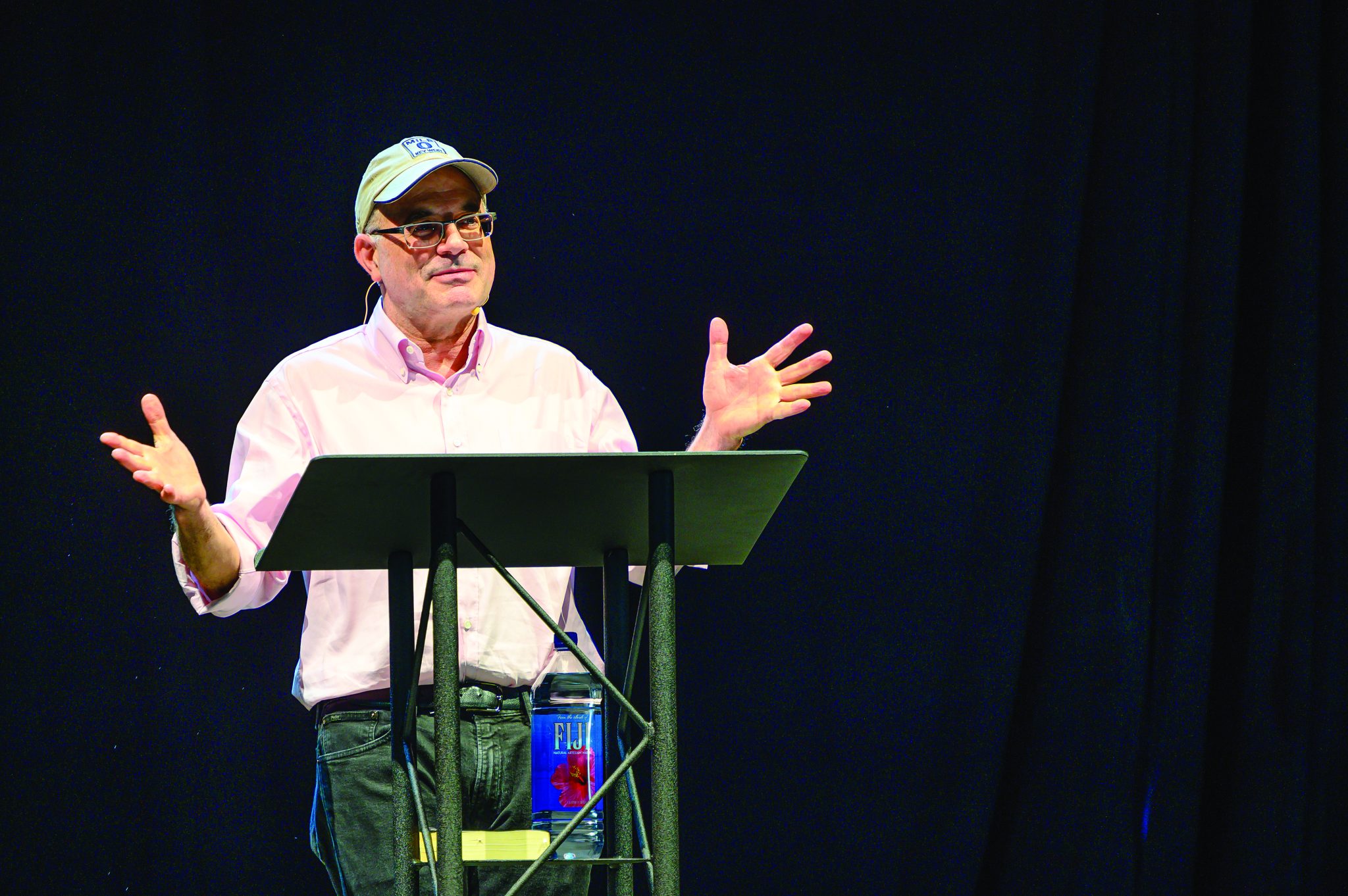
As soon as he deplaned for his March 2023 lecture at Festival of the Arts Boca, Charles Fishman made a beeline for the city’s Wastewater Treatment Plant. You know, as tourists do.
“I find them highly entertaining,” Fishman told the audience, referring—yes, indeed—to wastewater treatment plants. Of course, it’s a good thing somebody finds treatment plants interesting, and there is no better advocate for them than Fishman. The prizewinning journalist and author of The Big Thirst: The Secret Life and Turbulent Future of Water came away from his visit with some quietly alarming statistics.
To wit, the average American uses 83 gallons of water per day. A Boca Ratonian uses 254 gallons per day, more than triple the national average—a figure owing largely to our immaculately maintained golf courses and, most especially, our lawns, which we over-water. Fishman, only half-joking, referred to Boca as “crazytown” for our profligate consumption of H20.
Fishman cares about water, and he cares about Florida. He’s essentially a native of the state—he moved to what is now Pinecrest as a first-grader, and attended all of public school in Miami-Dade County. Later, he moved to Central Florida to work for the Orlando Sentinel. Now living in Washington, D.C., the Harvard-educated investigative reporter has written four books, among them One Giant Leap, about the space race.
“I consider myself a Floridian, even though I haven’t lived there since 1993,” he says. “And I have a very vivid sense of the power of water in the Florida landscape.” Weeks after his Festival of the Arts presentation, Fishman joined us via Zoom to continue the discussion.

What were your takeaways from exploring Boca’s water distribution?
Boca residents use two-thirds of their water watering their lawns. And the water utility supplies 33 million gallons a day and only gets back 13 million gallons a day at the wastewater treatment plant. So the math there is very easy. They send out 20 millions gallons a day—almost 1 million gallons an hour—that they don’t get back.
The water is incredibly cheap, and that’s not good, because it sends the message that, why shouldn’t I turn my sprinklers on from midnight to 3 a.m. if I can afford the $60 a month it’s going to cost me? Then there’s this quick argument that, well, it’s going into lawns, so it’s going back into the ground. But the water that you’re using is coming from a kind of deep aquifer. And the water you’re putting back in goes into what’s called the surficial aquifer, near the surface, and not the deep aquifer.
The deep aquifer is the Biscayne aquifer, and it’s the water that supplies Miami up through Palm Beach and the Space Coast. But it’s keeping the seawater out of the aquifer. You don’t want just a little bit of salt in the water you’re watering your tomatoes with, or your grass, or showering, or cleaning your clothes. Saltwater is bad news, and it is challenging and expensive to take out. And once it’s seeping in, there’s no good accessible mechanism for keeping the ocean out. The way you keep the ocean out is the freshwater aquifer is powerful and stable enough so that there’s literally a kind of barrier, a place where they come together.
And in the midst of everything, sea level rise literally increases the pressure on the freshwater aquifers. That’s more ocean pushing against the lake.
The people who run the Boca Raton water utility are really smart. It is a very sophisticated operation. I talked to [Utility Services Director] Chris Helfrich, and none of this is news to him. It’s a wellrun place. They recycle every gallon of water they get back, and send water out in their recycling system. We don’t do that in D.C. New York doesn’t do that. The problem is that most of the water doesn’t come back. He’s topped out. … He’s got the 13 million gallons a day accounted for, and the 20 million doesn’t come back.
Should education about water use be a political issue for local officials?
Water is so important in Florida. And Florida has mismanaged its relationship with water for 100 years. All the populated communities of Florida are designed to gather the 50 inches of water that fall every year and throw it away. Then you look around and say, where’s the water? We’re embarked on this vast, multibillion-dollar effort to restore wetlands along the base of the Everglades and try to undo the damage we do and also restore some of the natural functioning; that’s a sign of how badly we screwed it up to begin with.
So there isn’t a flip and simplistic politics of water. … But Florida used to have really advanced, sophisticated development rules. You couldn’t build unless there was a water supply to provide for the people you’re building for. That was abandoned. At some point in the last 15 years, someone looked around and said, “what Florida needs is more development.”
But you can clearly have both. In Florida overall, only 17 percent of the water is recycled. Boca recycles every drop you get, and you’re only at twice that because the way the system works. Instead of throwing away the stormwater, we need to think about that not as an inconvenience but as a resource.
We haven’t talked about red tide and algae blooms. These are all water issues—they are devastating economically. You can’t run a tourism business if there’s red tide. But they’re devastating environmentally, and I venture to say that 200 years ago, there were no red tides and algae blooms in most of Florida. And so they’re a sign that we’re not managing this right. We can do better without suffocating Florida. No one’s talking about strangling the economics of Florida.

There are people who believe that a water shortage is going to be the next national cataclysm. Could you foresee something that like happening?
We’re having that kind of apocalypse out west. Lake Powell is the reservoir closer to Denver; Lake Meade is the reservoir closer to Texas. Those are the two huge lakes created by damming the Colorado River, and Lake Meade is down 150 feet from its normal level between 1940 and 2000. That’s insane. You could literally have buried a 14-story building and uncovered it. One-third of the agricultural produce of the country relies on the Colorado River.
Water problems are local. The crisis of Las Vegas and Los Angeles and Denver and the Colorado River doesn’t directly affect the people of Boca Raton or Orlando or Naples. And most important, you can’t help the people of Denver with their water problem by changing your water use; water use in Boca doesn’t have any impact on water use in Denver. [By contrast], the U.S. electric grid is completely unified. If California is having an electricity crisis, people in Boston and Atlanta not using electricity actually helps. The capacity in Boston and Atlanta can literally be transferred to California.
… Water problems never get better on their own. You never look at a wet spot in the living room of your house or apartment and turn to your wife, and say, “honey, it looks like the roof is leaking. Let’s wait a month and see if it gets better.” And management of Florida’s aquifers and Florida’s rainfall and stormwater is exactly the same.
[In April], we had a kind of unimaginable crisis in Fort Lauderdale; too much water is as much of a crisis as too little. Fort Lauderdale was overwhelmed. But that’s also a warning. And the warning is, this wasn’t a one-in-a-century event. This is what the world is going to look like now. Get adjusted to it. Figure out what you need to do to accommodate the way the world is going to be. … But we can’t do it by flicking a switch. We’re going to have to spend money. And we’re going to have to acknowledge reality.
You also wrote the definitive book about the space race. By next winter, we may be sending astronauts to the moon again. What kind of an impact could this have on what we need most, which is bringing the country together for a greater cause?
That’s exactly the right question. For me, the big and unexpected revelation of going to the moon was, going to the moon was impossible in 1961, when Kennedy said, “do it.” And literally, eight years later, Armstrong and Aldrin are bouncing around on the moon. And two years later, we’re driving a car around the moon—an electric car, by the way. So for me, the biggest lesson was, Americans like to be challenged to do hard things, and we rise to the occasion.
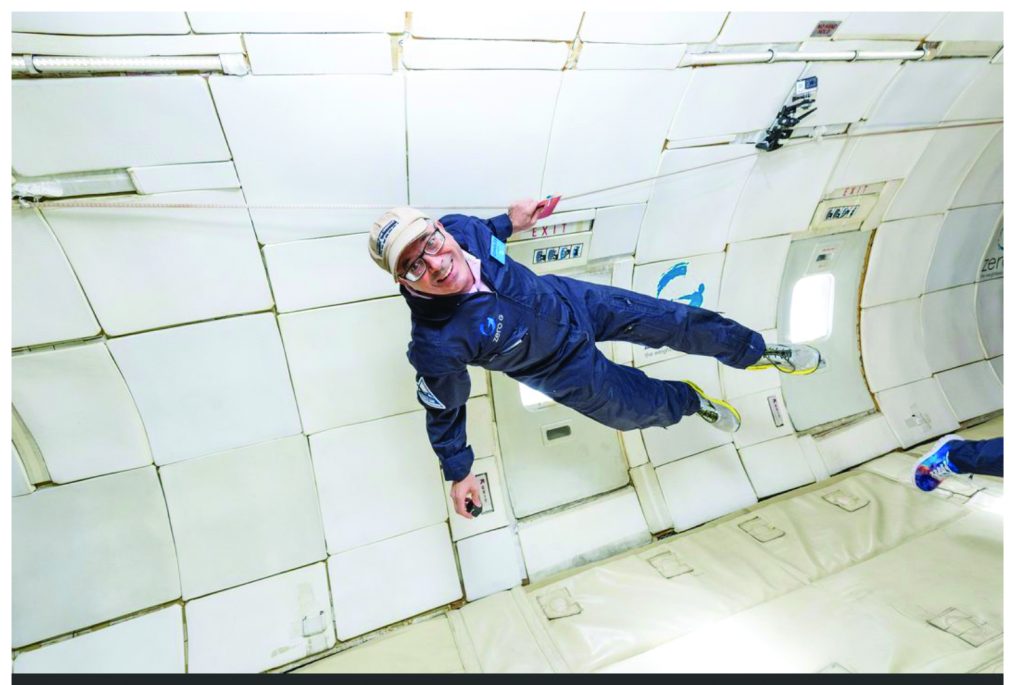
… I think we’re about to enter the space age that we all imagined when we watched “The Jetsons” or “Star Trek.” Starting 10 years from now, there’ll be hundreds of people working in orbit. And that will have happened because the economics have shifted, and it will make sense to do things in orbit that are really productive because it will be relatively inexpensive to go to orbit, and relatively safe.
We’re embarking on a new moon mission, once again, in a soft conflict—or a hard economic conflict—with Russia, after many years of working with Russia on space exploration. How do current world events affect this valuable collaboration?
I would add China. Russia and the U.S. still manage the Space Station every hour of every day, successfully, quietly, despite what’s going on. But a single effort like that isn’t going to change geopolitics.
The Russians do not have the resources to compete in another race to the moon or to Mars. The Chinese, on the other hand, not only have the resources and the talent; they think it’s a critical signal of their technological skill and prowess and standing in the world. So they’ve got a space station in orbit. They built it. They visit it. They have plans to get people to the moon.
I don’t mind that rivalry. Here’s what we got out of going to the moon: We got your iPhone. We got your laptop computer. The Apollo project was the first to use integrated circuits. And NASA taught the semiconductor companies how to make perfect computer chips. They created the culture of perfection in Silicon Valley. And Apollo was the first big software effort. The missions to the moon were the first time ever that computers had responsibility for human lives. And NASA set standards for what it meant for computers to handle that responsibility.
And all of that cascaded out to the digital revolution. No one in 1961 said, “if we go to the moon, everybody will have a phone in their pocket and a computer on their desk.” But ultimately that’s what happened. … Competition lights everybody up.
Can you imagine how the surface of the moon will look today with our high-definition video versus the grainy footage of coming on 55 years ago?
I’m sort of with the astronauts: The moon is desolate. It is spectacularly beautiful, but bringing great cameras there isn’t going to change the fact that it’s just shades of grey. But what happens is, you turn the cameras back and look at Earth, and the brilliant stark grey of the moon just underscores how spectacular and how unusual Earth itself is.
To me, what it underscores is, we’ve got the skills and the energy to fix the place we live right now. And that doesn’t mean we shouldn’t go to the moon. To me, it’s a reminder that if we can go to the moon, we can clean up Lake Okeechobee.
This story is from the July/August 2023 issue of Boca magazine. For more like this, click here to subscribe to the magazine.