GEO Group failed to get naming rights to Florida Atlantic University’s football stadium in 2013. Now the private prison/detention company is two votes from getting the whole university.
That’s because a GEO Group employee—Adam Hasner—is one of three finalists to become FAU’s president. Trustee Chair Piero Bussani said in an email to his colleagues Sunday that Hasner, Michael Hartline and John Volin will be interviewed on campus next month. Then they will take questions from the trustees, who will choose a candidate for approval by the Board of Governors.
Hartline is dean of the business school at Florida State University. He has 33 years of experience in higher education, beginning as an assistant professor. He has led FSU’s business school for nearly a decade and has worked in fundraising. He was a finalist in FAU’s first search, which the Board of Governors suspended for alleged policy violations.
Volin is executive vice president for academic affairs and provost at the University of Maine, a position he has held for five years. Volin also has three decades of related experience, having begun as an FAU professor in 1995. He worked at FAU for 12 years. His three degrees are in life sciences, and he ran the graduate-level environmental science program. He then went to the University of Connecticut and then on to Maine.
In contrast, Hasner’s only related professional experience is a decade serving on the advisory board of FAU’s business school. His application cites legislation to help FAU—such as creation of its medical program—during Hasner’s eight years representing the Florida House district that includes Boca Raton. Hasner has spent the last three decades in the private sector, working since 2016 at Boca Raton-based GEO Group, currently as executive vice-president for public policy.
In that role, Hasner says in his application, he has “initiated efforts to better educate policymakers and more effectively advocate by telling the company’s story to refute disinformation and rebut opposition.”
Such “opposition” killed GEO Group’s attempt in 2013 to buy the stadium naming rights for $6 million. Critics mocked the deal by calling the stadium “Owlcatraz.” They noted that one of FAU’s most popular majors is social work; the university trains students to oppose GEO Group’s business model of profiting from its operation of prisons and immigrant detention centers.
As in 2013, critics have plenty of ammunition. Just last week, a federal appeals court upheld a $23 million judgment against GEO Group for paying detainees at a Washington state facility $1 a day to work. Last month, the families of two inmates at a state prison near Belle Glade that GEO Group operates accused the company of negligence in the inmates’ deaths. The list goes on.
Politically, though, GEO Group is in great shape. The company expects to benefit from President Donald Trump’s planned immigrant deportations.
Four days before the election, GEO Group stock was trading at $14.45 per share. On Friday, the price was $35.35. On an investor call two days after Trump won, GEO Group Chairman George Zoley called the result “an unprecedented opportunity.” GEO Group just hired the federal government’s former top-ranking official for immigration deportation.
Speaking of politics, an FAU connection could explain Hasner’s choice. Trustee Pablo Paez is GEO Group’s executive vice president of corporate relations. Gov. Ron DeSantis appointed Paez in June 2023, one month before State University System Chancellor Ray Rodrigues suspended the search.
Rodrigues acted after then State Rep. Randy Fine, the governor’s preferred choice, did not become a finalist. The committee picked three people with extensive higher education experience. Fine had none.
A few months earlier, DeSantis had engineered the selection of former U.S. Sen. Ben Sasse as president of the University of Florida. He lasted just 18 months before resigning. Just before suspension of the FAU search, South Florida State College rejected three finalists in its presidential search and returned with one candidate: then-State Rep. Fred Hawkins. He was the governor’s choice.
The absence of Interim President Stacey Volnick is notable from the list of finalists. Since taking over two years ago, she has regularly drawn praise from trustees—“Outstanding” on her most recent evaluation —and the Board of Governors. The former chief operating officer would be a popular hire, having been an FAU administrator for 34 years. The public will not know whether Volnick did or did not apply.
As the state was suspending FAU’s search, the Tampa Bay Times was reporting on DeSantis’ attempt to “reshape” higher education in Florida along a right-wing political ideology and away from what he called “wokeness.” This has been especially true at New College in Sarasota.
The governor can dictate the choice of a president because he appoints most trustees and Board of Governors members. We will know soon if he intends to do so at Florida Atlantic.
Delray “quiet zone” audited following Brightline collision
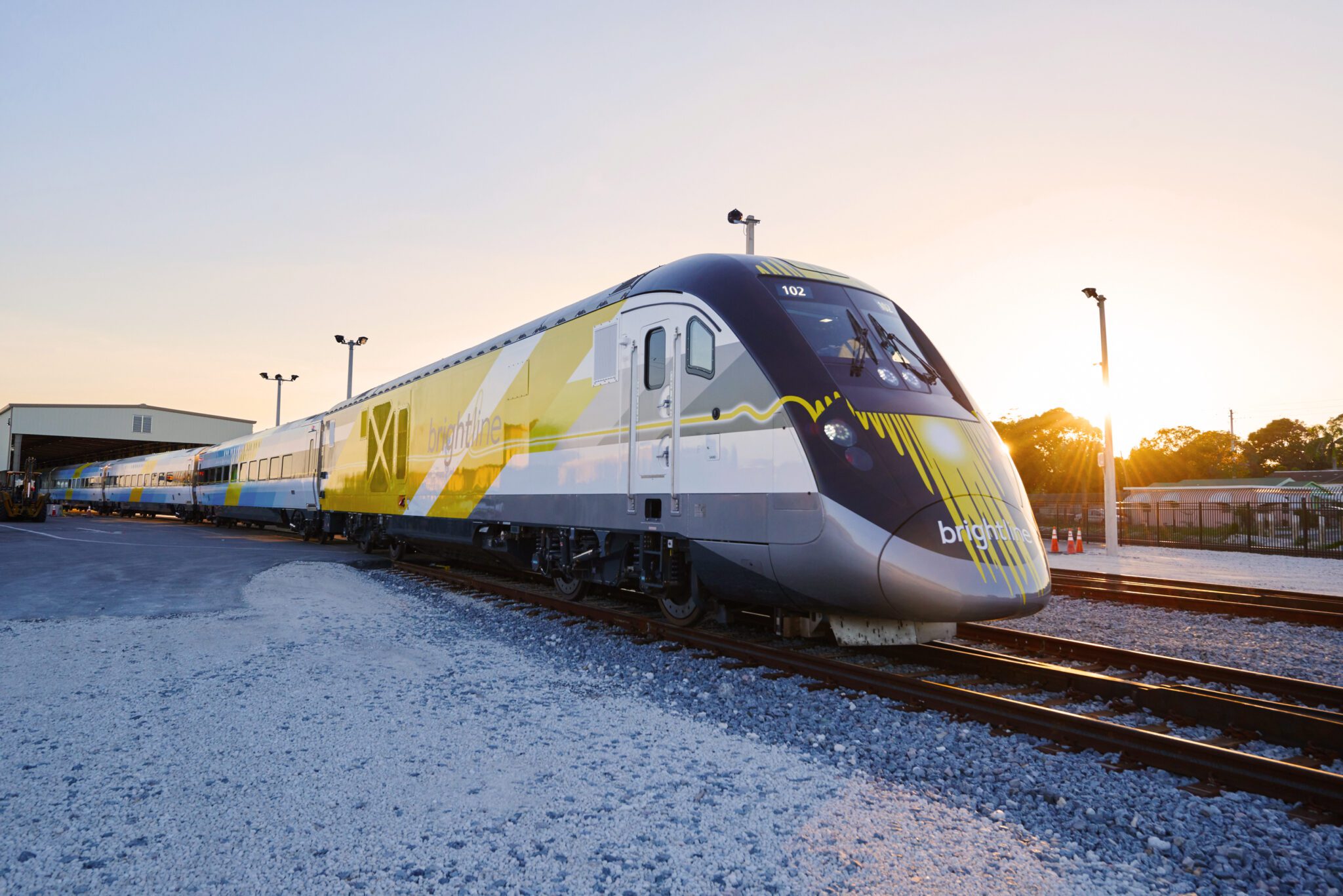
The Federal Railway Administration (FRA) has conducted an audit of Delray Beach’s “quiet zone” along the Florida East Coast Railway corridor.
It comes less than a month after a Brightline train collided with a city fire department ladder truck at the Southeast First Avenue crossing. The truck had been responding to a call, and the driver drove around the gates.
In a Dec. 31 email to Isaac Kovner, the city’s principal engineer, FRA official Rory Newton understated that the collision has “garnered significant attention.” He noted that the agency normally audits quiet zones—safety improvements that obviate the need for train horns—every three years. The last one for Delray Beach was in 2019, a year after the quiet zone began.
Clearly, though, the peg was the collision, not the audit schedule. Newton cited questions about “the general safety” of the quiet zone. City Commissioner Rob Long has noted that the Southeast First Avenue crossing does not have a four-quadrant gate that makes driving around it next to impossible.
In an email to commissioners, City Manager Terrence Moore said the audit was finished Friday. “Initial recommendations” include repainting pavement markings, installing new signs and removing trees and bushes that block warning signs. Depending on the FRA’s findings, Delray Beach might have to suspend the quiet zone until more extensive work is done.
Delray city manager announces new hire
City Manager Terrence Moore has named a new director of neighborhood and community services. She’s Jerri Pryor, who most recently has been chief of staff for a Fort Lauderdale city commissioner.
Pryor will be introduced at tonight’s commission meeting. Her hiring comes as Moore has hired a consultant to examine the code enforcement department, which Pryor will supervise. The human resources department is conducting a similar review.
Boca P&Z Board recommends approval for controversial townhouse project
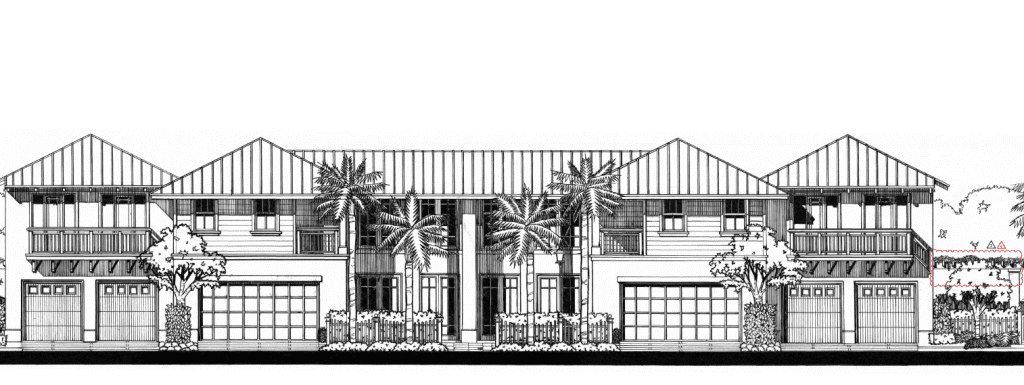
The Boca Raton Planning and Zoning Board recommended Thursday that the city council approve a townhouse project that has drawn strong neighborhood opposition.
Ibis Row—four townhouses, two stories—would replace a one-story commercial building. The site is in the single-family-home Palm Beach Farms community, across from another commercial building with a convenience store and barber shop.
Residents said the project would reduce their property values and bring excess traffic, endangering children who ride bikes to Addison Mizner School in neighboring Boca Square. One speaker said Palm Beach Farms would be “destroyed.” Another said it would cause “horrendous flooding.” Another called himself and others “citizens that have voted for you.” (Board members are appointees.)
The landowner’s attorney responded that because the project is residential, it actually would decrease traffic. A board member agreed, saying that the necessary rezoning would be “downzoning.” He also discounted fears that the precedent would lead to a wave of multi-family projects on other single-family lots. Noting that each unit would sell for $2 million, Chairman Arnold Sevell dryly expressed doubt that the project would lower the values of lower-valued homes nearby.
The vote was 4-1. Members added a condition that owners always keep cars in their garages. The project could go to the elected members of the city council next month.
Boca Regional expands with new free-standing ER
Boca Raton Regional Hospital further expanded its local presence last month with the opening of a free-standing emergency care center in West Boca’s Mission Bay community. The site is just a mile south of West Boca Medical Center, which has its own emergency facility.
Critics have said that free-standing ERs, which have proliferated in this area, are risky because of the travel time to a hospital if patients have a true emergency. A spokeswoman for Baptist Health South Florida noted the many services available at the new facility. It is roughly seven miles from the hospital.