There’s something jarringly funny about a hearse with a FOR SALE sign on its dashboard. A hearse is an automobile like any other, of course. Funeral vehicles are bought and sold with presumed regularity. But perhaps not always with the yard-sale directness captured in photographer Anastasia Samoylova’s “Hearse, U.S. Route 1.” The sign on the car’s dash is a blunt reminder that even in death, commerce trumps the sacred. Enhanced by the artist’s choice of stark black-and-white photography, a car that once carried the bodies of our loved ones looks like any discarded thing on America’s marketplace.
“Hearse” is probably my favorite shot among many equals in “Anastasia Samoylova: Atlantic Coast,” the Norton Museum’s travelogue of images from this Russian-born, Miami-based photographer. As the exhibition’s title indicates, Samoylova focused her lens on a specific geography—regions of U.S. 1 along the Atlantic seaboard of the United States, from Key West to Maine. She was inspired by a similar 1954 project undertaken by photographer Berenice Abbott, and her timing couldn’t be better: The historic highway celebrates its 100th anniversary next year.
The clash of gallows humor and melancholy that permeates a photo such as “Hearse” is present throughout many of Samoylova’s selections, which include people, objects and landscapes. Having lived in Russia for the first 30 years of her life, she photographs her adopted country with an outsider’s curiosity, freshness and lack of sentimentality, focusing on aspects of the United States that are rooted in myth.
Her photos can evoke Norman Rockwell scenes disrupted by dirt and irony; lonely Edward Hopper vistas absent the noirish romanticism; and Diane Arbus portraits without the sideshow luridness—various antecedents that contribute to a wholly original voice in photography.
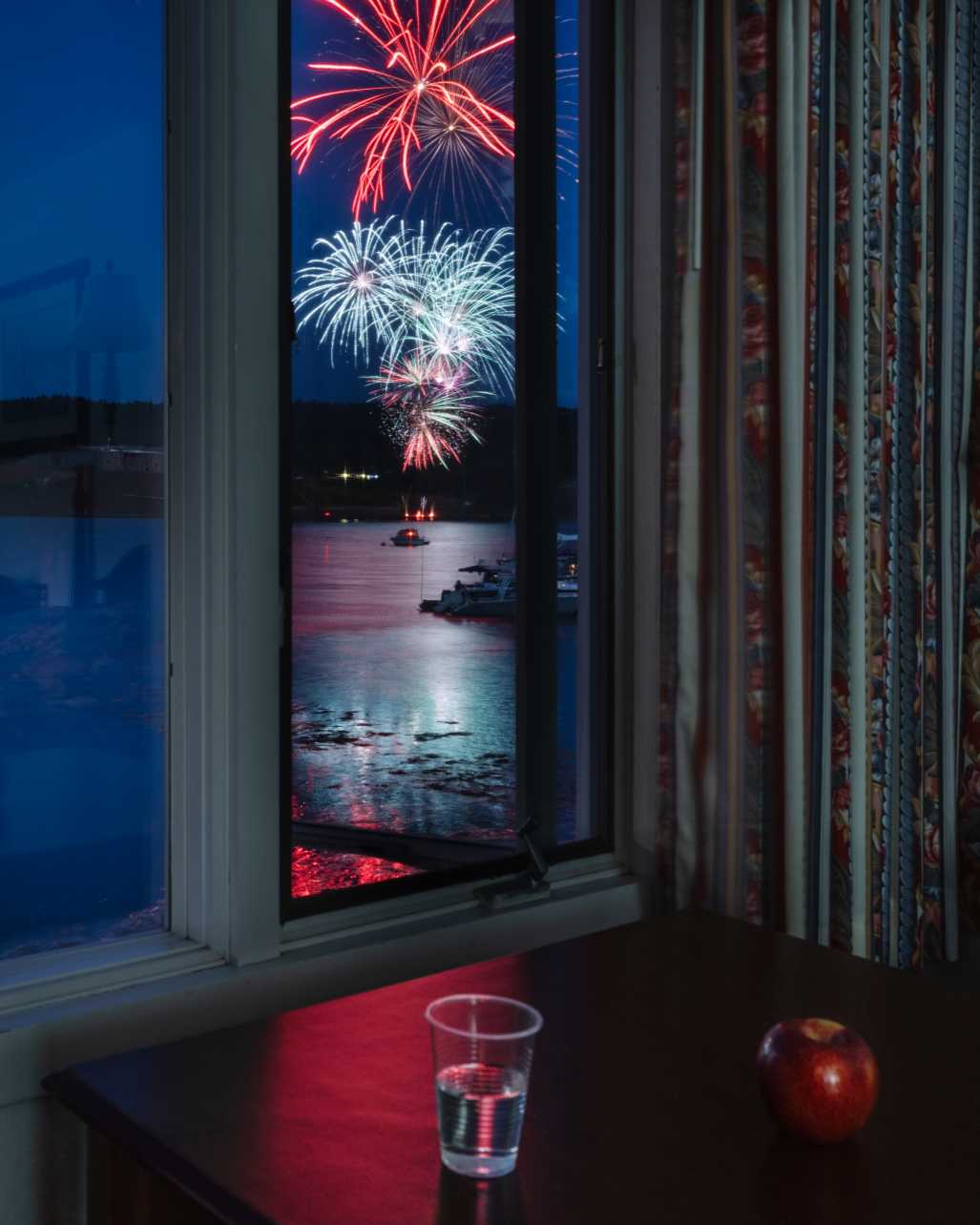
The chosen works in “Atlantic Coast” showcase Samoylova’s observant eye for both content and composition. She’s drawn to settings in which our view of the subject is occluded: A church spire mutedly visible through a smudged and scratched elevator window in Savannah; the bustle of a New York barbershop viewed through a rain-streaked façade. Even a camera itself is covered up, in “Photographer, Lubec, Maine,” a cloth draped over the device as it sits on a tripod, awaiting a sitter to fill an empty chair.
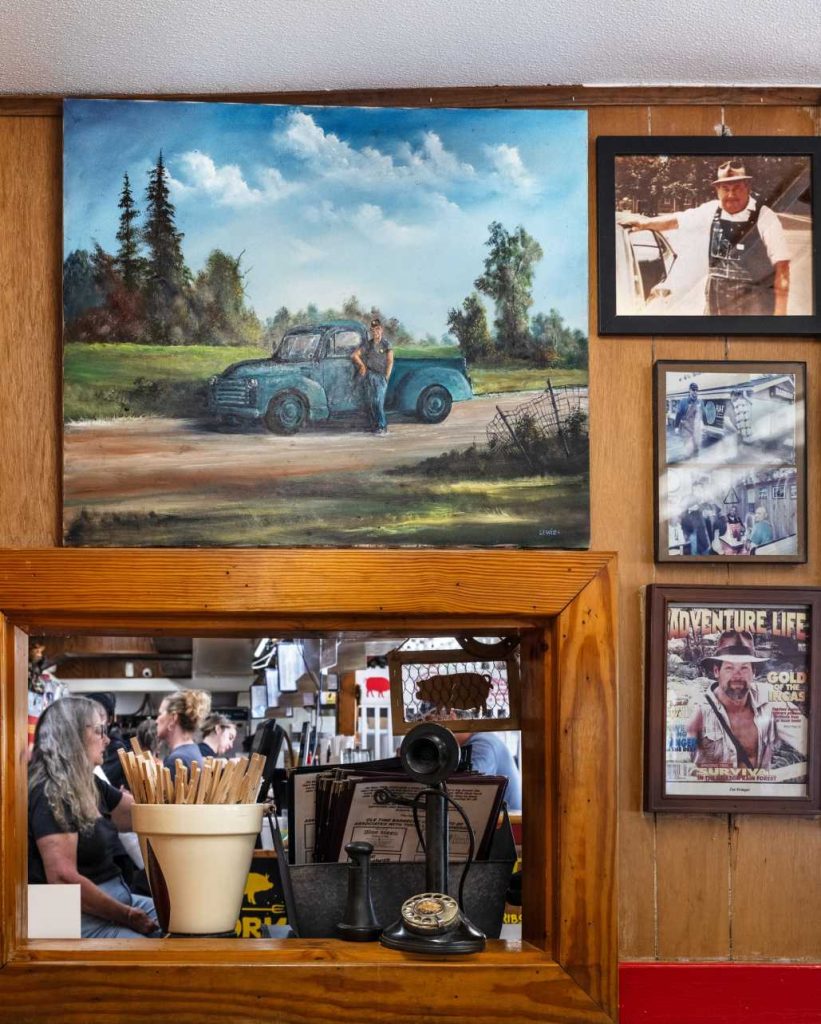
Geometry is another recurring theme, like the interior of a Raleigh, North Carolina diner neatly divided among squares and rectangles, from the open kitchen window to the signage on its walls; or the combination of a chance opportunity and rigorous intention in “Café Near Harvard,” in which a slanted “No Parking” street sign casts a shadow along the rectangular window of the title place, where two diners enjoy a meal.
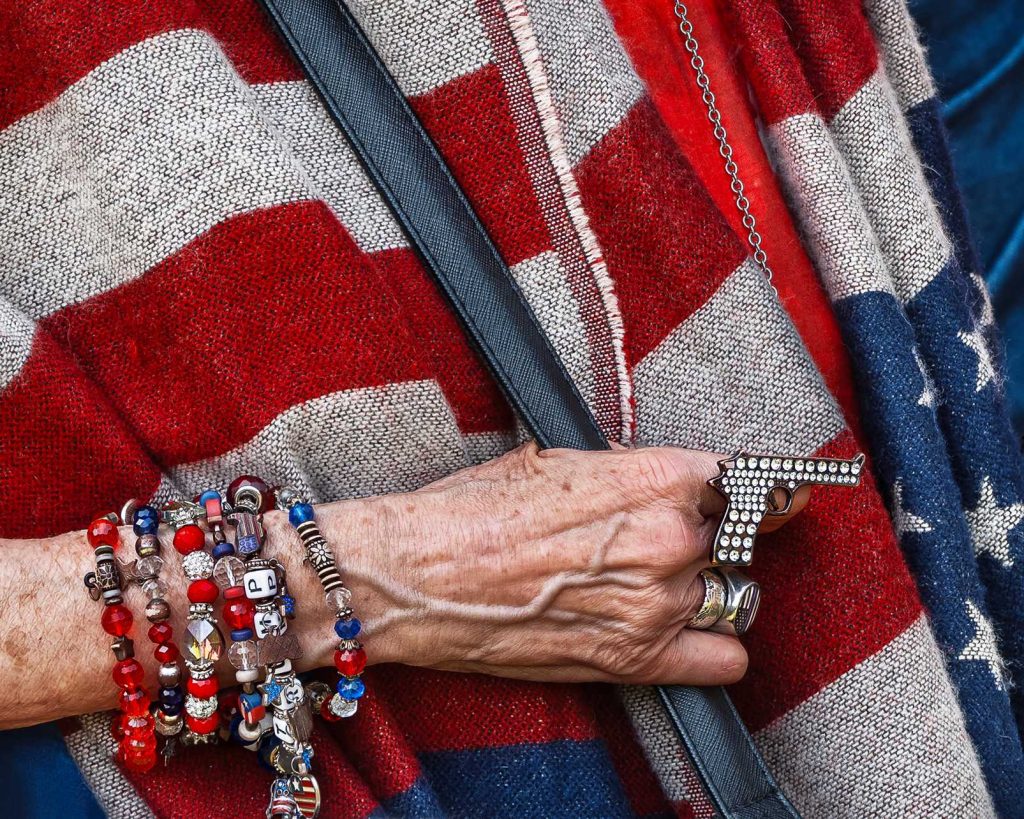
Samoylova titles her works with reserved neutrality. They are named after the object or person in the frame, and where it was taken. Inference and interpretation are left to museumgoers, and the cultural and political baggage each of us brings to a work such as “Gun Ring, New York, New York,” in which a sequined firearm ring juts from a finger on a veiny hand that grips a strap atop an American flag shawl; or “Cross Bearer, Cocoa Beach,” whose subject, their face obscured, clutches a crucifix and literature that presumably aims to save our souls.
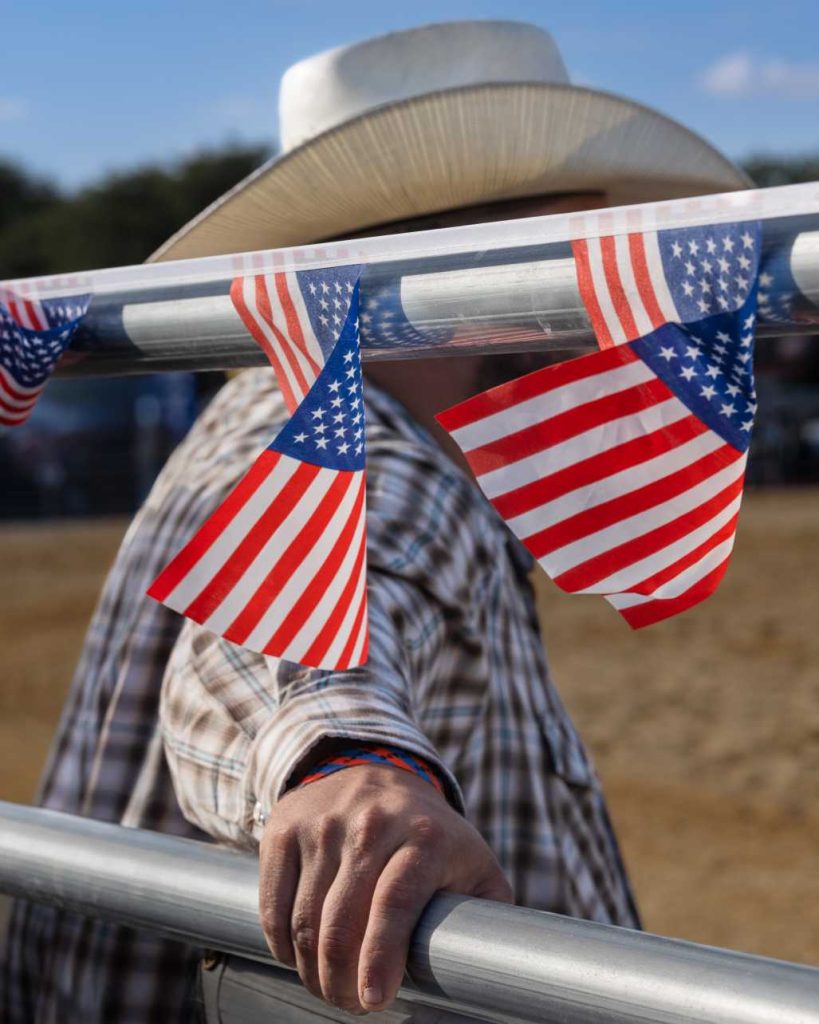
The face of the figure in “Man Behind Flags, Homestead” is similarly shrouded, covered by an American flag rippling on a gleaming pole. But with his hat, checked shirt and weathered hand, he embodies a certain image of the cowboy, the American frontier, the concept of the heartland even in a coastal city. For Samoylova, the essence of a place and its people are often captured through its symbols.
But for all of its occasional humor and for the artist’s admirable withholding of judgment, it’s easy to walk away from “Atlantic Coast” with a sense of a nation whose promise and vitality have been betrayed by time and neglect. Destruction and abandonment permeate the artist’s travels, most directly in her harrowing landscape of the collapsed Francis Scott Key Bridge in Maryland, but anywhere and everywhere in ways large and small.
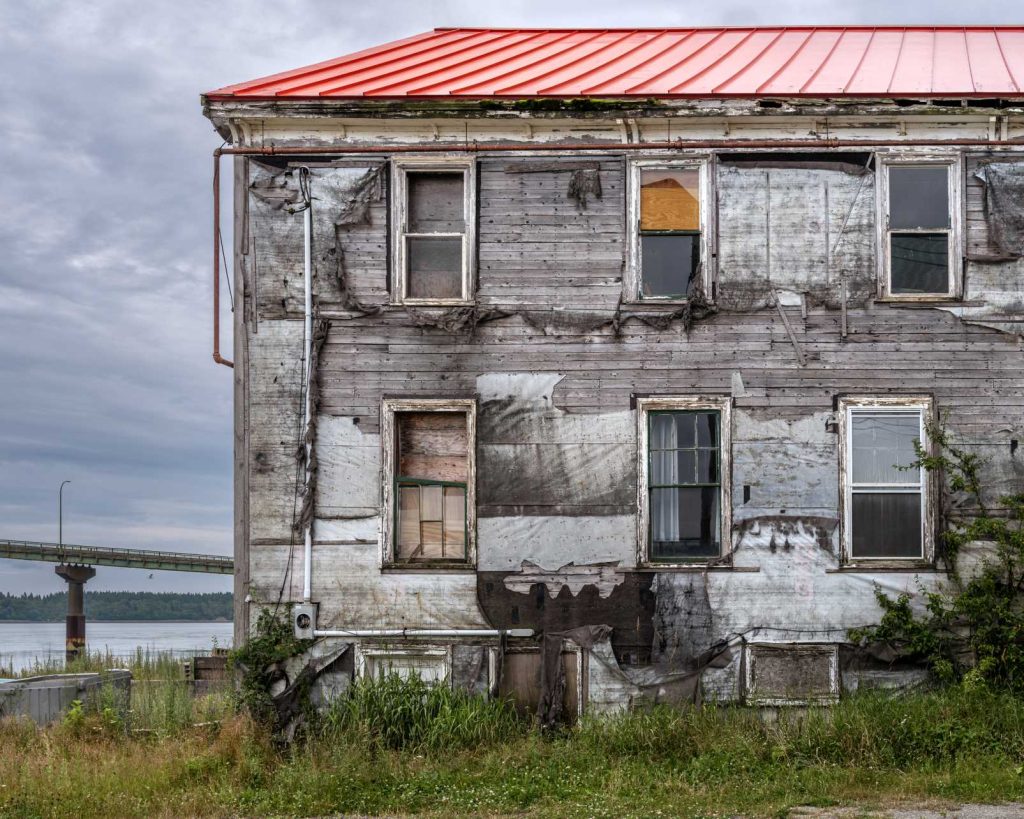
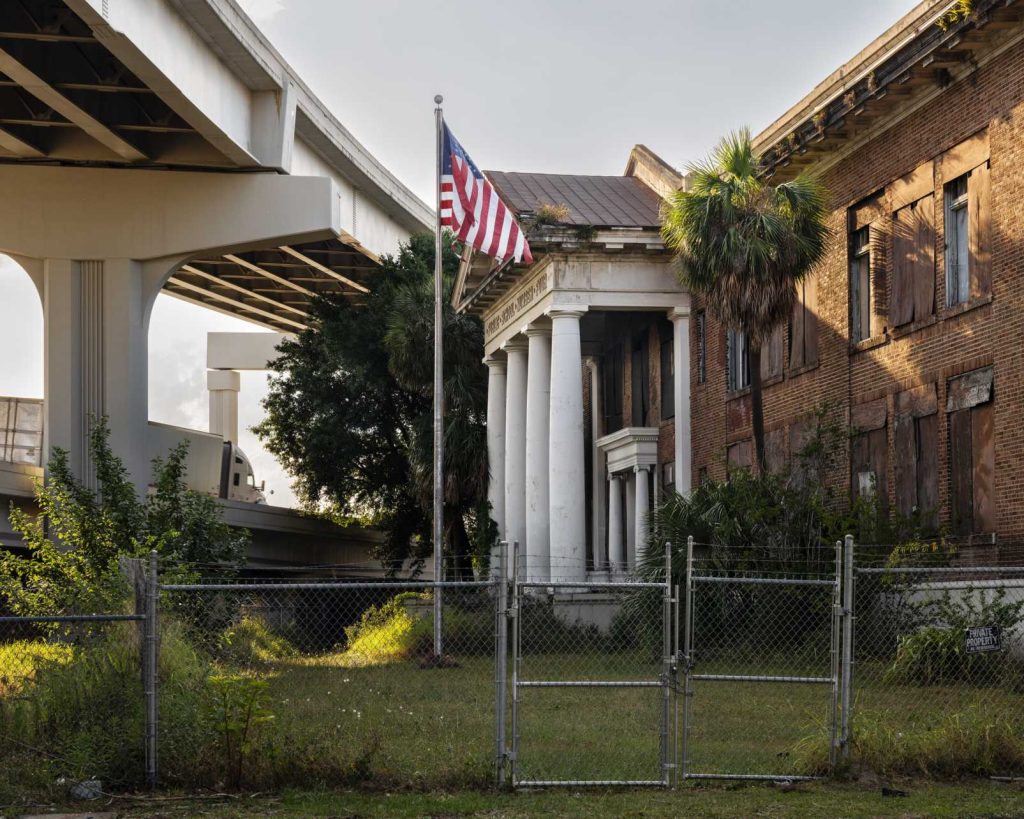
In “House by Water, Lubec, Maine,” the home’s foundation is peeling, its windows are busted and boarded, its grass overgrown, the victim of some ghastly climate event. In “Old Gas Station, Near Lubec, Maine,” rust spreads like a cancer across a neglected car, ancient gas pumps and hanging “Esso” sign, all of it barely leavened by the incongruous Christmas wreath unbothered by the tarnished surroundings. The subject of “Abandoned School Under Highway, Jacksonville” is just that—a husk of a building, with a history but no present utility. The subject of “Covered Car, Waycross” seems to congeal into the firmament around it.
Another way to look at the instantly funny image of a purchasable hearse is that times are so tough that even the proprietors of a funeral home—as recession-proof a business as any—have fallen on hard times. Many facets of America are present in Samoylova’s coastal survey, from nightclubs and war re-enactments to cotton farms and guitar shops. Progress, however, is seldom seen. I hope, for our sake, that Samoylova’s visions are a time capsule and not a harbinger.
“Anastasia Samoylova: Atlantic Coast” runs through March 1 at Norton Museum of Art, 1450 S. Dixie Highway, West Palm Beach. Museum admission is $18 adults and $15 seniors. Call 561/832-5196 or visit norton.org.
For more of Boca magazine’s arts and entertainment coverage, click here.