Most artistic mediums run a gamut from the avant-garde to the conventional; in sculpture and painting, for example, pieces of impenetrably experimental art can be produced with the same materials as a decorative statue or a beautiful sunset. Video art, though, still feels like a province of the weird. If it didn’t have at least a modicum of strangeness at its core, video art would lapse into traditional entertainment—the sort that populates our streaming feeds and movie theaters.
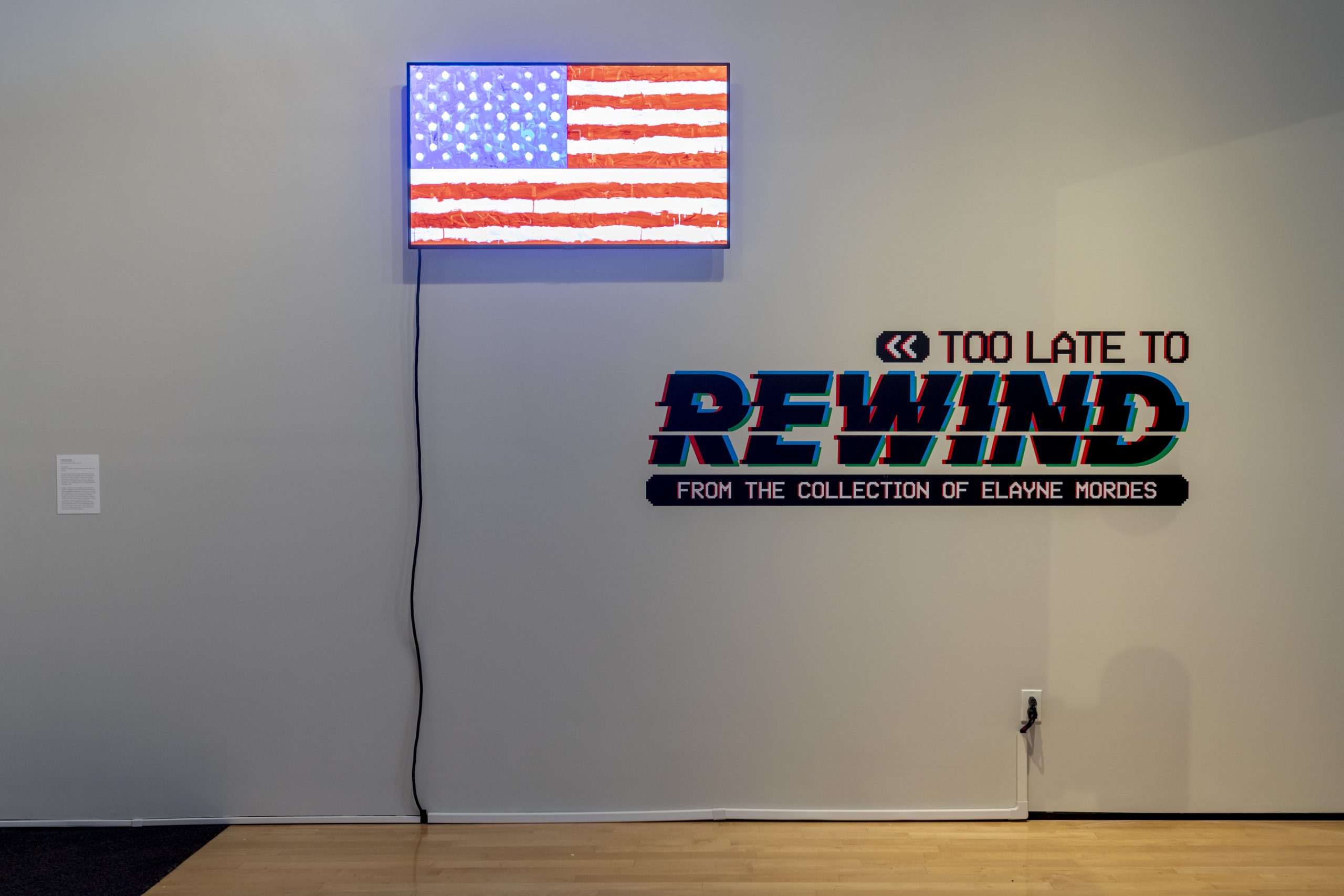
To its great, stubborn credit, “Too Late to Rewind,” a humorously titled exhibition of video work running through the spring at Boca Raton Museum of Art, fulfills this unspoken promise of the medium. There is little here of traditional entertainment value, and I offer this observation not as a deterrent but as a plaudit.
The exhibition is drawn from the collection of Elayne Mordes, an honorary trustee of the museum, and is the first in a series of exhibitions celebrating collectors who have given generously to its permanent collection. Curator Kelli Bodle presents the work in a wide range of formats, from vintage cathode ray TV sets and 30-year old Macintosh computers to wall-filling projectors and light boxes, the contents on which vary as widely as their diverse apparatuses.
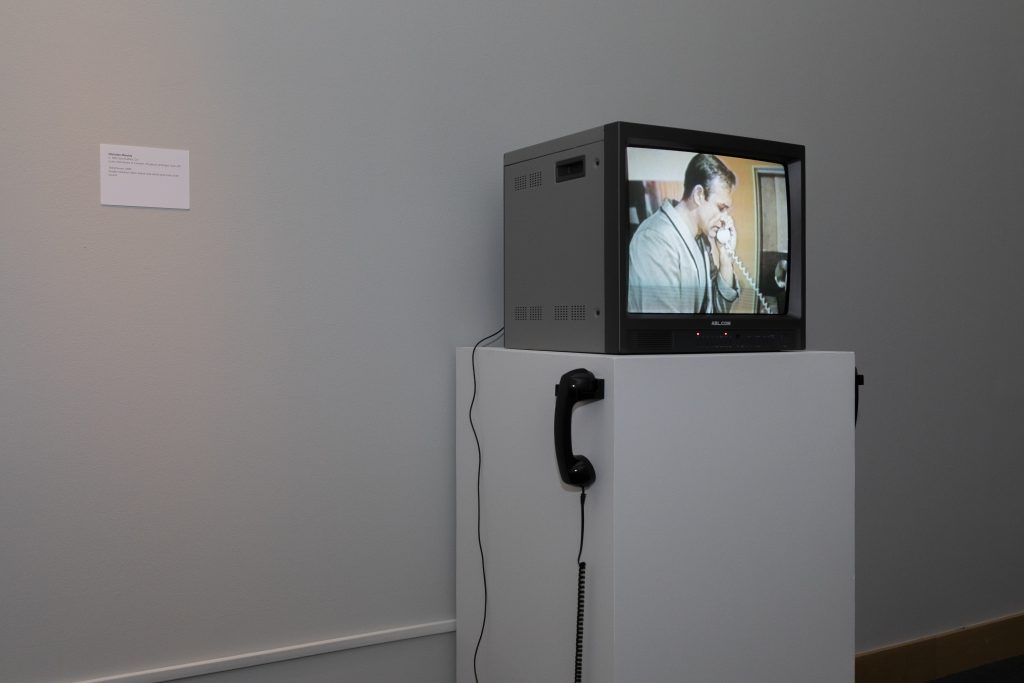
My favorite piece, as much for its labor-intensive construction as its result, is Christian Marclay’s “Telephones,” a 7-minute montage of characters receiving phone calls in classic Hollywood movies—a far more challenging endeavor in the mostly analog days of 1995, when Marclay unveiled the work, than today’s world, when such films have been digitized and are widely available on streaming services. “Telephones” is a participatory work: The viewer picks up a phone receiver connected to the television, and listens to the ringing devices and the actors who answer them. Their responses to the stimuli constitute an emotional gamut of apprehension, fear, anticipation and excitement over what awaits on the other end of the technology, with “Telephones” effectively serving as a retroactive requiem for a form of communication no longer cloaked in mystery.
“Telephones” is positioned opposite my other favorite piece in the exhibition, Laurie Anderson’s “Puppet Motel,” an interactive CD-ROM released for a 1995 Mac that still hasn’t been reissued on any other format. Unfortunately, the game did not produce any sound in the attached headphones on the day I visited, but its eccentricities were present even in silent form. Museumgoers are invited to click around an attic space, with various options sending them down Andersonian rabbit holes replete with Easter eggs, including a full lecture from composer John Cage, and an animation of multicolored ducks falling off the edge of a ruler like lemmings. At one point I entered a door and read a story about Anderson’s experience with a palm reader. In different circumstances, I would have wanted to spend all day with “Puppet Motel,” a testament to its medium’s outsized possibilities, not to mention its creator’s bottomless capacity for the absurd.
Elsewhere, visitors can encounter two athletes soundlessly butting heads for several minutes on a bulky console television (Carlos Amorales’ “Amorales’ Interim”), a slow pursuit between two characters in a museum of art and antiquities (Isaac Julien’s “Baltimore”), a work of pure cinema and the exhibition’s closest flirtation with a linear narrative, which has an entire mini-gallery space all to itself; and a disturbing still video, suggestive of a snuff film, in a which a man dangles from the ceiling on a rope, sometimes slumped motionlessly, other times twitching helplessly (Tatsuo Miyajima’s “Counter Voice in the Air”).
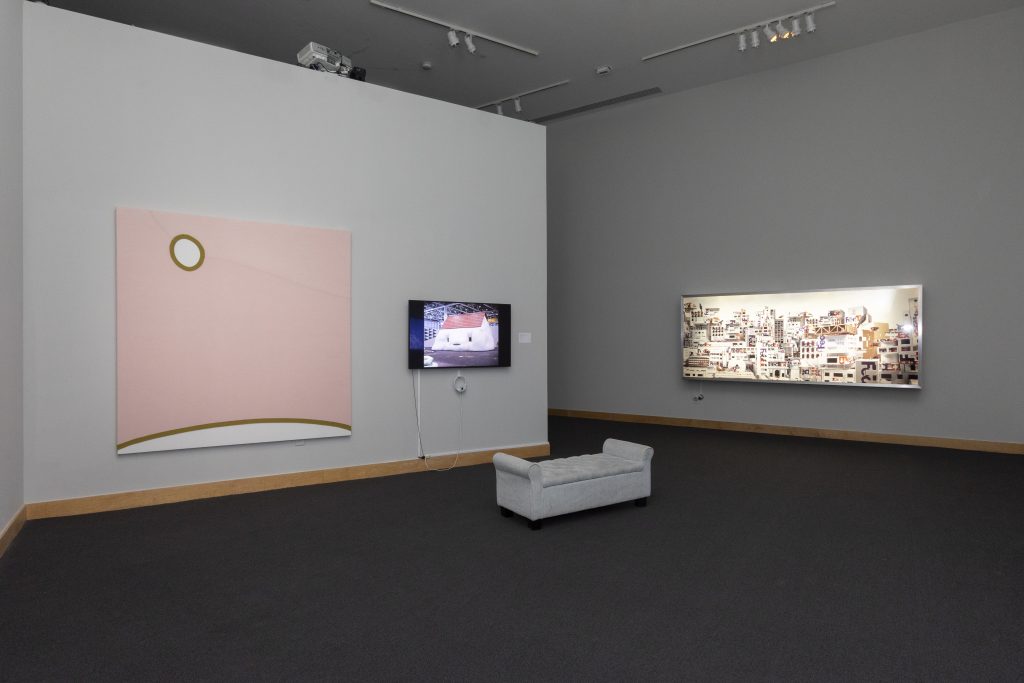
There is sly, deceptive humor in Adad Hannah’s “The Raft of the Medusa,” a riff on a tableaux vivant, in which models hold a pose for a seemingly indefinite amount of time in order to create a “living picture.” From afar, it seems as if the giant, wall-projected HD video is simply a still image; only on close inspection do we pick up on the subtle movements of the actors as they occasionally slip in their impossible efforts to remain stone-still.
A video and found-object installation combine pleasingly in Beatriz Millar’s “Lux Mater,” in which a video of the preparation of an egg-based dish shows on a screen above a table, on which rests a checkered tablecloth and a stacked place setting where such a meal could be consumed. With the video’s baking close-ups, we’re left with the impression of food prep as its own kind of art-making, whose materials congeal in a bowl like so much paint.
I can’t say I “got” every piece in “Too Late to Rewind,” but it’s quite possible that for some works, their enigmatic natures aren’t meant to be decoded. I certainly didn’t stay in the museum watching all 144 minutes of Euan MacDonald’s “House, Planes, Interval,” which seemed to me like sustained Warholian exercises in deliberate banality, whose sprawling duration is very much the point. Art like this may strain one’s patience, and perhaps even open up dialogues as to what video art is. But compared to art that is self-explanatorily pretty, I’d rather be confused than unchallenged.
“Too Late to Rewind” runs through March 29 at Boca Raton Museum of Art, 501 Plaza Real, Boca Raton. Admission runs $16 for adults and $12 for seniors. All 561/392-2500 or visit bocamuseum.org.
For more of Boca magazine’s arts and entertainment coverage, click here.