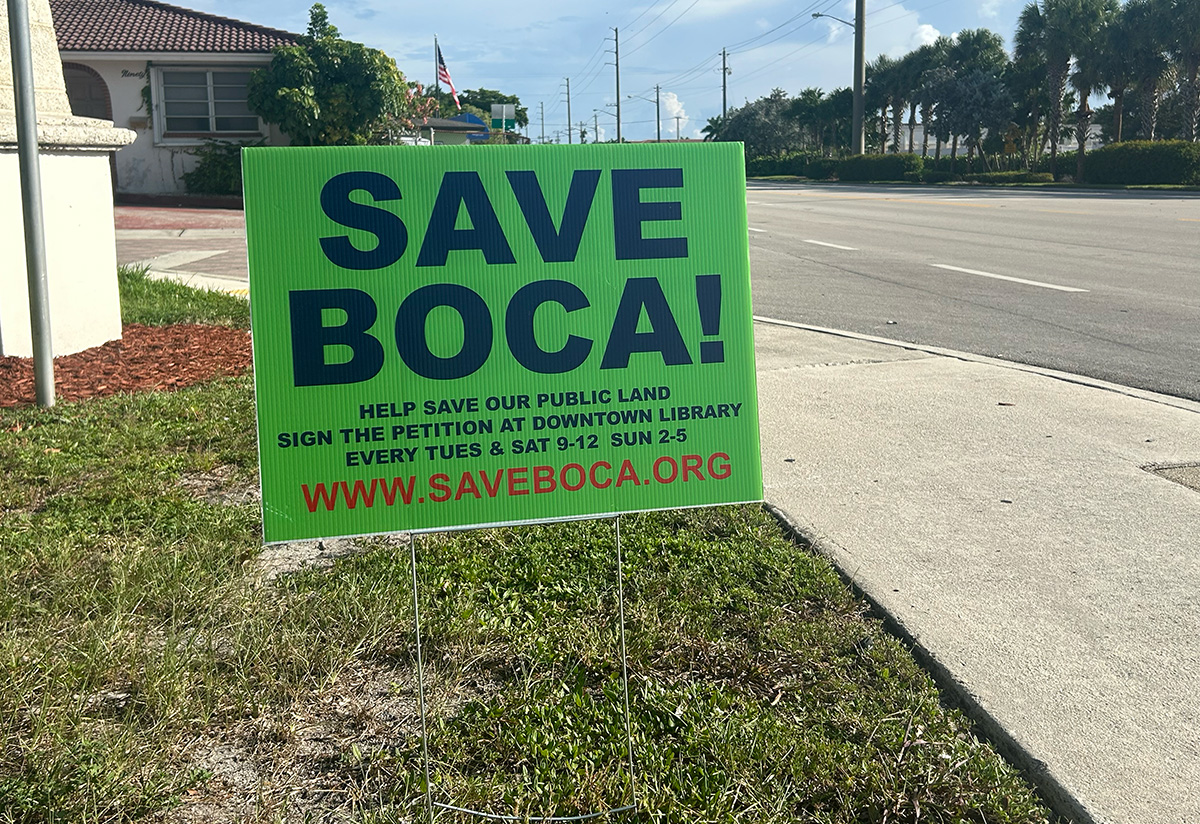
A Boca Raton ordinance that would put any sale or lease of public land to a referendum vote has been amended with a few key exceptions.
During Tuesday’s regular City Council meeting, the amended ordinance was introduced. Whereas the original Save Boca prohibited the lease or sale of any public land larger than a half-acre without a referendum vote, the amended ordinance carves out exceptions for the “continuation, renewal, extension, or amendment” of current leases with nonprofits on city-owned land, easements for utilities that “serve the residents of the City of Boca Raton or Palm Beach County,” use of city-owned land for public facilities or operations, and the temporary use of city-owned land for “recreational or community activities.”
The amended ordinance also removes the “any part thereof” language of the original proposed ordinance that became the subject of a lawsuit that ended with a judge declaring the Save Boca ordinance and charter change unconstitutional. To see how the amended ordinance would affect city functions, one need look back only a few weeks.
At the first meeting of Boca Raton’s new city council, Councilmember and Save Boca Founder Jon Pearlman pulled from the consent agenda an item that would have allowed an easement for a company’s existing telecommunications conduits that would have provided communications for Central American countries. The city would receive more than $100,000 in annual payments, at no detriment to residents. After it was clarified that the easement is unrelated to a separate easement by the same company in Spanish River Park, the ordinance was approved with a 5-0 vote.
Under the language of the amended Save Boca ordinance, it’s unclear if this easement would constitute as “serving” residents, since the telecommunication lines provide communications for nonresidents. Would the $100,000 in annual payments constitute a service? There’s no language in the bill that provides guidance for such a determination. We have reached out to the Boca Raton city attorney for clarification.
Another consideration is the cost of such elections. The price tag for putting the original Save Boca ordinance and charter change on the ballot of a January 2026 special election would have approached $500,000, had the lawsuit not intervened and removed them. Waiting to put referendum votes on regular ballots could result in lengthy—and costly—delays to project timetables. Developers may think twice about investing in a project if there’s the risk of the project being voted down by residents, as with the Terra/Frisbie proposal.
UPDATE (5/1/26):
Boca Raton City Attorney Joshua Koehler responded that the aforementioned easement, if larger than a half-acre, would not fall under the easement exception based on revenue generated alone. “The ordinance is written in terms of service to residents, not financial benefit to the City. So revenue alone would not determine whether or not the exception applies,” said Koehler in an email. The determination would be made based on “whether there is a meaningful local service component (i.e. you’d look at local service, capacity, or system benefit provided to residents).”
Boca Raton to seek consultant for new downtown campus plan
Boca Raton city staff recommended the Treasure Coast Regional Planning Council (TCRPC) for guiding the formation of a new plan for the city’s downtown campus area. The TCRPC is an organization created by local governments that provides guidance in matters of growth and development. It is a public, not-for-profit group that provides services to local governments at cost.
However, it was made clear on Monday that the city would not be seeking their counsel.
Councilmember Jon Pearlman treated the TCRPC representative with skepticism that bordered on hostility. Referencing past TCRPC projects that have included private development, Pearlman asked “Who hired you and paid for that work?” The TCRPC is solicited by local governments. Its private sector work extends only to providing low-interest loans for small businesses.
Pearlman remained unconvinced.
“The citizens, the residents, they don’t want any other public-private partnership coming this way, ever again,” he said.
The TCRPC’s plan would include months of public engagement where residents could provide input for the master plan. A priority of the TCRPC with regards to public land is that “Not only should you retain what you have, you should try to get more,” said the representative.
Still, Pearlman argued that the city should put out a request for proposal (RFP) for a consultant. That means a private company. Private companies, unlike the TCRPC, do not operate at cost. They operate for profit, meaning a higher cost to taxpayers. Private companies may also have different priorities than an organization created for the benefit of local governments.
A request for proposal (RFP) will be put before the council at the next workshop meeting.
A short-lived task force?
The recently-approved Downtown Task Force created by the Boca Raton City Council to gather community input for a new downtown campus may be dismantled before it even gets to work.
Pearlman, the lone “no” vote against the creation of the task force, expressed concerns that the task force could be populated by friends or acquaintenaces of current city council members.
“I don’t think that council members should have communicated with any members of their short list via text or email,” said Pearlman.
When Councilmember Drucker pointed out that this would include Save Boca members, he responded, “I think we should transition this concept to a task force that is encompassed by the current advisory boards that serve the city.” Pearlman’s chief objection to the creation of the task force in the first place was that it would be comprised of unelected members. Advisory board members are not elected; they are appointed.
Grau also objected to the task force—which she voted for—saying that the selection process is “creating divisions.”
Drucker pointed out that the resolution was already passed (with a 3-1 vote, for which Drucker was absent). The city council can vote to repeal the task force with a majority vote.
Even if the task force is repealed, its work may have been redundant anyway. A consultant will likely be conducting public engagement sessions for residents to voice their wishes and concerns for the downtown campus project.
An update on former Boca Raton Mayor Scott Singer’s congressional run

Former Boca Raton Mayor Scott Singer is still running for Congress, only now he’s running in a different district.
Singer was originally slated to challenge Rep. Jared Moskowitz for his District 23 Seat that, prior to a successful redistricting effort led by Gov. Ron DeSantis to deliver President Donald Trump favorable midterm results, covered Boca Raton, Coral Springs, Parkland, Coconut Creek, coastal Pompano Beach, and parts of coastal Fort Lauderdale. Moskowitz’s district has been reshaped into the 25th district, which includes the area from coastal Delray Beach to coastal Miami. Moskowitz can run in any of the three districts that his former district was broken into.
Singer announced his congressional bid in December 2025 with a video that featured “America First” motifs and imagery of President Trump. He announced his intention to run for the newly-created 25th District just after the redistricting was approved by the Legislature. Campaign finance data shows that he raised nearly $1.4 million in the period from December 2025 to the end of this March, with more than $400,000 in of personal loans and more than $900,000 from individual donations.
An uneventful Boca Bash
Boca Raton City Manager Mark Sohaney reported that this year’s Boca Bash was uneventful. Just four years ago, Cole Preston Goldberg was arrested for allegedly trying to murder his girlfriend—for which he was found not guilty. Sohaney attributes the smooth sailing of this year’s event—which is not city-sanctioned—to “maximum” law enforcement presence.
Top marks for local beaches
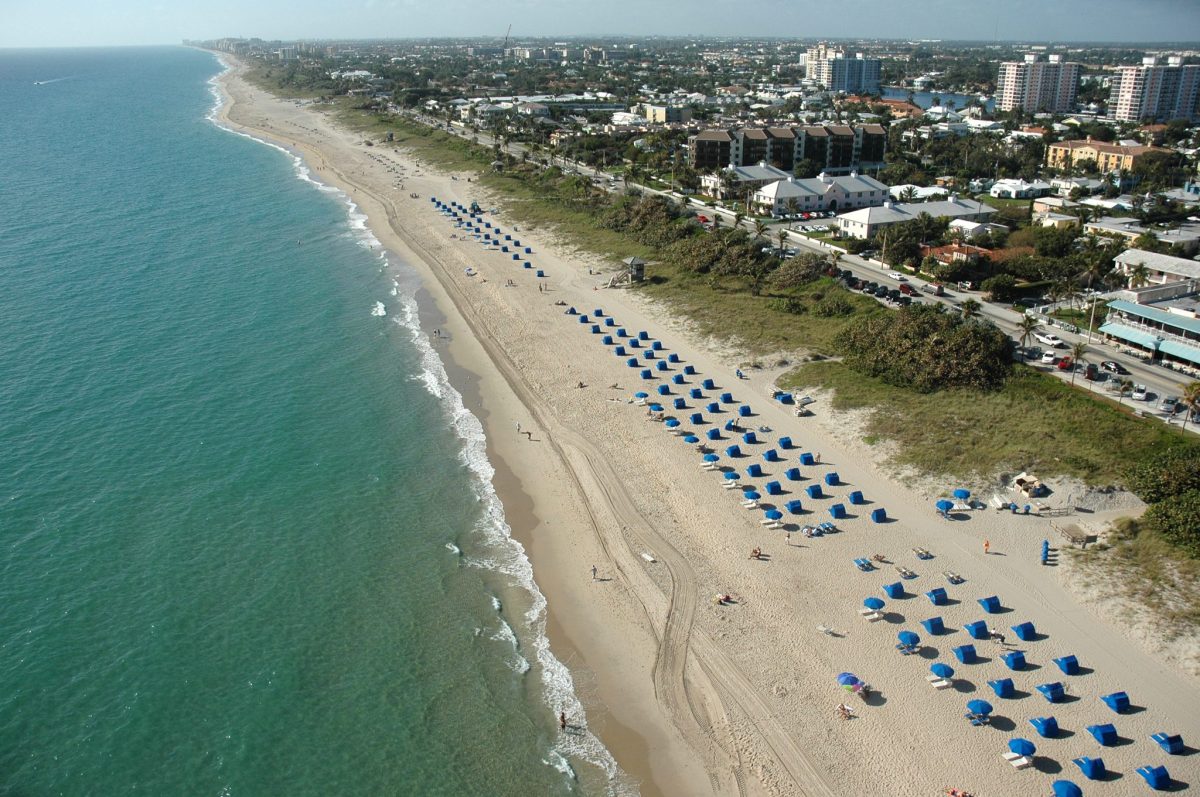
Both Boca Raton and Delray Beach were once again awarded with Blue Flag designations for their municipal beaches.
The designations are awarded by the Foundation for Environmental Education for water quality, accessibility, and safety. This is Delray Beach’s fourth consecutive Blue Flag designation and Boca Raton’s Spanish River Park’s beach’s second consecutive designation. They are two of only three beaches in the United States to be honored.
Both cities will host ceremonial flag raisings at their respective beaches on May 7.