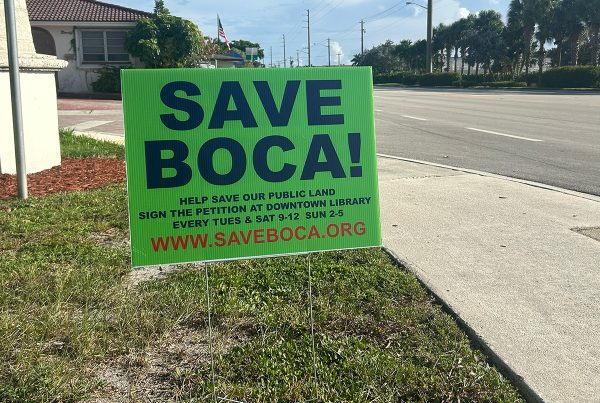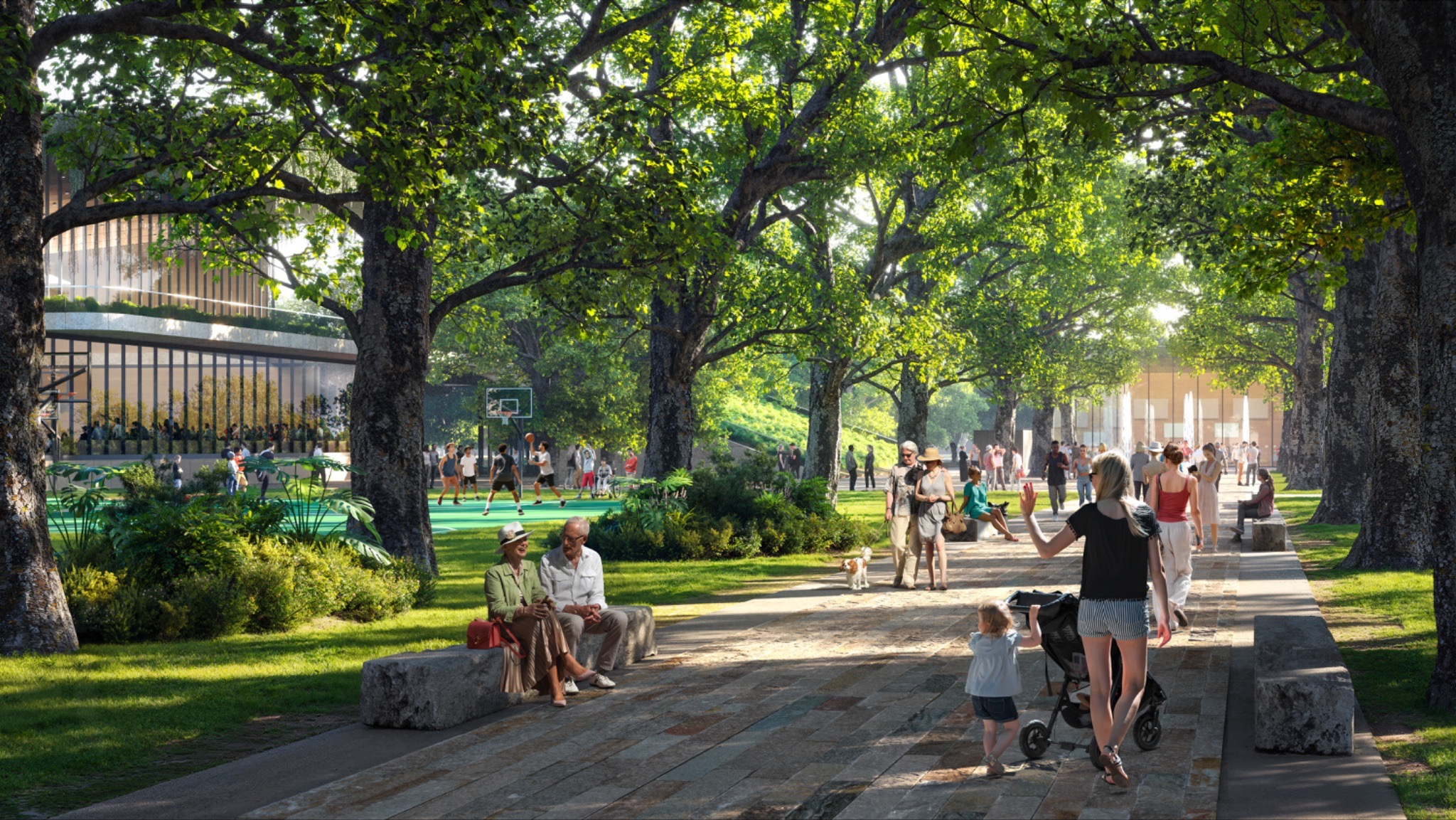
Boca Raton city council members must decide how to word the March ballot item on the proposed Terra/Frisbie downtown redevelopment plan. Not surprisingly—since most members support the plan—the proposed wording is favorable.
It reads this way:
“Shall the city approve agreements with Boca Raton City Center, LLC leasing 7.8 acres of property east of Northwest Second Avenue near Brightline Station for 99 years, creating a walkable neighborhood with residential and commercial uses, generating estimated rent and revenues to (sic) city of over $3 billion, enhancing city-owned property, including:
Preserving Memorial Park and honoring veterans; Expanding public recreational and green spaces; new community center, city hall and police substation?”
(Boca Raton City Center is Terra/Frisbie’s corporate name on the project.)
All the information in that wording is true, or at least arguably credible. The city’s consultants haven’t given a final report on the potential revenue, but $3 billion is the most recent estimate. The wording also comes in just under the limit of 75 words for ballot proposals.
The wording, though, is most definitely the council majority’s positive spin on what has become Boca Raton’s most controversial development project since Mizner Park three-plus decades ago. That majority includes Mayor Scott Singer and Council members Yvette Drucker, Fran Nachlas and Marc Wigder. Only Councilman Andy Thomson has opposed the project in its earlier versions.
Debate on the wording, which goes before the council at tonight’s regular meeting, could reflect the politics of the issue. Nachlas and Thomson are running for mayor. Wigder is seeking a second term; one of his two opponents is Jonathan Pearlman. He founded Save Boca, the group that opposes the project.
During Monday’s city council workshop meeting, Save Boca supporters criticized the wording as too favorable on the projected finances and thus misleading. The debate may continue tonight, but the city gets to decide on the wording. Leading up to the election, though, the city only can provide information; it cannot advocate for approval of the project. Individual council members can—and surely will—be part of the campaign, on one side or the other,
March now will feature a straight up-or-down vote on the project. A judge tossed Save Boca’s ballot proposals to require a referendum on any transfer of more than one-half acre of public land. But the council already had agreed to a vote on the Terra/Frisbie project, and the developer agreed.
FAU faculty respond to new provost selection

Last week’s announcement of Florida Atlantic University’s new provost came as no surprise. From the reaction, though, that’s how most of the faculty wanted it.
As I reported, FAU’s first choice to be chief academic officer—University of Florida Associate Provost Brian Harfe—turned down the job. Rather than turn to one of the other two finalists, FAU pivoted to Ken Dawson-Scully, who has been associate provost at Nova Southeastern University (NSU) since 2021.
In that role, Dawson-Scully has led NSU’s research efforts. Last February, the Carnegie Foundation upgraded NSU from an R2 to an R1 research institution—the highest ranking. In June, FAU achieved the same distinction. Dawson-Scully’s focus thus has been in sync with FAU’s aspirations. He also emerged quickly as a good fit.
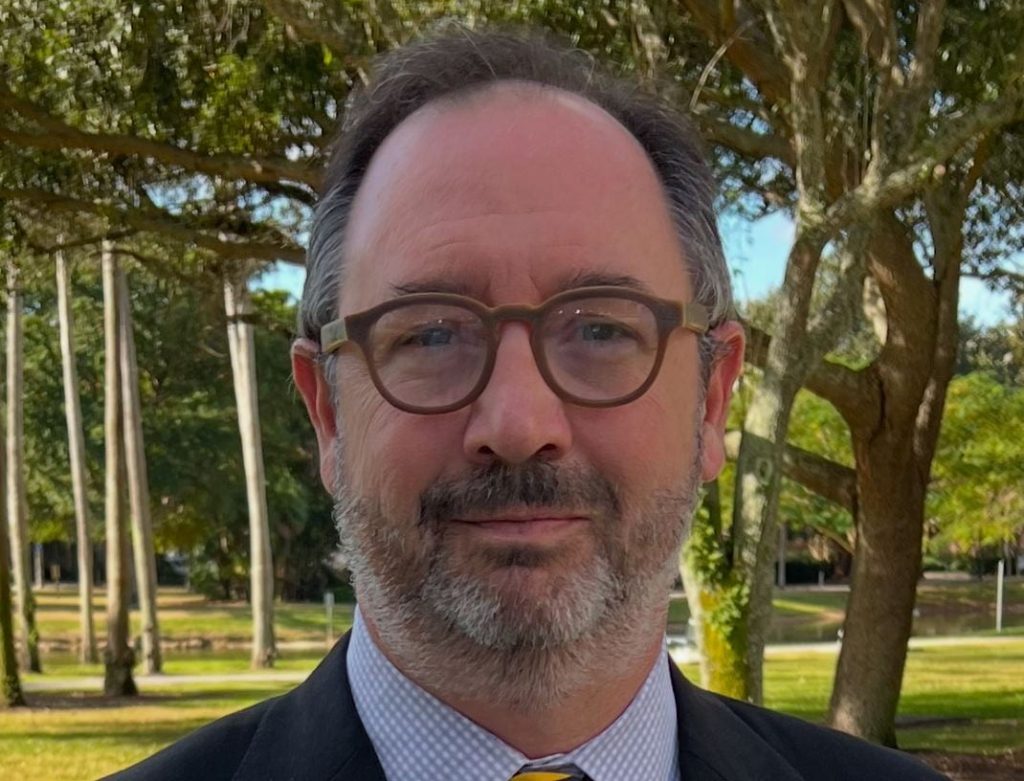
The other two finalists were out-of-staters. In contrast, Dawson-Scully spent 13 years at FAU before going to NSU. With state universities facing so much uncertainty from the governor’s office, the Legislature and the Board of Governors, Dawson-Scully’s familiarity with FAU will help.
For all the emphasis on research, though, Dawson-Scully’s main priority will be to improve results across FAU’s 10 colleges and 170 degree programs. In June, the Board of Governors placed FAU on its watch list because of poor performance in two key student performance metrics. A second straight drop could cost FAU state money. That urgency may explain why Dawson-Scully will start soon—Jan. 1.
Kim Dunn, an FAU professor who serves on the Board of Governors and is a past Faculty Senate president, praised the hire. “I’m optimistic,” she told me. So did William Trapani, the current senate president. Trapani also credited Interim Provost Russ Ivey for helping FAU get that R1 status and to crack the top 100 in U.S. News and World Report’s public university list.
Trapani said of Dawson-Scully, “His selection augers a very bright future for FAU. As someone who has worked at FAU and continued to work in Florida, Ken has an excellent awareness of our institution and its potential as well as the knowledge of the state needed to navigate its current dynamics. There is tremendous promise in his selection.”
Approval of new softball complex at Sugar Sand Park on Boca agenda
Speaking of the Terra/Frisbie project, another item on the agenda for tonight’s council meeting is approval of a contract for design of the new, four-field softball complex at Sugar Sand Park. It will replace the two downtown fields at Memorial Park and another at Meadows Park.
Under the roughly $200,000 contract, the Delray Beach-based Currie Sowards Aguila architectural firm will design the fields, restrooms, a press box, a concession stand and lighting for the fields and parking lots. The work is happening under an agreement between the city and the Greater Boca Raton Beach and Park District, which owns and operates Sugar Sand Park.
A survey showed that there are no gopher tortoises or indigo snakes on the site, which long has been designated for future recreation use. Still, the firm will check for the presence of indigo snakes. Like gopher tortoises, they have been designated as a threatened species.
Though Save Boca supporters have criticized the potential loss of “downtown recreation,” softball players and parents have praised the move as an overdue upgrade that will achieve parity with baseball facilities. City officials also say that the complex will make maintenance easier. The move seems likely to happen no matter what the voters decide on the Terra/Frisbie plan.
Boca Raton City staff recommends approval of apartment development
Housing demand continues in Boca Raton.
Also on the agenda for tonight’s meeting is approval of the Atrium residential project on Clint Moore Road just east of Military Trail. The roughly nine-acre site was the headquarters of Levitz Furniture, which closed in 2008. It sold for $25 million in January 2024.
The developer wants to build 222 apartments in an eight-story building, with 15% of the units designated as affordable or workforce housing. The project requires a rezoning and a land-use change, meaning that it needs a supermajority of four votes.
The Community Appearance and Planning and Zoning Boards recommended approval. At the Planning and Zoning hearing, only one person spoke, and he supported the project as helpful to the area. City planners also recommend approval.
Delray Beach city manager addresses emergency response times

Public comment during Delray Beach City Commission meetings can turn into a gripe session about city services. However, the gripes aren’t always legitimate.
So, City Manager Terrence Moore has begun to schedule formal responses to what the staff believes to be unfounded gripes. Example: the Nov. 4 meeting.
Previously, a resident had complained about what he called a slow police response time to an emergency call. Moore thus asked the police and fire departments to make presentations and provide what he called “clarity.”
Police officials explained that the department ranks calls in three categories, with emergencies first. The third category is for calls that are at least an hour from the incident.
Based on data over three years, the average response time to the most urgent calls is just under four minutes. Even for the lowest priority calls, the average response time is roughly 10 minutes. Those compare favorably with national numbers.
Fire department officials explained that their key number is rollout times, since that’s what the department can control. For medical emergencies, they said, the standard is for paramedics to be on the truck within 60 seconds. For fire calls, which require donning equipment, the standard is 80 seconds.
Transportation times can vary because of traffic conditions. In general, though, the department hopes that a vehicle can respond within four minutes. Commissioners seemed satisfied. They had no questions. Commissioner Rob Long said the session helped to combat “rumors.”
Moore had planned a response to complaints about the new parking program for the Nov. 18 meeting. He delayed it so the city first could collect more data.