More action at the Delray meeting
It might have been the most fascinating moment I’ve seen in 30 years of watching local politics. It might also mark a helpful turning point for Delray Beach.
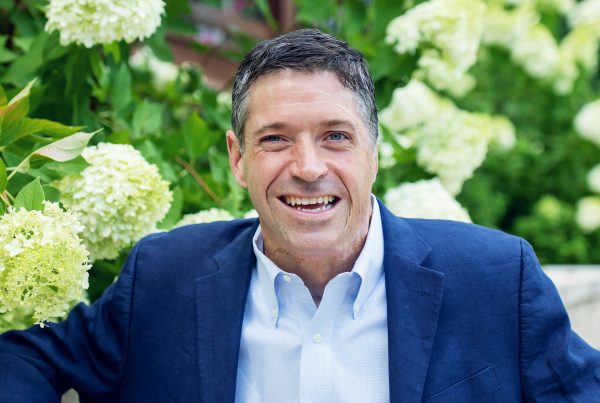
Near the end of Tuesday night’s city commission meeting—after a collegial discussion of nominations to city boards—Commissioner Jordana Jarjura (above) read the statement she had promised after Commissioner Mitch Katz last week accused Jarjura of ignoring ethics rules.
Before the commission then was a vote on whether to hire former City Attorney Noel Pfeffer and his new firm— Conrad & Scherer of Fort Lauderdale—for four months to help the city’s understaffed legal department. Total cost: $80,000. Katz claimed that Jarjura couldn’t vote because the president of Gulf Building, where Jarjura works, owns one percent of Conrad & Scherer. Jarjura also is a former partner at Conrad & Scherer.
Katz’s attack enraged Jarjura, in large part because Katz claimed that he received his “information” in an anonymous letter. Katz had not verified whether an ethics issue even existed.
“My colleague,” Jarjura said Tuesday, “clearly does not understand the (state law) he was citing. . .He has no idea whether I, in fact, even had a conflict. As he often does, he chose. . .to publicly disseminate an accusation and make statements without knowing whether or not such statements were factual.”
Jarjura was just warming up. Despite Katz’s claim of receiving the information just before last week’s meeting, Jarjura said, “This was an ambush he had been planning and boasting about to others for weeks. And despite the gravity of his allegations, he chose to wink and smirk at a member of the public right before he pulled out his ‘anonymous’ letter.
“To simplistically gloss over limited public information and a reach a legal conclusion of the existence of an ethics violation is irresponsible. It is false and it is defamation per se. To then go on Facebook to attack and defame the president of the construction company I am general counsel for is egregious.” In her statement, Jarjura all but threatened to sue Katz if he pressed the issue.
Because Katz did not first consult Interim City Attorney Janice Rustin for legal guidance, Jarjura said, his motivations were “grandstanding, self-promotion, ego, petty politics,” amounting to “yet another unctuous, theatrical attempt to attack me.”
Mayor Cary Glickstein and Commissioner Al Jacquet backed Jarjura. Shelly Petrolia was absent. Glickstein said Katz had intended to “undermine the person you sit next to (on the commission dais)” in a way that is “so transparent to everyone in this city. . .It’s out there, Mitch. I’m talking about the bragging.” Jacquet said to Katz, “You can’t throw rocks. It’s so sophomoric.”
Eventually, Katz said, “I apologize to Vice Mayor Jarjura.” He tried to blame whoever supposedly sent the letter, but that was a dodge. I’ve seen commissioners and council members criticize colleagues on policy, but personal attacks are rare. Rarer still are responses like Jarjura’s that swing sentiment against the accuser so much that he apologizes. On Wednesday, I called Katz for comment, but didn’t hear back.
Perhaps fortunately, the next commission meeting isn’t until Aug. 16. In an email Wednesday, Jarjura told me that she might have withheld the statement if she had known how Tuesday night’s discussion would turn out. “I don’t want to lose any forward movement for a more collegial commission.
“I am encouraged and humbled that Commissioner Katz decided to retract and apologize. It meant a lot to me. I am hopeful that this is the start to a new chapter for our commission where we can respectfully debate the issues without political rhetoric and conjecture.”
Replacing Pfeffer
What happened between commissioners Katz and Jarjura could alter Delray politics in a beneficial way.
Beyond the personal nature of the confrontation is the damage done to the city by the ongoing fight over the legal department. Lost in the rancor last week was that former city attorney Noel Pfeffer’s firm withdrew its offer that Delray hire Pfeffer as a temp until the commission agrees on a replacement, whether a firm or an individual. Such work probably also would have involved Michael Dutko, who was on the city’s legal staff before joining Pfeffer at Conrad & Scherer.
Absent Katz’s attack on Jarjura, the commission likely would have approved the contract, 3-2. Katz and Shelly Petrolia long ago soured on Pfeffer, for reasons I don’t understand. During Pfeffer’s two years, the city prevailed on most issues the department worked or supervised.
Since the deadline to apply for the city attorney’s job isn’t until Sept. 9, the department must continue to operate for several months with just three of its five lawyers. Interim Attorney Janice Rustin already has asked the lawyer who usually handles only police matters to do more day-to-day work.
Unfortunately, Delray Beach has to resolve some big issues before the commission finally agrees on whom to hire. Among other things, the city must conclude a parking agreement for the iPic project and negotiate leases for Arts Garage and Old School Square. The city will divide the work among private lawyers already under contract.
Then there’s the biggie—the Atlantic Crossing lawsuit, which has an October trial date. U.S. District Judge Donald Middlebrooks first must rule on the city’s motion to dismiss, and mediation is mandatory before trial. Depending on those outcomes, a moment could come when the commission must discuss a settlement.
In that event, to whom would the commission listen? The Fort Lauderdale firm of Weiss Serota Helfman Cole & Bierman is defending the city. What if the lawyers recommended going to trial, which would be the most lucrative decision for the firm, even if some commissioners believed that a settlement might be better?
Pfeffer knows the case and could have provided unbiased advice. Rustin is a capable lawyer, but she has just four years of experience. Pfeffer has 30-plus years. More problematic, Mayor Cary Glickstein and Jarjura believe that Jamie Cole, one the city’s lawyers on Atlantic Crossing, sought to discredit Pfeffer in hopes of the firm getting the city’s business. Tuesday night, Glickstein said angrily, “I hope Jamie Cole is proud of his action”—resulting in Delray severing ties with Pfeffer.
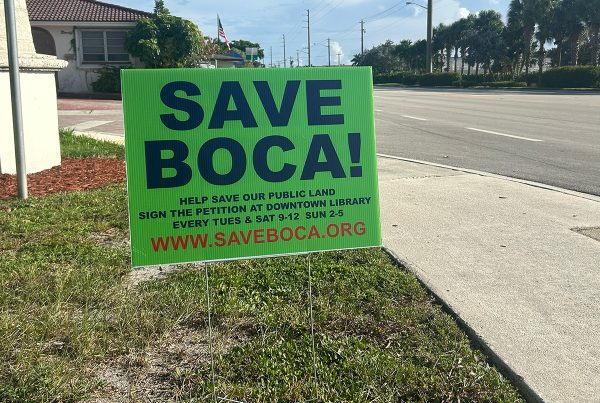
In her statement responding to Katz, Jarjura said, “We seem to have forgotten the purpose for which we were each elected to serve.” She and Glickstein have complained repeatedly about social media yapping in Delray Beach that traffics in rumor and speculation, not facts. As in Boca, these voices seem to know who and what they are against but not what they are for.
Such a dynamic is more common to cities like Lake Worth and Riviera Beach, where much backbiting takes place but little gets done. Delray Beach has much going for it, and will have even more if the city’s politics don’t turn self-destructive.
“I’m optimistic,” Glickstein said in an email Wednesday. “The members of the ‘get-a-life’ club who vilify anyone that doesn’t do their bidding is fractional, their common thread being no real sweat equity in moving this city forward other than being proficient on a keyboard.”
CRA workshop
Before Tuesday’s commission meeting, the tone was much more hopeful and the time much more productive when the board of the Delray Beach Community Redevelopment Agency and the commission met in a workshop with their respective staffs.
City Manager Don Cooper has proposed an ambitious citywide plan for repairing roads, sidewalks and street lights, especially in the southwest neighborhoods. The plan includes a makeover for Osceola Park, a master plan for Pompey Park in the northwest neighborhood, plus work at Veterans Park and Old School Square. The Osceola Park work would come first.
If the scope is ambitious, so is the approach. Cooper told the gathering Tuesday that he wants to do all the work in each neighborhood simultaneously, not “piecemeal.” Other cities take that approach, Cooper said, but for Delray Beach it will be “a bold, new experiment.” Cooper called the seven-year schedule “aggressive but doable.”
Coordination is critical because the work would take place within the CRA’s large boundaries. The CRA has planned work of its own, and the commission wants the CRA to share costs. Because so much revenue from increased property values stays within the CRA, Mayor Cary Glickstein said, without a change in how the two entities operate, “There will be an inflection point” where the city can’t provide adequate services outside the CRA. Glickstein noted that the CRA’s revenue is “above projections,” and said simply, “We need help.”
CRA board members worried most about flexibility. If a neighborhood’s needs change, can the plan change? If a private developer pays for some of the improvements, can money be shifted to other needs?
Cooper said yes to both, as did Glickstein, though Glickstein acknowledged that the city “has never adopted this sort of comprehensive approach. We’re going to have to take a collective leap of faith.” Cooper said he must create staff teams to oversee the work, which will happen after “a lot of community involvement.”
The plan is really Delray Beach going back to what started the city’s renewal nearly 30 years ago: bonds to improve infrastructure. Such unglamorous investment brings good returns that taxpayers can see.
As Cooper said, when the Capital Improvement Plan is finished, the CRA “will be out of business as far as blight is concerned.” Cities form CRAs to eradicate blight. Ideally, the blight disappears, and so does the CRA.
That is still years away, but the beginning may have happened Tuesday. Cooper called the meeting “productive” and said he and Costello “are trying to bring the boards together.” Glickstein said the goal is to speed up the CRA’s “‘mission accomplished’ objective.”
Opioid abuse funding
Opioid abuse remains the least-discussed big issue in the presidential campaign, but out of the Clinton-Trump spotlight things are happening.
Congress can’t even approve Zika money to help Florida and other states. In the Obama administration’s budget, however, is $1.1 billion for states to expand treatment for what a news release calls “opioid use disorders.” According to the Centers for Disease Control and Prevention, in Palm Beach County, the annual drug poisoning death rate is more than 15 per 100,000 residents – the highest level.
Under the president’s plan, Florida could get as much as $47 million, based on a formula that ranks the seriousness of abuse state by state. Hard as it may be for officials in Delray Beach and Boca Raton to believe, Florida ranked just 31st in the drug poisoning death rate in 2014, the last year for which statistics are available.
If Congress approved the money, a state’s share would depend in part on its “application and plan to combat the epidemic,” according to the news release. The Florida Legislature’s response has been irresponsibly slow.
There’s other movement at the federal level. In August, we hope to receive an amended statement from the departments of Justice and Housing and Urban Development that may allow local governments to start regulating sober houses. Last month, Sens. Marco Rubio, Orrin Hatch and Elizabeth Warren asked the General Accountability Office to “conduct a review of federal and state oversight of sober living homes.” They added, “Sober living homes can be an effective recovery service for those suffering from substance use disorder, but little is known about how this cottage industry functions overall.”
No kidding. U.S. Rep. Lois Frankel, D-West Palm Beach, took the lead on pushing for the new joint statement. If Rubio wants to show that he can be a senator who cares about the job, helping South Florida cities regulate sober houses offers him a great chance.