Put the heart back into your holiday season. Here are a few ways to look beneath the tinsel and ribbons and bright wrapping paper for gifts that make a real difference in real lives—all in your own backyard.
HabCenter: Paying it Forward With a Taste of Honey
The great 13th century Persian poet Rumi got what the holiday spirit was all about, even though he likely didn’t celebrate it: “Be a lamp, or a lifeboat, or a ladder. Help someone’s soul heal. Walk out of your house like a shepherd.” Which is pretty much what the HabCenter does every day. You, too, can tap into the real holiday spirit with a little jar of honey—and maybe a donation to keep HabCenter’s lamp burning.
What it Does: The Palm Beach County Board of County Commissioners launched The Habilitation Center in 1973 when it donated the property in West Boca Raton for a work and learning center aimed at families with loved ones with developmental differences, those who had phased out of the school system and no longer had services nearby. The Boca Raton location, which opened in 1978, has since become a lifeline for hundreds, with a waiting list of 2,000 in Palm Beach County alone, a wait that can last up to 20 years.
HabCenter serves people with all manner of developmental differences, from autism, Down syndrome, intellectual limitations and cerebral palsy to schizophrenia, bipolar disorder and more. It provides work opportunities and mental health services as well as STEAM programs, vocational training, arts and music, tech training—you name it. There’s even a substantial plant nursery, and a beekeeping and honey operation.
But there’s another difference here, too.
“In a typical neuro-divergent space, the people have to adapt to the ways things are done. But what we do here is adapt the environment to their needs, so we provide adaptive ways for them to work—to live a full, purposeful life. They do that through learning various job skills and mental health counseling programs,” says the center’s CEO, Sherry Henry.

In the manufacturing plant, HabCenter employees might package documents, measure wires, package cosmetics (including building the boxes), construct circuit boards, and all kinds of assembly work contracted to the center by outside businesses. They get mentoring as well as paychecks—and the work is tailored to their specific skill sets. Some workers are outsourced to employers like Publix or Sprouts. And those clients who may not be suited for the manufacturing side of things can attend the wide range of aforementioned programs.
“The HabCenter is important for our community, because this population has nowhere to go,” Henry says. “And we provide purpose. We provide enrichment. We provide improvement in their skills, like having conversations on what is appropriate in certain settings. We make them feel like they belong. And they do belong.”

Funding: HabCenter funding comes from earned income from manufacturing clients, the plant nursery, fundraising, grants, private donors and state appropriation funding.
Funding Challenges: “[Funding] has not been consistent,” Henry says. “The county support is critical to our mission, and they have really championed our cause for the past 47 years. The level of support doesn’t remain the same in terms of how much, but we really are successful because of what the county has done to help us become self-sufficient.”
Henry says recent legislative changes put forth by the current state administration have impacted the organization, including how the state will support clients who work at the HabCenter, resulting in a significant drop in funding.
There is also the image. “We’re not sexy,” she says. “We do face the challenge of not having the shiny thing that everyone wants to champion—I am not disparaging this, but there are a lot of resources for children, but not as many for adults. For this population, they do not go into adulthood and become self-sufficient. They will need lifelong support. I see people not really connecting with that.”
Still, HabCenter staff and professionals and volunteers are undeterred—because they see what the HabCenter does. Henry recalls one client who transformed from an unruly and abandoned young man with no skills but a bad temper, to someone who has learned how to live in a community.
“He finds he is able to work and earn income. He [like all our clients] gains independence by taking his money and buying something he needs, or going to the movies—the things typical people do easily without even thinking about it. The HabCenter is also teaching him social skills—learning how to talk to a manager, how to ask for a raise, how to deal with conflict in the workplace—doing all that in a very supportive environment where each opportunity is a learning opportunity. … He feels like he’s loved, and he is loved.”
How it Can Be Your Holiday Present: The HabCenter makes its own kosher-certified honey ($20 for six ounces, $22 for eight ounces)—and it also makes lip balm from the wax from the honey ($15).
HabCenter, 561/483-4200; visit habcenter.org
Her 2nd Chance: Give a Hand Up With Jewelry

Don’t get us wrong; a little blue box from Tiffany under the tree is hard to beat. But what if you gave the gift of purpose—even someone’s future—with a more understated bracelet from Her 2nd Chance?
What it Does: Her 2nd Chance was founded in 2018 by Keely Copeland, who found herself newly sober and in recovery but having trouble getting a job, a predicament shared by many trying to rebuild their lives. Out of that frustration she created the company that specifically hired women in recovery. What differentiates Her 2nd Chance from other recovery programs is that it is entrepreneurial, a social enterprise that trains women in running an ecommerce business that sells customized mugs, tumblers, greeting cards, bracelets, and corporate gifting items through her2ndchance.org and a shop on Etsy. It also offers fulfillment services to businesses, all from a vibrant high-style workspace converted from a small warehouse in east Boca Raton.
Her 2nd Chance offers women in early recovery transitional employment, which is a crucial component of a successful recovery journey for a few reasons. It provides a structured environment that helps re-establish a sense of routine and accountability, and it also offers a pathway to economic independence, building practical skills and confidence.

Public Relations Supervisor Mary Fuller says the women have “real jobs in the real world, and now with the jewelry project, many of them are becoming trained as jewelry makers. They feel they have purpose. We are offering them a hand up, not a hand out.”
The one-year program also offers an impressive array of support services and partners, including a Wellness Works initiative that includes daily meditations, weekly team lunches, monthly well-being workshops, and quarterly team-building events. The Bridge to Employment program prepares participants for community employment with career mentoring, resume assistance, mock interviews and skill-building workshops, ensuring a smooth transition to their next employer.

Fuller says she sees a growing need for the work Her 2nd Chance does and says the board is “passionate about finding innovative ways to ensure every woman who seeks our help finds the structured support, a living wage and renewed purpose she deserves.”
And it’s all worth it when Fuller sees the transformation.
“By the time they leave the program, our women often carry themselves with a new sense of pride, seeing their potential and worth far more clearly. The fear of failure is replaced with the confidence that they can succeed in a healthy, sober life.”
Funding: Her 2nd Chance is funded through grants, individual donations and sales from the social enterprise program.
Funding Challenges: Her 2nd Chance is a relatively new organization, and Fuller says she is committed to getting the word out, driving up product sales “so we can hire more women” in the face of a growing need.
How to Make it a Gift: Her 2nd Chance is introducing a new line of bracelets, priced at $12 per single strand, in time for the holiday season at her2ndchance.org. Customers can order singles or stack them. And remember: Your purchase directly assists a woman’s journey toward independence and a brighter future.
Her 2nd Chance, 561/405-6346; customerservice@2ci.org; her2ndchance.org
The Palm Beach County Food Bank: Meetings With a Heartfelt Agenda

Everyone you know is trying to figure out some way to make that four-course Christmas dinner even better this year—complete with that Santa-and-reindeer centerpiece, the shimmering glass ornaments, a special Williams Sonoma tablecloth that pulls it all together.
Then there are the thousands upon thousands of Palm Beach County residents who may, if they’re lucky, get Christmas dinner in a grocery bag at a local food pantry, or prepared, in a Styrofoam box. Between inflationary issues, housing costs, insurance hikes and wages not keeping up with cost of living, Palm Beach County Food Bank CEO Jamie Kendall says hunger is real for 192,000 Palm Beach County residents.
“They are classified as Asset Limited, Income Constrained, Employed (ALICE)—basically the working class—maybe two parents working at slightly-over-minimum-wage jobs. … You throw two or three kids in the mix, and they are one flat tire away from a disaster. It’s those folks that are the majority of the people that we help.”

What it Does: The Palm Beach County Food Bank procures food, then partners with local organizations to distribute it to a growing population of people who may not know where their next meal is coming from.
“We get food in a number of ways,” Kendall says. “Food drives, food retailers and manufacturers, some federal programs such as the USDA’s The Emergency Food Assistance Program (TEFAP), and we end up purchasing a lot of food. Our biggest job is getting all this food in—and becoming a clearinghouse for it. We work with almost 200 partner agencies in Palm Beach County that have boots-on-the-ground distribution programs: your shelters, the Lord’s Place, church pantries, places like Boca Helping Hands. … There’s never any cost for any of the food that our partner agencies get from the Food Bank.”
In addition, the Food Bank has added a few “direct distribution” programs, like its “backpack” program to provide schoolchildren who qualify for free breakfast and school lunches with enough food to tide them over on weekends; it serves about 5,000 kids a week. There are summer feeding programs when school is out—they serve about 65,000 meals during a 10-week period—and there are programs to help elders by routinely furnishing them with both bags of nonperishable food items at various locations as well as fresh vegetables and fruit (too expensive now for most on modest fixed incomes), distributed to senior centers on Fridays. The Food Bank steps up in other ways when the need presents itself, but its newest program is the state-of-the-art Michelle Hagerty Community Kitchen, a vast gleaming kitchen within Premier Kitchen that is capable of preparing 10,000 meals a day—and is fully generated so it can be activated for disaster services.

Funding: The Food Bank is funded mostly “from individuals and foundations, and we do a lot of grants,” Kendall says. “In the past we have gotten some state funding, but that has gone away.” Its impressive new Premier Kitchen may be another source of funding, as in-house culinary programs and events gain traction throughout the community.
Funding Challenges: Prior to COVID, most food was donated to all the food banks. When agriculture and the food industry were roiled by COVID’s production and supply chain upheaval, food became an urgent need for many, and it was no longer available for free. Years later, food banks still have to pay for food, rather than have it donated.
A recent and stunning blow to the Food Bank was a last-minute change in this year’s state budget, which had originally slotted $38 million to be divided among food banks in Florida that had been in existence for at least five years. At the 11th hour, the funding was slashed, and the remainder given only to Feeding America food banks. The Palm Beach County Food Bank is an independent food bank and received nothing, a loss of more than $1 million. “There was no explanation,” Kendall says.
How it Can Be Your Holiday Gift: The Food Bank’s new flashy Premier Kitchen offers a myriad of experiential possibilities you can give as gifts. Companies can hold team-building meetings in the kitchen’s sleek adjacent boardroom, already wired for Zoom meetings and all kinds of presentations. Then attendees can enjoy a catered lunch from the Food Bank chef and its newly minted culinary students through the Food Bank’s inaugural social enterprise program to train people for jobs in the hospitality industry. Afterward, the group can donate their time and spend a couple of hours packing or sorting food in the Food Bank’s volunteer center, if they wish. Prices vary according to the number of people and the menu, but there’s nothing better than a holiday lunch meeting with a side of feel-good.
And, even better, Kendall says, the Food Bank’s Premier Kitchen can do anything you can think up, from a cooking class to a chef demonstration to a dinner party; one donor is even holding his wedding rehearsal dinner there next year.
Palm Beach County Food Bank, 561/670-2518, info@pbcfoodbank.org
Arts Garage: With a Song in Your Heart

Sometimes the best gift is not something you wear or drive or hang on a wall. In this case, it’s a memory-maker: music all year-round, up close and live.
What it Does: Started by the Delray Community Redevelopment Agency (CRA) as a community arts project like Arts Warehouse in 2011, this small nonprofit has become a robust, thriving arts venue in Delray as well as South Florida. It offers top-notch concerts in an intimate “listening room” format where the audience, seated comfortably at tables for most concerts, is close to the entertainment and welcome to bring their own food or snacks (liquor is sold at the venue). President and CEO Marjorie Waldo, now an arts icon in her own right, took over Arts Garage in 2016, when it was sinking due to its initial mismanagement.
“I spent the first two years turning around an agency that was on the brink of closure,” she recalls. “It was a real turnaround through a multi-pronged approach—not just financial.”
She led Arts Garage in resolving debt; reinventing policies and procedures; rebuilding relationships with vendors, employees and performers, as well as the city of Delray; and, finally, fine-tuning the programming. “It required all of that and all at the same time. It was almost like starting a new business,” she says.

Fast forward to 2025, and the venue is a star in the South Florida entertainment firmament, featuring world-class jazz and blues, top-quality tribute performances, and “big Latin” and Latin jazz performers, among the many other offerings. Waldo uses fine-tuned metrics as well as her own growing command of entertainment trends to gauge what audiences want, and the results have been impressive. In 2024, Arts Garage hosted more than 300 events, served nearly 29,000 attendees, and featured more than 1,600 artists generating $4.1 million in economic impact and the equivalent of 63 full-time jobs in Delray Beach.
Arts Garage has also embraced community outreach and offers adult and children’s education programming, artist receptions, summer camp and after-school activities, a special senior series to accommodate people with mobility issues, a program that donates supplies to local schools and charities, free ticket programs for nonprofits, and more.
The success of Arts Garage has been proven, and a driving factor is Waldo’s passion for the arts.
“If you’ve been impacted personally by the arts, or you’ve seen other people impacted, then you have no doubt in your mind of the value of this cultural phenomenon that brings people together,” she says. “It bridges gaps that exist between age, race, ethnicity, socioeconomic levels—it all disappears when you are staring at the same painting or you’re sitting at the same show. That disappears as you become engaged in a common universal experience.”
Funding: Arts Garage funding is from ticket sales, grants from the CRA (in the future, possibly the City of Delray) and the Cultural Council for Palm Beach County, with local and county grants covering about 20% of the budget. Other sources of funding are private donations, sponsorships and memberships.
Funding Challenges: “My concern is about ongoing funding,” Waldo says. “For example, we lost the state grant when the governor vetoed the line item for arts and culture funding for the 2024-2025 year. … We assumed we’d get the same thing the legislature recommended the prior two years, which would have been about $100,000, but they actually came in below that at about $70,000 in state support. But when he vetoed even that, it was an historical action; we weren’t given a reason.”
How to Make it A Gift: Buy the gift of experience, with an annual membership at Arts Garage (they range from a Bronze at $250 to a Platinum at $5,000). All have member benefits, but Diamond members and above also get early access to events and many more perks. Why a membership?

Waldo explains, “One, you are providing the impetus for someone who may already love the arts but may not be active to get out of the house—I can’t turn off the news, but I can shut it down when I am listening to a show—and it doesn’t matter who’s sitting across the table from me. We can be from different socioeconomic backgrounds, different racial backgrounds, political or religious backgrounds, but we all love the blues or Cortadito’s Buena Vista Social Club show or whatever. … Part of it is providing an opportunity for people you love to come to things that make them feel better … and maybe make new friends. You are also supporting an organization that takes paying it forward in the community very seriously.”
Arts Garage, 561/450-6357; artsgarage.org
The Boca Raton Historical Society: Celebrate Our Centennial

Sometimes the best gift is a reminder that you are part of a place—that’s come a long way in a short time. As Boca Raton continues to celebrate its 100th birthday in 2025, here are a few ways this season to be part of the party.
What it Does: The Boca Raton Historical Society (BRHS) came into being in the nick of time—in 1972, when many of the young city’s pioneers were still alive and remembered the way things were. The city was founded in 1925, but it wasn’t until the Junior Service League (later to become the Junior League) came along that the notion of preserving its history became a major project. It was that initiative that spawned the Boca Raton Historical Society.
“We became right away an academic institution, because the late Dr. Donald Curl was on the board and was the first history professor at FAU,” says Mary Csar, outgoing executive director of the Historical Society for the past 27 years. “He’d write these ‘Spanish River Papers,’ which were historical articles that got us off to a good start really learning and telling Boca’s story.” [The ‘Spanish River Papers’ are still being written, by a variety of authors, including Susan Gillis, the Museum’s longtime curator—Ed.] Many pioneers were still alive, so they donated artifacts and stories; literally everything in our pioneer exhibit came from those people. That gave us a sure footing early on. … South Florida was so young, when you think about it.”

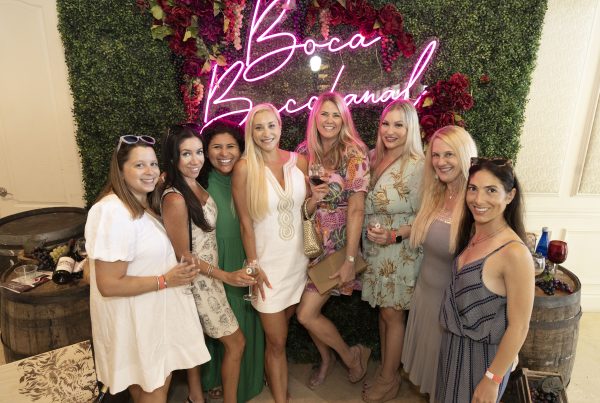
Over the years the BRHS launched the Schmidt Boca Raton History Museum, started Boca Bacchanal to raise money for children’s programs, restored the historic Streamliner train cars, and welcomed curator Susan Gillis, whose meticulous cataloguing literally created the museum. Today, the museum offers changing history exhibits, “Free Fun Saturdays” for children, community educational programs, Town Hall Talks, a Speakers’ Bureau, walking historical tours of The Boca Raton, the annual Walk of Recognition, the popular Toast, Taste & Trolleys events, and more.
As Csar says, “The Historical Society is a wonderful resource for the community. … The Boca Raton Historical Society is much more proactive in collecting history and sharing history than other towns our size. Understanding your local history gives you a sense of place, and it gives you pride in your community. You know where you live, and you know you are part of it.”

Funding: The BRHS counts on county bed tax money, membership programs, grants, donations, fundraisers and the proceeds from its annual fund to keep ticking, plus items sold in its gift shop.
Funding Challenges: The BRHS used to count on a state grant, but since the current state administration’s slashing of its cultural/arts budget, this is the second year the BRHS has not received it—a shortfall anywhere from $40,000 to $80,000.
How it Can Be Your Holiday Gift: Celebrate Boca’s legacy with holiday ornaments commemorating the centennials of the City of Boca Raton ($25.95), The Addison ($18.95) and The Boca Raton ($24.95). Our favorite gift, though, is “Dream City: A Pictorial History of Boca Raton,” a coffee table-style book produced in honor of Boca Raton’s centennial that documents our local history from the late 1800s thru today ($100).
Boca Raton History Museum, 561/395-6766, ext. 100; bocahistory.org
This story is from the November/December 2025 issue of Boca magazine. For more like this, click here to subscribe to the magazine.