
King Tide
This week—especially today—brings the latest reminder about South Florida’s vulnerability to sea level rise and the latest reason for an individual and collective response from local government.
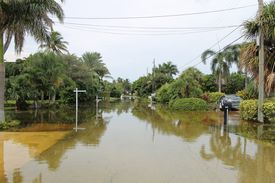
Through Monday, some low-lying coastal areas will get more flooding than usual with the full moon. The cause is the King Tide, which happens when the moon, sun and Earth are in a particular alignment—usually in the fall.
Typically and admirably, Delray Beach sought to give residents as much information as possible. The city issued a news release to warn of the higher tides and explain city efforts to minimize the flooding. The release also noted that flooding is worse because the sea has risen roughly 10 inches in the last century. Higher levels, higher tides.
As I have written, sea level rise in this region is more problematic south of Boca Raton because the land is much lower. Miami Beach is developing what could become a very costly plan to protect some of the most valuable real estate in Florida. Areas near the beach in Fort Lauderdale suffer chronic flooding.
But so do portions of Palm Beach County. The difference is in the community response. Delray’s has been among the most aggressive.
Nearly two years ago, the city hired a sustainability officer, John Morgan. He had worked at the South Florida Water Management District, which helps local governments plan for sea level rise. Consultant Nancy Schneider works with the city’s Rising Waters Task Force. Delray Beach will give the county information about which parts of the city regularly flood, to help with the wider response to a changing climate.
In an email last week, Morgan told new Assistant City Manager David Scott about Delray’s response to the King Tide and sea level rise in general:
For this week, the city put barricades where salt water overflows storm drains and comes over seawalls. The city asks residents to photograph the flooding. Meanwhile, the county will be using drones to record the effects. Delray Beach Emergency Manager Steve Hynes is using the King Tide to help the city prepare for more serious flooding.
The problem is particularly bad at Delray Beach’s marina. Morgan said the city has installed flex valves at some stormwater outfalls; a contract to equip the remaining marina outfalls has been approved. During the current budget year, Morgan wants to give City Manager Don Cooper a cost estimate for installing the valves on all stormwater outfalls where high tides cause flooding.
The Rising Waters Task Force, Morgan said, will present “findings and recommendations” to the city commission in January. Staff also will present information from the Climate Compact Resilient Redesign workshops. Cooper told me in an email that while climate change won’t be part of the goal-setting session staff and commissioners hold today, rising seas will require more money in Delray’s Capital Improvement Plan.
Commissioner Shelly Petrolia has argued that the city should not allow more underground parking facilities, which extreme flooding could submerge. Atlantic Crossing would have one. The city could accomplish that with a “zoning in progress” ordinance that would prevent the approval of underground parking while Delray crafts a comprehensive sustainability plan.
Delray Beach’s big push on this issue started with the city’s decision in January 2014 to sign the mayors’ pledge, stating the city’s support for the Southeast Florida Climate Change Compact. Signatories commit themselves to a program of public awareness and public improvements that will make themselves and thus the region more prepared for the effects of climate change.
Boca Raton has come much later to the issue than Delray Beach. The city has not signed the pledge, though Mayor Susan Haynie told me on Wednesday that Boca is “exploring” it. Staff members, Haynie said, are “examining the obligations and fiscal impact.”
According to a city spokeswoman, Boca finally has formed what the city calls an Environmental Sustainability Team, which reports to Assistant City Manager Michael Woika. The group, the spokeswoman said, will examine “air quality, regional cooperation and partnerships, open space, climate change/sea level rise, energy and renewable resources, water quality, transportation, preservation, recycling” and other topics.
To match Delray Beach, Boca must move quickly. I could find no information about the King Tide on Boca’s websites. Delray’s website had plenty, and it also offers information about Federal Emergency Management Agency flood maps and the national flood insurance program. Last week, Delray Beach released the 2015 evaluation of its Floodplain Management Plan.
One could wish that the seas weren’t rising, but action is a better response. Delray Beach has set a good example for Boca Raton.
Florida governor’s office blocks emissions limits
Given Florida’s vulnerability to rising seas, it might seem puzzling that Attorney General Pam Bondi has joined the lawsuit seeking to block new Environmental Protection Agency limits on greenhouse gas emissions that cause the climate to warm. All predictions are that 2015 will be the warmest on record, as preceding years were.
Bondi’s actions are not puzzling, though, when you realize that her policy and that of Rick Scott is to oppose anything from the Obama administration even when Florida would benefit. Scott still refuses to expand Medicaid under the Affordable Care Act.
The president’s plan sets limits for each state on carbon emissions from power plants, but states get to decide how to meet those limits. Florida would have to reduce carbon dioxide emissions 11 percent by 2030. That’s a much lower amount than Midwestern states where most large generating plants use coal, the dirtiest fuel.
This state’s largest utility, Florida Power & Light, long has supported federal action to reduce carbon emissions. One reason is that FPL now generates most of its electricity from natural gas—which burns much cleaner than oil and especially coal—and nuclear.
In fact, an FPL spokesman said the company’s emissions already are under the state limit in the EPA’s Clean Power Plan. So it is unlikely that customers would face what Bondi speculates would be “dramatically higher electricity bills.
History shows why Bondi’s estimate probably is wrong. A quarter-century ago, a bipartisan plan to cut sulfur dioxide— the cause of acid rain—passed Congress. President George H.W. Bush signed it. Polluting power plants warned of catastrophic costs.
Instead, the costs were a fraction of the hyperbole, and the results even better than expected. The program allowed the “trading” of pollution credits. Such flexibility within companies helped accomplish the overall reductions.
States that don’t create their own programs under the Clean Power Plan would have to use that same cap-and-trade system. A national program passed the House in 2010, but coal-state and anti-regulatory Republicans blocked it in the Senate.
If Florida were landlocked, Bondi’s action would be merely political. Since her job is to represent what’s best for Florida, though, her action is political and irresponsible.
David Scott and Delray
David Scott’s arrival as Delray Beach’s second assistant city manager is well-timed.
Scott came from Pinellas County. For three decades, his government work has involved public works and utilities—the hidden nerve systems of cities. In an email, City Manager Don Cooper said he has given Scott supervision of the Environmental Services Department—that includes Public Works—the Community Improvement Department and the Parks and Recreation Department.
Cooper said Scott’s hiring “completes the management structure recommended” by the commission. With Cooper able to delegate more between Scott and the other assistant city manager, Francine Ramaglia, Cooper should be able to focus more on broader commission-requested priorities. Expect much talk about those priorities when Cooper and the commission hold that goal-setting session this morning at Delray’s golf course clubhouse.