As audience members, we’re used to a certain kind of motion picture, one that complies with accepted rules regardless of genre: characters with an understandable psychology, a plot that moves in a discernable direction, a story with a beginning, middle and end, and editing that forms a coherent procession of images. Something like 95 percent of movies distributed in American cinemas adhere to these strictures, and the ones that don’t are often subject to the same scrutiny: If they fail to provide any of these comforts, they fail to be successful products in a consumer marketplace.

Terrence Malick’s rapturous “Knight of Cups” (opening today at Cinemark Palace 20 in Boca) doesn’t belong in that 5 percent so much as it inhabits the .1 percent of American movies, a film so staggeringly experimental that its very existence in multiplexes is astonishing to behold. It not only fails proudly and spectacularly on all of these fronts of cinematic predictability; it’s also a veiled critique of the marketplace of the movie-industrial complex—the rotten, art-squelching business that forces such formulas on us in the first place.
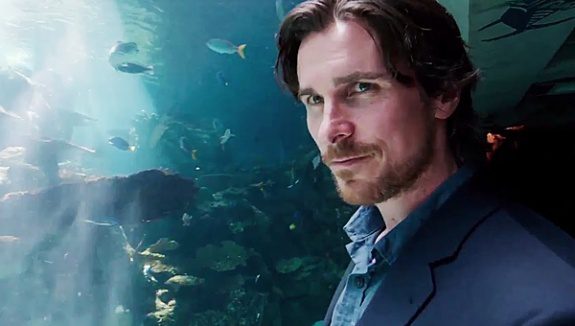
And, because he’s Malick, he managed to fill his two-hour meditation on Hollywood’s vapid soullessness with genuine Hollywood stars. Christian Bale plays Rick, but he might as well be nameless: Aside from some voice-over musings lifted from the 1678 Christian allegory The Pilgrim’s Progress and other arcane texts, he’s a cipher who barely speaks. He’s a restless and bored screenwriter and, like the tarot character that gives the film its name, he is adrift without the excitement of a new stimulation, preferably from the fairer sex.

Fragments from his life proceed in eight splintered chapters, most of them named after tarot cards that speak to the section’s symbolism: “Judgment,” “The Tower,” “Death.” In one, he listens to rants and raves from his troubled brother (Wes Bentley) and father (Brian Dennehy) in the aftermath of his other brother’s apparent suicide. In most of the others, he idles his time at lavish Gatsby-like parties and loses himself in the company of gorgeous women—models, actresses, strippers and physicians played by the likes of Cate Blanchett, Natalie Portman and Imogen Poots, among others—only to remain alone by the end of the segment, his happiness ungraspable. He’s like the dog we see diving into one of the film’s many pools, lunging at a tennis ball just of reach.
Some of the scenes surely take place in the past, but to ascribe linearity to this tone poem is to consign yourself to two hours of suffocation. Audiences need instead to ride the continuum—to float wide-eyed on this flowing river of a film, through all of its unexpected tributaries. Increasingly unshackled by narrative, Malick has wandered further into the wilderness with each film he has made, and “Knight of Cups” almost makes his groundbreaking “Tree of Life” look like a Clint Eastwood prestige picture.

That said, precedents exist. Viewers versed in art-house cinema will notice shards of Fellini’s “8 ½,” Rossellini’s “Voyage to Italy,” Lynch’s “Inland Empire,” Sorrentino’s “The Great Beauty” and especially Godfrey Reggio’s “Koyaanisqatsi” in Malick’s palette of influences. But the resulting style—of rich visual contrasts; a symphonic, multi-tracked soundtrack; camera movements that hurtle and glance and deflect rather than film anybody head-on—is singularly Malick’s own, pure and distilled.
To impose meaning on it all almost seems gauche, akin to enforcing figurative logic on a Rothko or a Kandinsky. But for those grasping at straws (or their own hair) on the way out of the auditorium, the tarot card connection helps. So does the director’s lingering gaze on the trappings of Hollywood excess—the monstrously sized pools and backyard bacchanalias, the skyscraping towers of conspicuous consumption, the incessant industry jargon and pretentious prattle about ketamine parties and vacations to Sarajevo, the endless supply of toothpick-like L.A. bodies parading across the screen, the omen-like earthquakes that disrupt the privileged sterility of this ersatz city. Hardly anybody talks to each other in “Knight of Cups,” but Malick doesn’t need to spell out his commentary; the images are enough to suggest a modern-day Sodom and Gomorrah waiting for their divine extinction.
Mostly, though, Malick’s most modernist film—in both setting and aesthetics—offers a vision of Hollywood, Los Angeles and the world that resembles nothing we’ve seen before. “Dreams are nice, but you can’t live in them,” one of Rick’s girlfriends tells him. But Malick does, for two uncompromising hours, and that’s why “Knight of Cups” is so ravishing.