
You’ve never seen Camp Miasma, the fake horror franchise at the center of Jane Schoenbrun’s complex and cult-y new metafiction, Teenage Sex and Death at Camp Miasma (opening today at Cinemark Bistro Boca Raton). But if you grew up around slasher films, from demented art like The Texas Chain Saw Massacre to disposable product like Sleepaway Camp, Slumber Party Massacre, and most of the Friday the 13th series, you know the type: Naïve teenagers, usually drunk and stoned and in various states of undress, are picked off one by one by a masked, homicidal, always male killer. One attractive young female—the “final girl”—is permitted to survive, often to reappear in the sequels, but it’s cold comfort to the rest of the victims.
In Ronald Reagan’s puritanical 1980s, the height of the low-budget slasher, the killers may as well have been blade-wielding avatars of the Moral Majority, punishing promiscuous pleasure seekers. And if a character happened to be Black or, God forbid, trans, their fate was sealed before they could finish their first line.
Such has been the cultural baggage carried by the woebegone slasher as it has hobbled into the 21st century, all of the old sexist and transphobic tropes re-scrutinized in our woker era. Wes Craven was well aware of these stereotypes even back in 1996, when he made the satirical Scream, but this critique was more formal than ethical or moral, winking at us from the surface while still satisfying the genre’s basest impulses.
Sex and Death at Camp Miasma is something else entirely. The intensely personal work of the queer director Jane Schoenbrun—whose previous feature, the eerie I Saw the TV Glow, also centers on a character’s obsession with a fictional staple of horror-adjacent media—it follows a fellow queer filmmaker, Kris Williams (Hannah Einbinder), a veritable stand-in for Schoenbrun, as she prepares to shoot a reboot of Camp Miasma, an influential 1980s sleepaway-camp shocker that become a cultural phenomenon.
A dazzling opening montage of invented movie ephemera and newspaper headlines charts the rise and fall of Camp Miasma in the time it takes a dream-pop cover of R.E.M.’s “Nightswimming” to backstroke on the soundtrack. The original film became an overnight sensation, spawning action figures and arcade games and fan fiction and myriad sequels before flaming out around the eighth or ninth uninspired retread. We also learn that the final girl from the original film, Billy Presley, retired from acting after her breakout role in the franchise, refusing to return for any of its sequels, and disappearing from the public eye.
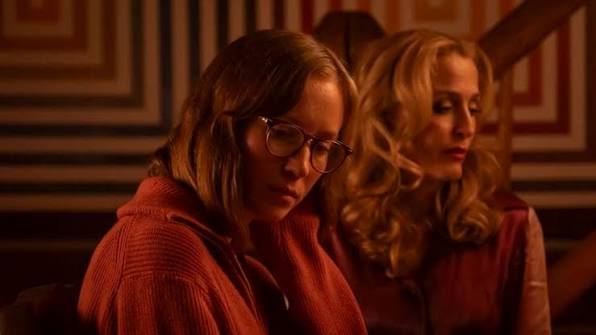
Our story picks up decades later, with Camp Miasma mostly a mothballed memory in the Gen-X consciousness. Our director, Kris, fresh off a critically acclaimed, if commercially unsuccessful, art-house horror movie, has been green-lit to pursue a more “elevated” reboot, and she’s convinced that if she can just sit down with the reclusive Billy Presley (Gillian Anderson), she can convince the now 60-year-old shut-in to reprise her role from some 35 years ago.
Given Presley’s surname, perhaps we shouldn’t be surprised that she lives on a kind of Neverland Ranch of her own: a cabin in the woods of northern Washington, on the very set where Camp Miasma was filmed. Many of its creepy props remain in place, and Billy has even fashioned a working 35mm cinema, where the only film reels are of—you guessed it—Camp Miasma. Billy calls this curated museum her “private alternate universe.”
References to Sunset Blvd. are dropped before we can conjure what appears to be a modern-day Norma Desmond, ossified in the image of her onetime limelight. But Anderson, in her best performance in years, quickly dispels this notion with a wicked, self-effacing sense of humor, as well as an emotional tenderness that only unfurls in the movie’s masterful second half.

I single out the second half in part because we, like Kris and her elusive project, take our time to find our way through this film’s unusual tone, pitched somewhere between camp and homage, parody and think piece. Slowly ascending the stairs of Billy’s cabin to a high-tension score by Alex G, and half-expecting to see a shadowy figure when she reaches the top, Kris voices aloud our own thoughts in the moment: “I feel like there’s about to be a jump scare.” This will either work for you or it won’t, and I was on the fence about this for quite some time. I also didn’t need the food-porny close-up montage of Billy and Kris dipping KFC into containers of sauce and devouring the results, a seemingly silly detour for such an otherwise cerebral experiment.
But with Schoenbrun, you take the occasional indulgences for the insight and audacious sense of adventure that follows. Kris’ visit becomes an intimate two-day affair, and by the time the ladies sit down in front of Billy’s projector to screen Camp Miasma anew, Schoenbrun’s vision has begun to flower. So much of Teenage Sex and Death at Camp Miasma involves watching, alongside our protagonists, the re-created original film, in all of its grainy glory, fake blood, coerced sexuality, and antediluvian sociopolitics. (Kevin McDonald, of Kids in the Hall, and Zach Cherry, from Severance, are among those cast in Camp Miasma.)
Witnessing the film through these characters’ memories and perspectives is essential, because Schoenbrun’s film is about the juxtaposition of immersion and disassociation that movie watching, especially in the horror genre, requires. Billy, who claims to have had her first and best orgasm while filming the crucial sex-turned-murder scene of Camp Miasma, instructs Kris, who has always considered herself “not good at sex,” to inhabit the gaze of both herself and the killer, who in Miasma carries a phallic harpoon that he plunges into his victims. You don’t need to be Freud to capture the symbolism, but feminist film theory of this sort is seldom broached in a mainstream horror movie, and it all sprouts from our experience watching a movie through these characters’ eyes. Regardless of our personal gender, we are voyeurs to a doubling of the female gaze.
As in the film within the film, layers build upon layers, and Easter eggs hide in plain sight. The presence of Mulholland Dr. character actor Patrick Fischler in a cameo in both Camp Miasma and the “real life” parts of the film makes us think of that David Lynch masterpiece, and the way its two female characters are twinned and doubled, much like Billy and Kris. A VHS tape of Brian De Palma’s Dressed to Kill, about a gender-bending killer mirroring the nonbinary villain in Camp Miasma, appears in a flashback of the 8-year-old Kris bingeing slashers on her bedroom TV, unaware of their corrosive effect on her developing mind.
“I think I saw too many movies as a kid, and it fucked me up real bad,” Kris confesses to Billy, in her most vulnerable moment, after a botched lovemaking session surrounded by boxed movie-theater candy. As opposed to a love letter to slashers, as some critics have concluded, Teenage Sex and Death at Camp Miasma is in fact a long-awaited reckoning with the sordid, painful, stunting legacy of the genre.
There will be many, perhaps the majority, of viewers who won’t share the wavelength of this profound and beguiling movie, with its self-aware deployment of nostalgia as a crutch, its magical realist sequences, its unsettling blur of reality and fantasy. And that’s OK. Schoenbrun will likely never be a mass-market director—though I’d love to see their take on a Marvel movie, should they be recruited for the job—but they have their pulse on how movies change us, and how, perhaps, we can change movies.
For more of Boca magazine’s arts and entertainment coverage, click here.