It’s easy to write about art that I fully “get.” But the elusive, beguiling, incomprehensible stuff? That’s where I have little to say, because it’s difficult to convey in words what makes the pieces so magical.

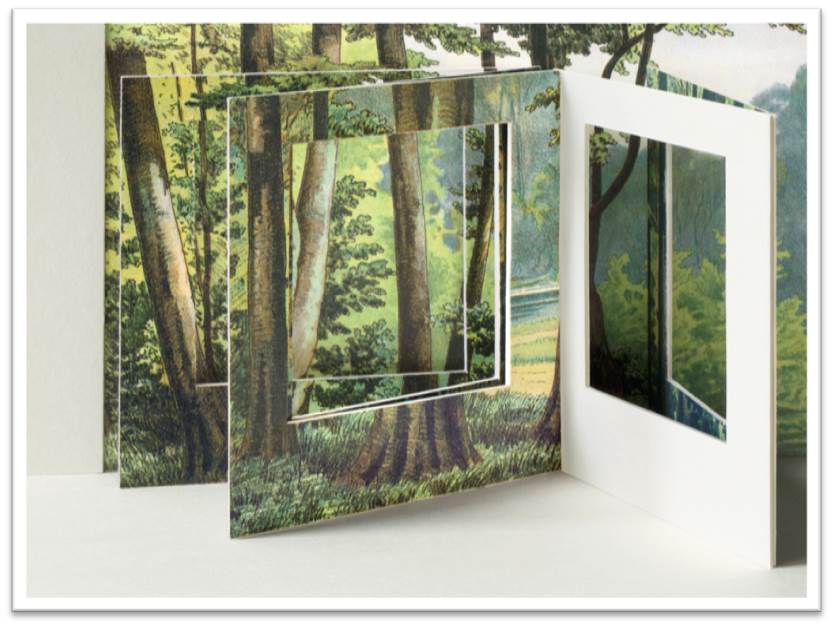
A perfect case in point are the photo-based prints of Miriam Bohm, one of four artists showcased in this year’s Rudin Prize for Emerging Photographers, a biennial competition/exhibition at the Norton Museum of Art. Based in Germany, Bohm creates geometric abstract art from photographic material, a deceptive process achieved by photographing arrangements of patterns, printing these photographs, and integrating the prints into the original photos—a process of doubling and redoubling.
The result is that in works like her “Prospect” series—Numbers I, II and III of which hang at the Norton—rectangles float within rectangles and create the illusion of movement. Stare at them long enough, and the shapes will seem to float toward you, without the need for 3D glasses. This art is alive. And it’s amazing.
Bohm is competing against three photo-artists—I hesitate to use the word “photographers,” because their work stretches so far beyond traditional camerawork—whose art, in their own ways, is just as boundary-pushing. This also means their art is just as challenging to encapsulate into a few words. But here is my best shot.

Rami Maymon, of Tel Aviv, is interested in the “residue” an image leaves behind, so it makes sense that his image of a pair of lovers, titled “Secret,” seems to be decaying a bit before our eyes, its subjects on the verge of evaporation. “Provenance” shows us the almost skeletal remnants of a close-up portrait, the husk of a headshot in haunting monochrome. His other works often involve photographs of photographs; indeed, the process of photographic reproduction is inherent in the final product, only the results are impermanent and ephemeral—fleeting glimpses of the ghosts in the machine.

Guatemala’s Renato Osoy is the most eclectic artist in this competition, with an oeuvre that encompasses textual art, video and photography. He also works large in scale; his Norton gallery contains only three pieces. “Mirroring Mirror” features side-by-side video screens of a young woman sitting across from herself; only in one of the videos, she’s sleeping and has a different hair style. Nothing happens, at least in the time I stared the piece; it’s a quiet meditation on individuality, functioning almost like a couple of human still-lifes.
Osoy’s most impressive work is “Archival Iterations, Identity Variations,” a collection of 140 digital inkjet portraits placed in neat rows. The faces, always resting above military uniforms, look familiar at first, but each one has been cut into 11 separate parts and then reassembled like a puzzle. The process of this reassembly was deliberately sloppy; on close inspection, the sitters’ eyes and lips don’t line up. These are everyday images rendered askew, each one a glitch in the matrix, and the piece is an illuminating commentary on the way our brains fill in, and normalize, these off-kilter images.

Finally, Brooklyn’s Delphine Fuwundu is the most conventionally photographic of these renegade photographers, and her connection to the viewer is the most immediate. A longtime chronicler of hip-hop culture and black female identity, Fawundu’s Rudin Prize selections were shot in West Africa, where women sit on couches alongside busts of Chairman Mao, or carry produce on their heads, or peek mysteriously through flowing laundry sheets. In all of them, they are aware of the camera, gazing directly at us, implicating us as privileged voyeurs of their exotic, developing world. In some ways, her shots look like they could have originated in her hometown; the subjects in her “Africa Hip-Hop” series share clothing, bling, hair styles and hand gestures with American hip-hop devotees, finding inevitable western assimilation in a far-flung region.
These four artists are often miles apart in their approach to the photographic image, but each of them clearly resides on the frontier of the medium, helping to expand our horizons and make the inexplicable possible. The winner of the competition will be announced Dec. 1; as far as I can tell, it’s anybody’s to win.
“The Rudin Prize” runs through Jan. 11 at Norton Museum of Art, 1451 S. Olive Ave., West Palm Beach. Admission costs $5-$12. Call 561/832-5196 or visit Norton.org.