
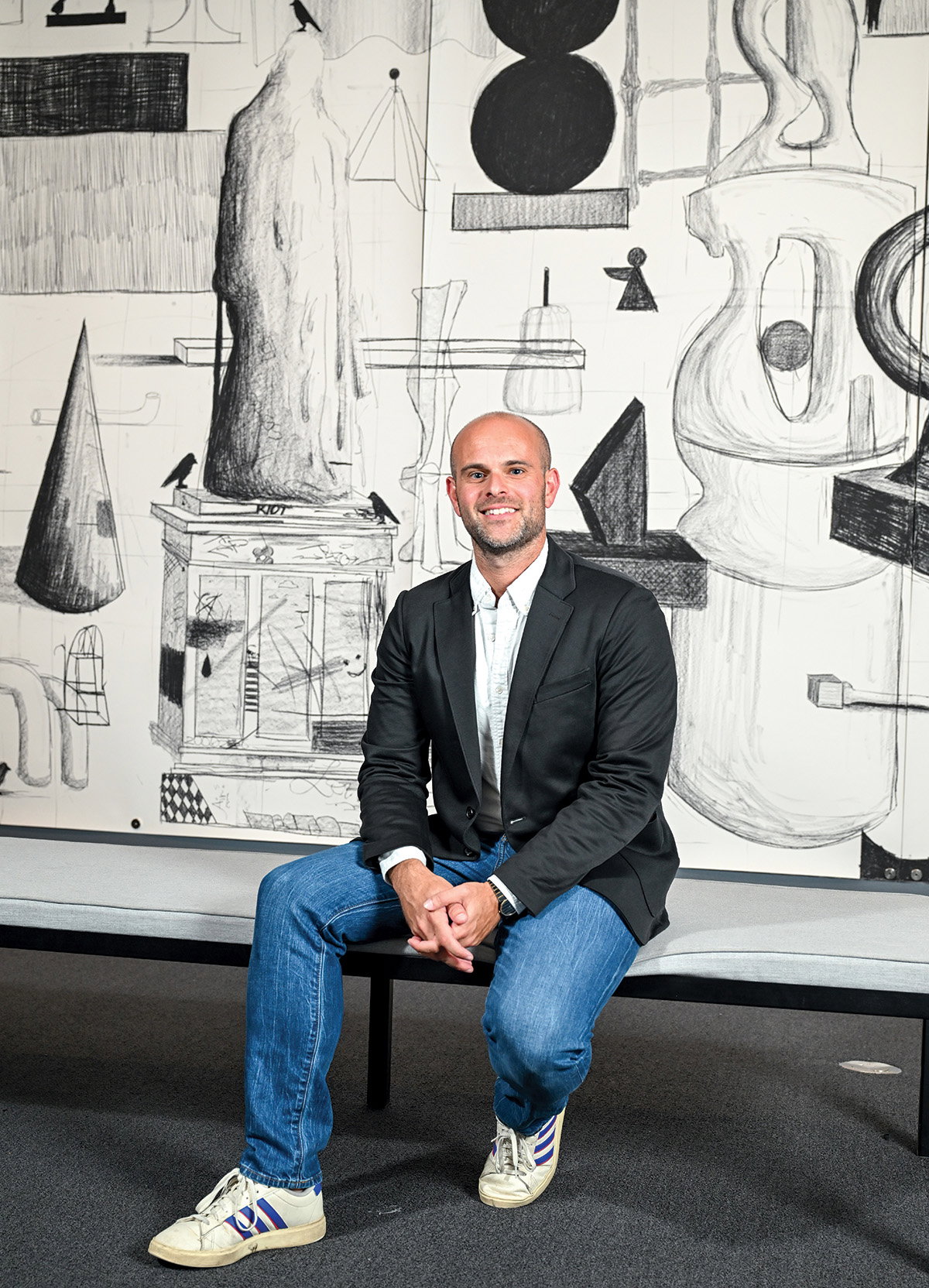
Ross Karlan’s interest in the arts germinated early in life, thanks in part to the family business. “My dad owned a small arthouse movie theater in Connecticut where I grew up,” he recalls. “I used to watch them splice the film and make the popcorn. I grew up with that Hollywood fantasy, and that sent me deep into the rabbit hole of cult cinema.”
He would go on to write his undergraduate thesis at the University of Pennsylvania on the work of the great surrealist filmmaker David Lynch, a passion project that surfaced more recently in his day job as a visual art curator. “Because I have these weird passions—classic Hollywood and Brazilian modernism and contemporary Cuban art—I’m able to invite people into that world I’ve created for myself that creates this entire community of hundreds of artists that I then have the opportunity to come in contact with,” Karlan says.
Karlan’s circle of influence grew wider this past January, when he was appointed the first curator-at-large of the Boca Raton Museum of Art. In the role, which is external to the museum’s in-house curatorial team, Karlan serves as its “boots on the ground in the South Florida arts scene,” as he puts it, scouting for contemporary-art talent at museums, galleries, artists’ studios, and collectors’ homes from Miami to Palm Beach. Ena Heller, the Boca Museum’s director and CEO, has jokingly referred to Karlan as its “consigliere.”
Fluent in Spanish and Portuguese, Karlan earned his master’s degree and his PhD in Hispanic Literature and Cultural Studies at Georgetown University—a seemingly unusual degree for a modern art curator, but as he shares with Boca magazine, one that serves him well in South Florida’s polyglot art world. He has been instrumental in securing the first solo museum exhibition of longtime Miami modernist Typoe Gran, “Anatomy of a Practice” (running through Oct. 11), as well as the second-ever U.S. museum survey of the groundbreaking West African artist Frédéric Bruly Bouabré (running through Oct. 18).
Karlan will continue to focus on art from unsung masters working off the beaten path. His future Boca Museum exhibitions include the first U.S. exhibition of octogenarian Brazilian artist Maria Lira Marques, whose work is rooted in natural mud pigments from her country’s environmentally ravaged Jequitinhonha Valley.
What excites you about the Boca Museum?
In the grand scheme of South Florida, this museum is in this perfect moment to come out with amazing opportunities and shows. It’s geographically between West Palm and Miami. It doesn’t have to balance some of the things that other institutions have to balance; we’re not fighting the tourism market as much as something like the Bass Museum of Art [in Miami Beach] might be. There’s an opportunity, with Ena’s leadership, of a hard reset—a new curatorial eye, a new directorial eye. There’s a new demographic coming to Boca of younger people and families who want this community space.
How does your degree in Hispanic Cultural Studies help in your curatorial work?
I did cultural studies as the great equalizer. … It’s totally random, but it actually gives me a ton of groundwork to understanding the history of what’s happening in this transatlantic world. Working in Miami with artists from all across Latin America, the Caribbean, Brazil, the southern United States, and a little bit of that European and African influence actually ends up being this really cool petri dish of everything I’ve worked to study over the last 400 or 500 years of global history. Some of it I use as a launch point, even with conversations with artists. … It is a weird degree, but it has a domino effect.
Are the artists you meet aware of this museum, or is it a discovery for them?
It’s been interesting. I have found that some international artists have heard of it because of the reputation of Boca Raton: “Oh, isn’t that where people retire in Florida?” [laughs] But then it actually means that there is an association, [and they learn] that it’s great that there’s a museum here.
How does your own taste inform what you would decide to bring here?
A friend in grad school would always say, “you’re inviting someone into your house, and no one knows your house better than you.” I can really speak to what’s in my house, and what I know, and what I’ve studied … whether it’s regional or social dialogues or random literary or film references.
The more you learn, is your “house” getting bigger?
Totally. Every day that I open my computer or walk into a gallery, if there’s something that hits, you have to add a wing to the house.
This story is from the September/October 2026 issue of Boca magazine. For more like this, click here to subscribe to the magazine.