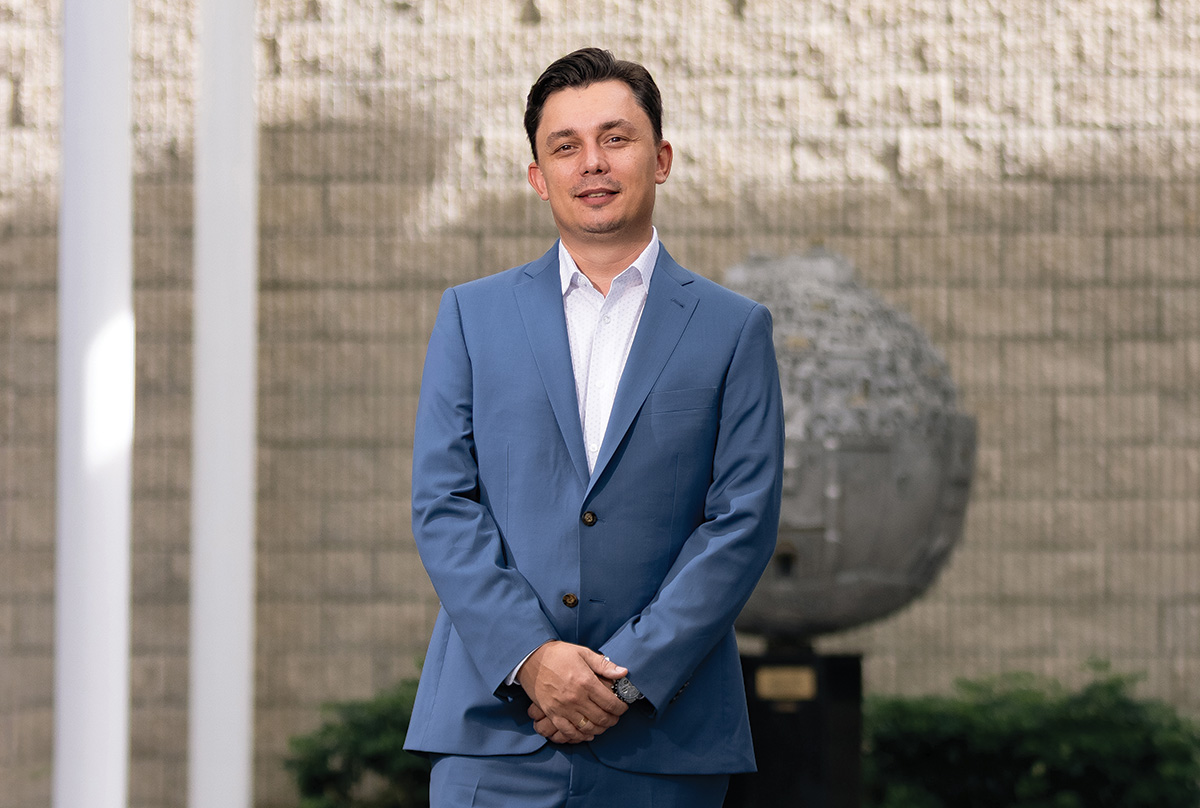
Igor Alterman just couldn’t quit South Florida.
From 2022 to early 2025, the nonprofit executive spent three fruitful years as president and CEO of the Jewish Federation of Greater Dallas—a momentous period in which he broke fundraising campaigns, enhanced the organization’s digital footprint, and rallied the Jewish community in the aftermath of Oct. 7, 2023. But Alterman, who had spent seven years prior as the executive director, and ultimately CEO, of University of Miami Hillel, couldn’t ignore the siren call of the Sunshine State. So when a recent leadership opportunity arose at the Jewish Federation of South Palm Beach County, he didn’t hesitate to apply.
His family “just loves South Florida,” he says. “There are certain things that you miss when you move from one location to another, and those are the ones that are intangible. It’s even the humidity on the street that kind of wraps you around it. It’s the radio ads that you hear. It’s the things you cannot buy. So we knew that eventually we would like to make our way back to what we now call home, and for us, that’s South Florida.”
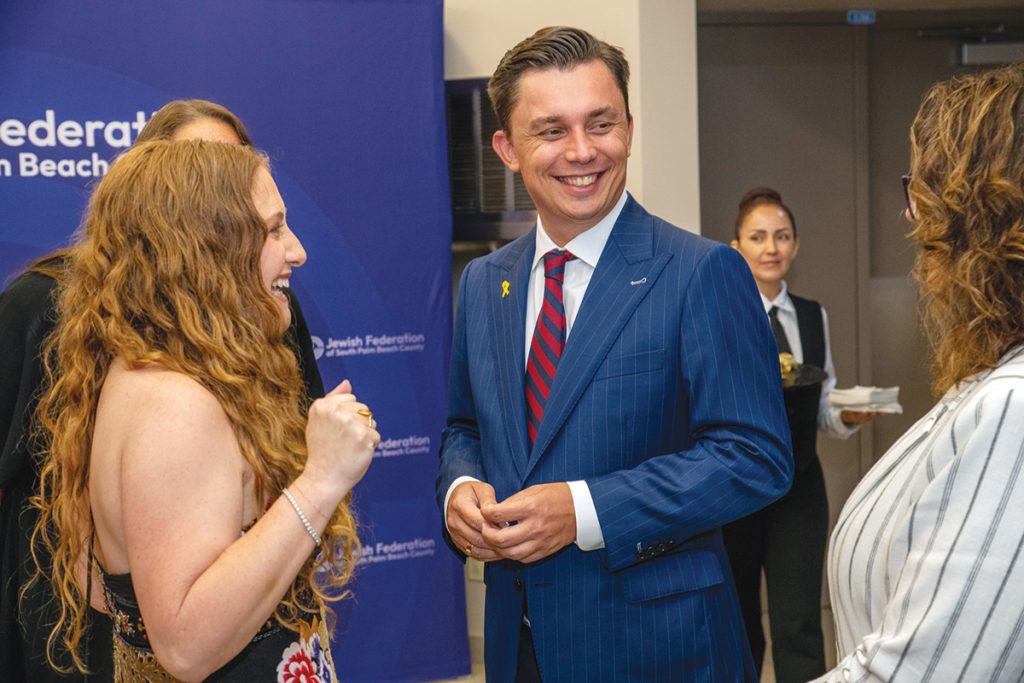
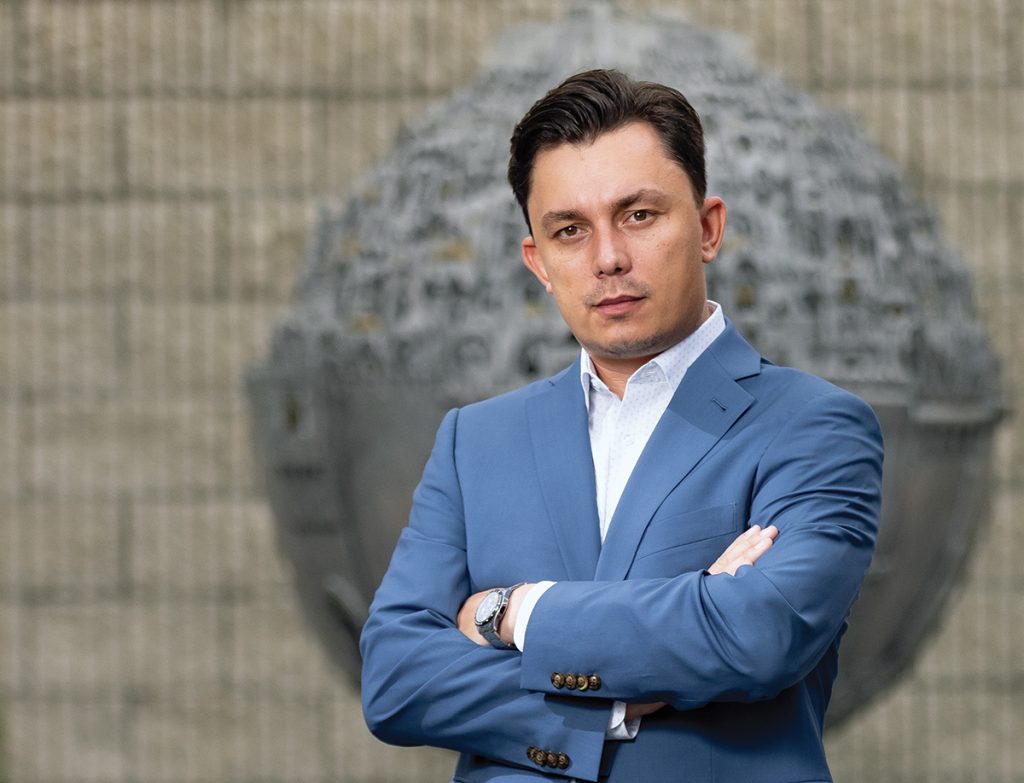
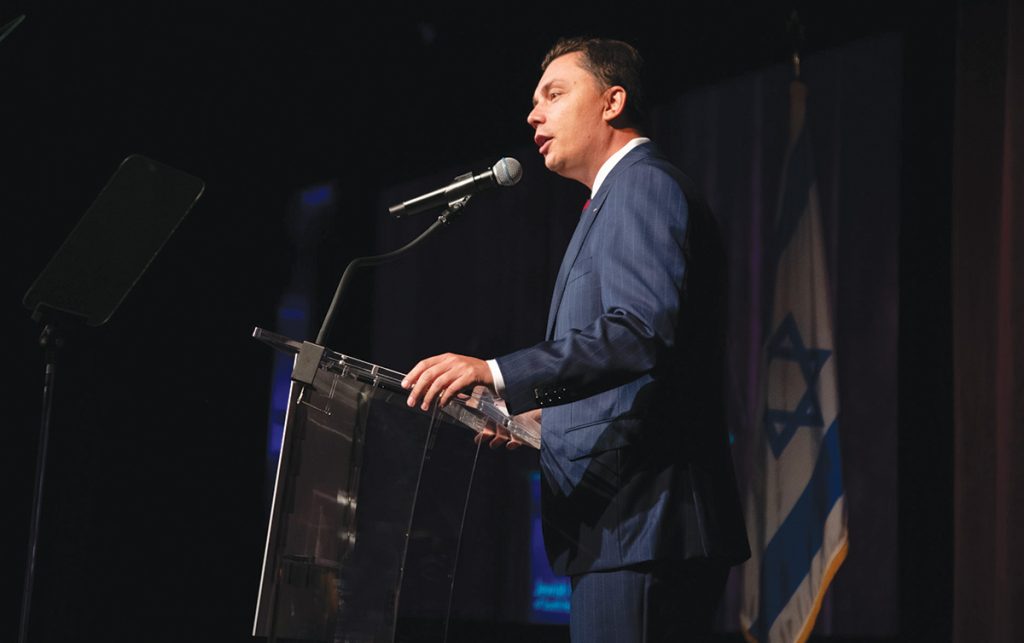
This past February, Alterman began his tenure at the largest Jewish campus in North America. The Federation’s 100 acres support an ecosystem that hosts three schools, the Levis Jewish Community Center, the Jewish Association for Residential Care, Ruth and Norman Rales Jacobson Food Pantry and more. No other Jewish Federation branch, Alterman says, offers so much service and support under one umbrella, which is why he refers to the Federation as “the central address for Jewish life in the Greater Boca Raton area.” In this interview with Boca magazine, he shares his story, reflects on the Federation’s role in the community, and addresses issues affecting Judaism here and abroad.
What was your earliest memory of being Jewish?
I was born and raised in the Soviet Union in the early ‘80s, and then raised in the former Soviet Union and Russia. And to be frank with you, my earliest memory of being Jewish was a negative one. I was probably in early middle school. My parents, at the time, changed our last name, which you know me under Alterman, to a much more Russian-sounding last name to protect me and my sister from a very institutionalized and deep antisemitism that has been present there. And I started getting bullied for being Jewish. And I learned that my father did not get a job that he was supposed to get because of his ancestry. So that was my first exposure to Jewish life. Similarly to many Russian Jewish families, we tried to lower our profile. And then later on, I got involved when I was in high school and early years of college, and that became a much more positive experience.
So your family was culturally Jewish more than faith-based?
Definitely culturally Jewish—very much assimilated as a family. I knew that my great-grandparents spoke Yiddish. I knew that the names of my grandparents sounded Jewish. So we knew that that was a part of our culture and our tradition, but it was very much diluted by the oppressive and dictatorial regime of the Soviets.
What led you to ultimately running Jewish Federations?
My now wife, then girlfriend, got me involved with Jewish life in our hometown, the city of Bryansk, Russia. I became involved with Hillel, which is the largest Jewish student organization in the world, and it had a chapter in our hometown. And as I got involved, that’s where it was a much more positive experience, because it was a chance for me to get involved and learn and understand what Judaism actually means.
I then studied in Israel. Then I got my master’s degree in New York City … in Jewish Education and Jewish Nonprofit Management. And with that background, there are different routes that you can go, but predominantly you run Jewish nonprofits.
My first step here in America was to work at Cornell Hillel. I then spent 12 years at different Hillels around the country, and most recently, before moving to Dallas, it was eight years at the University of Miami Hillel, where … we tried to create a model which would serve as a magnet for Jewish engagement in a denselypopulated Jewish area to make sure that our impact far exceeded the boundaries of Coral Gables as a campus.
After eight years there, I was thinking about my next steps. And in our world, there are only so many directions we can choose, and Federations were one of them. And it just so happened that Dallas was searching for a new executive director. Dallas was rapidly changing; similarly to South Florida, it’s growing by leaps and bounds. People are moving there, and they wanted to bring their Federation into the 21st century. So they needed somebody who could facilitate that change. And I agreed to do that.
The experience that I got there, the opportunity, the understanding of the system, the impact of its work, were invaluable. But when I saw that this position opened [in Boca Raton], and that the parameters of what they were looking for matched my interests, we knew immediately that that would be something we would pursue
What role does the Federation play in the local Jewish community?
Federation is a central convener on behalf of the Jewish community. We are like the beating heart—the central nerve that works on the benefit of the entire community, agnostic of people’s personal choices. They can be secular, they can be Orthodox, they can be reform. They can be religious, they can be cultural, they can be whatever they want to be and find themselves on the spectrum if they identify or support diversity, inclusion and Jewish life.
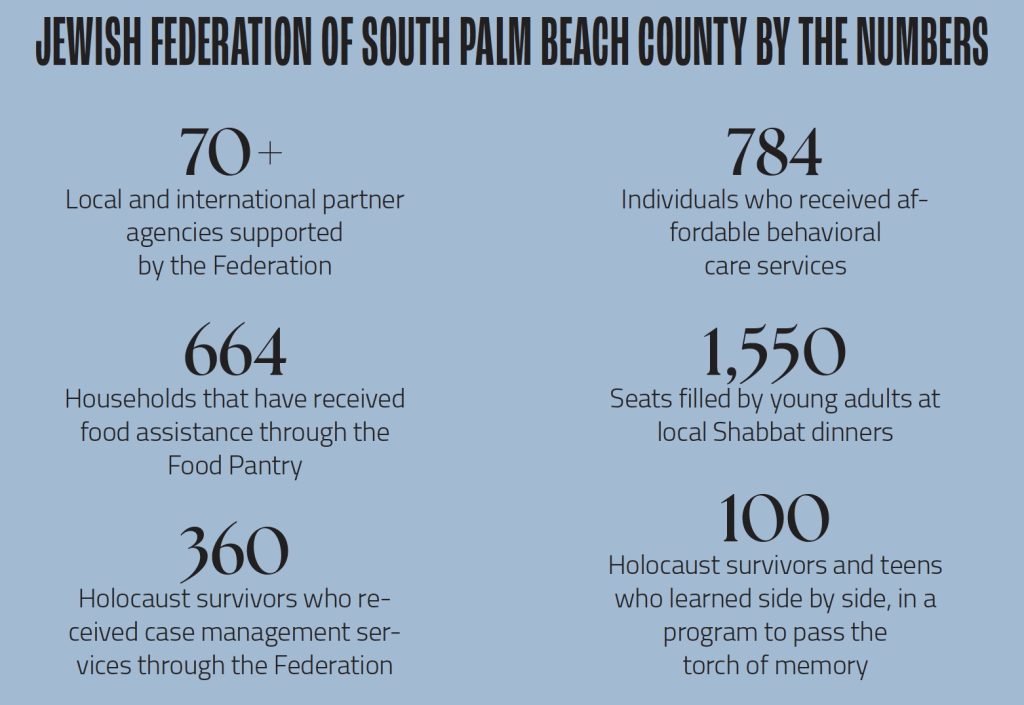
I’ll give you a few examples. We are very fortunate in South Florida to have very strong Jewish education. So Federation offers tuition assistance to parents that want to send their children to Jewish day schools, or Jewish summer camps, sleepaway camps or JCCs. Federation invests. We’re one of the largest nonprofits in the area. On an annual basis, we invest millions of dollars, and that’s not an exaggeration, into the local community. We truly, truly believe that in order for us to be a good citizen of the community, we need to look at the community as a whole. So when we invest, for example, in Jewish Family Services with our annual allocations, their work far exceeds the Jewish community. As a matter of fact, in certain areas of their work, most of their clients are not Jewish, and we are proud to support their work. The same goes for the JCCs and other very small and large nonprofits, synagogues, summer camps and university campuses who work deeply with FAU. We support some of the colleges outside of our primary catchment area that are in Florida.
We also see ourselves as a concierge in a way. So if you’re a young family or if you’re just moving to the area, we want to help you. We want to hook you up with the Realtors, the doctors, the lawyers, whatever you may need, so that there is a funnel, and we are that place for you to feel a part of the community.
Did you find the Boca Raton Jewish infrastructure to be more ingrained than it was in Dallas?
To clarify, we are working in Delray/Highland Beach as well. South Palm Beach County is our primary catchment area. But truly, we are the Jewish broker. This is who we are. This is where the core of our community lives. This is where the infrastructure, as you refer to it, is. We are one of the largest Jewish communities in the country, which means, realistically, in the world—in North America, at least. And I would say that we’re very blessed with the fact that we see a lot of people migrating to South Florida. Many of them are Jewish, specifically because of the existing infrastructure. We have education, we have synagogues. We have opportunities for individuals that require special attention, whether this is mental health or special needs. We have highly rated senior living facilities, Sinai Residences being one of them, which the Federation has built on behalf of the community. So this is unparalleled.
Shifting to some of the issues affecting Judaism, Boca Raton has not been immune from rising antisemitic incidents in recent years. Where is the Boca Jewish community now in terms of antisemitic threats? How safe do our residents feel?
This is a very important subject. It’s not the one to take lightly, and we know it. In the past years, the Jewish community in North America is spending close to $800 million on security. It’s close to a billion bucks that is spent on protecting the community from hate. We can only imagine what this money could do if it were sent to the social services, education, culture, etc.
Antisemitism is very real. Antisemitism is ugly, and unfortunately, you can only learn things through your lived experiences. And I was born and raised in a country where it was institutionalized—where antisemitism was synonymous with the government, synonymous with the streets, synonymous with the town square. We cannot allow for that to happen in America. It has been, for decades, immune to it, or at least it took it very seriously. And unfortunately, right now, what we see statistically [is the] FBI just came out with their annual report, and it’s clear that Jews—just 2% of the American population—are the most targeted minority in this country, period.
There is a perception of safety, and then there is actual safety. We work day and night with law enforcement. Whether it’s the Palm Beach County Sheriff’s Office, which is amazing, our federal partners and our local partners, we have developed a full security arm within Federation to ensure that each and every Jewish nonprofit, and there are about 60 of them locally here within our specific catchment, are provided with security assessments. We advocate for FEMA security grants, which we are very successful at getting. We brought in over $1.5 million last year to harden the security in the agencies. We are providing our own allocations to make sure they are able to get cameras, they’re able to get staff, they’re able to get software licenses that will allow them to be safer.
I’m knocking on wood here, but compared to some other parts of the country, South Florida is definitely a much more welcoming environment for the Jewish community. But we have to be absolutely alert and vigilant as it comes to security, because it’s not something to take lightly.
In terms of combating it, I don’t know if re-education is the right word, but taking people that have these beliefs and transforming them … is that something that’s on the table?
We’ve been deeply invested in Holocaust education—in proactive work on campuses or high schools or middle schools or elementary schools, even. Our partners at ADL have No Place For Hate, a program that is national. There is an organization that we fund called inSIGHT, and it works with the Palm Beach County School District. They are deeply, deeply involved with Holocaust education, but it spills over into other forms of hate and where it can lead to. We are taking educators to Poland on a version of March of the Living; we are showing them the concentration camps and what transpired, with an opportunity to travel to Israel afterwards.
So we are deeply engaged in ways of educating the community, on different levels, on the dangers of antisemitism. But I will also admit I think we are in a crisis, because many people are trying to whitewash antisemitism with their own definitions that suit their political needs, and that leads us to a very challenging place where the community feels unsafe, and we see a deep, deep rise of antisemitism that currently is masqueraded by anti-Zionism. Because somehow it became acceptable to substitute and call yourself an anti-Zionist, but essentially spew out hate against the Jewish community.
You mentioned the Holocaust. There are commentators with audiences in the millions who are platforming Holocaust denialism or even just Holocaust skepticism. Did you ever think you’d see a time when Holocaust skepticism was not the third rail that it used to be?
No. I think revisionism in general is a huge issue. Social media is a massive problem. And I think the federal government has to take responsibility on ensuring that the benefits of social media exist, but there need to be also standards that those companies should be held accountable for. For the first time in generations, American Jews are feeling uncomfortable—are feeling that things have changed as it relates to the social contract between the Jewish community and the society at large. There has been a dramatic shift, in whether it is domestic terrorism, or whether there are influences that are brought from outside. But we have to be vigilant in making sure that no hate puts root in our society. Because unfortunately, as we all know, Jews are usually the canary in the coal mine, and what we’re seeing around is truly, truly alarming.
Regarding Israel’s military campaign in Gaza, where does the local Jewish community in South Palm Beach County stand, and where does the Federation stand?
We are a Zionist community that proudly stands with Israel, with empathy to everyone who fell victim of the senseless violence caused by Hamas on October 7, and the events that followed the attack. Federation takes a stand that all hostages need to be brought back home. This was an uncalled, barbaric invasion of a country.
We certainly are mindful of the results, and no human life should ever be lost for no reason. I think that we got to a point in this environment where everything is so binary. You have to be either pro this or anti that. You can be pro-Israel and pro-Palestinian in the sense that no innocent victim should ever be murdered. We are deeply heartbroken for the situation that is unfolding in the Middle East. At the same time, we’re very clear of the responsibility that is on Hamas for the actions that have happened. They should disarm. They should release the hostages. And every effort should be put by the international community to ensure that the civilians in Gaza and other regions in the Middle East are supported.
Where should the Jewish community in Boca and elsewhere take hope right now?
In the incredible resilience of the Jewish people—their ingenuity and commitment to life. We say “L’Chaim” when there is a toast. We pray for Jerusalem and peace in the world every Friday night. So I would say that the incredible notion of peoplehood and interconnectedness between the Jewish people is something that we can definitely believe, learn from and truly support.
This story is from the November/December 2025 issue of Boca magazine. For more like this, click here to subscribe to the magazine.