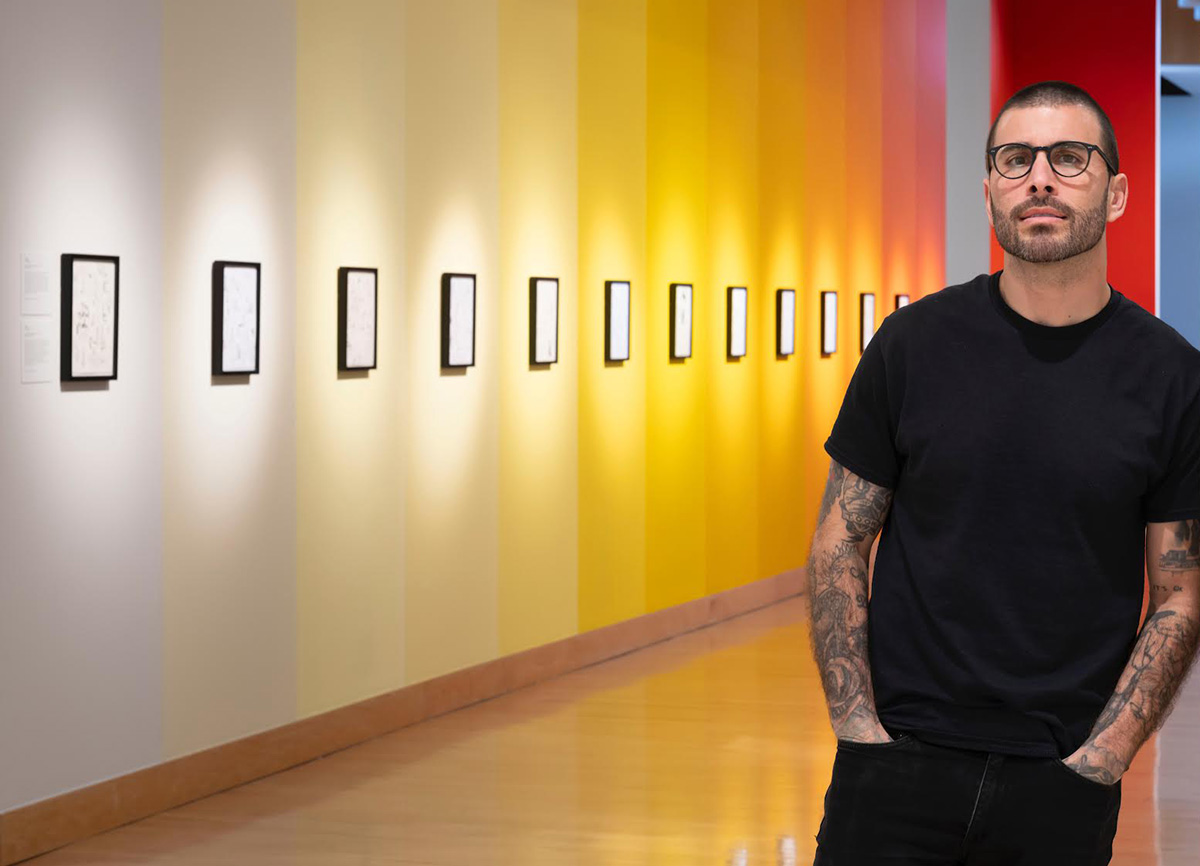
The more you look, the more you see. It sounds like a simple enough objective when viewing contemporary art, but it takes a maximalist masterpiece like TYPOE GRAN’s Eden to put into perspective how comparatively infrequently this desire is met. I could spend an hour immersing myself in the hieroglyphic symbolism of just this work alone, which opens the Boca Raton Museum of Art’s TYPOE GRAN showcase, “Anatomy of a Practice” (running through Oct. 11).
Staring at the work on a computer screen, which was my only access to the colored-pencil drawing prior to the visiting the museum, does not do it justice. There’s simply an abundance of there there. A cursory glance suggests a motely children’s playground scattered on a bright green lawn, complete with playful blocks in Crayola hues, their three-dimensional shapes flatly placed on a two-dimensional canvas.
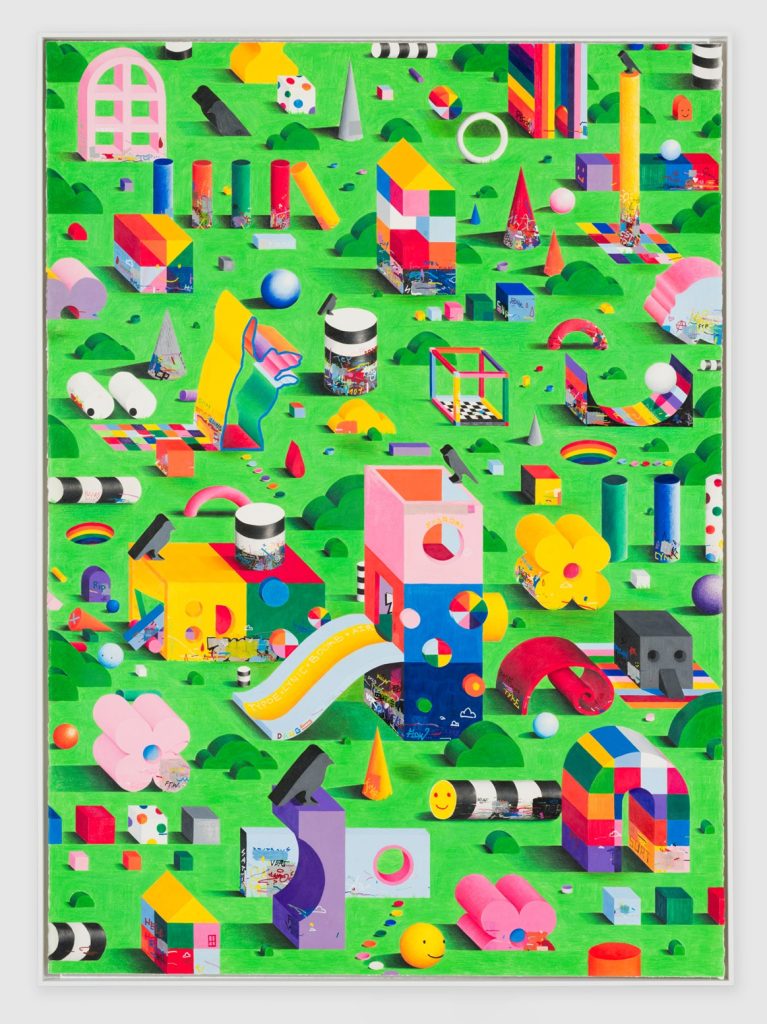
Look closer at Eden, though, and you’ll notice signs of decay, neglect, even death—graffitied objects, overgrown weeds, a raven, a tombstone—that bely the work’s surface cheeriness. The piece, visitors will discover, is classic TYPOE, reveling in tensions between nature and civilization, and between the innocence of childhood and the more complicated realities of adulthood. It also seems to represent the final salvo of a certain vibrant period for this longtime Miami artist, whose large-scale murals have been shown at venues ranging from the Miami Brightline station to the Artis campus in Naples to the Pop District and Andy Warhol Museum in Pittsburgh. Like Warhol, TYPOE favored bold, bright colors in the tradition of Pop art.
But since suffering an injury that required multiple surgeries over a 10-year period and limited his ability to work with his hands—a challenge that led him to work with art fabricators—his most recent work, which constitutes “Anatomy of a Practice,” has taken a starker direction, one largely bleached of the sleek design and neon hues of his earlier mixed-media works. Turn the corner from Eden, and the next TYPOE piece shown in the museum’s gallery is titled I Am Death and Death is Me, a self-portrait in clay and cement in which the artist’s unrecognizable face is contorted into a shape recalling Munch’s The Scream. This version of TYPOE is white as a ghost, his visage complemented by doodles around the periphery, including a child’s drawing of a house, an hourglass, a cube, and a flower.
The more of TYPOE’s recent oeuvre you explore, the more you’ll be able to decode ciphers such as these, because just as in the corpus of other street artists, such as Basquiat and Banksy, recurring images link each individual piece into a greater worldview. By titling this meta exhibition—his first solo show in the U.S.—“Anatomy of a Practice,” TYPOE is essentially pulling back the curtain on his process and the visual preoccupations that add up to a semiotic language.
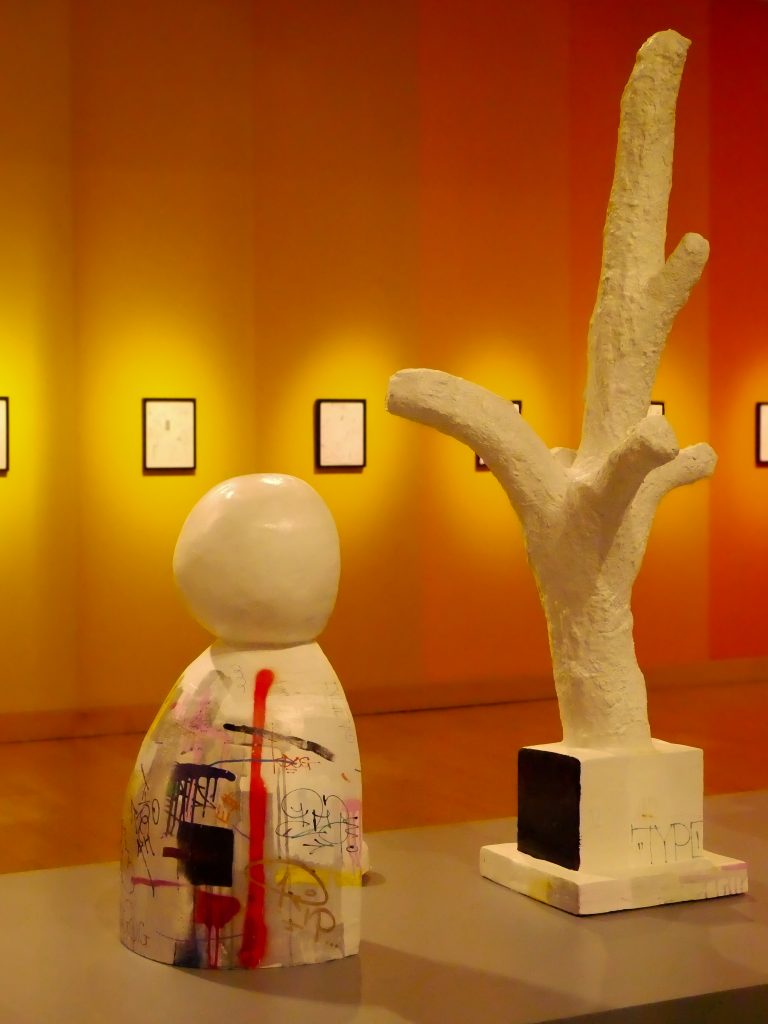
If this sounds like a cerebral undertaking for the spectator, fear not: “Anatomy of a Practice” is multilayered, but it retains the visual pleasures inherent in all of TYPOE’s work. It’s an enjoyable visit whose centerpiece works are likely to stagger even those who enter the exhibit free of context. Landscape (A Meditation on World Building) features an array of sculptures presented on a stand, like a police lineup of oddities from the Star Wars cantina scene, from small pawnlike figures to contorted cubist visions of trees and bones to a little vehicle called a “Death Machine” that has a smiley face for a wheel. Look closely at the doodles that restlessly adorn the clay sculptures, and you may notice a crown, perhaps a sly nod to Basquiat.
On a nearby canvas such as Empty Heaven—an ironic title, given the cluttered nature of its contents—TYPOE’s unusual shapes approximate common vessels, but not quite: One is almost a vase, another almost a sundial. But in these Rube Goldberg creations, their purposelessness, their afunctionality, feels like the point. It’s like peering into an alternate dimension where the atoms that created our familiar and coherent concrete objects came together askew.
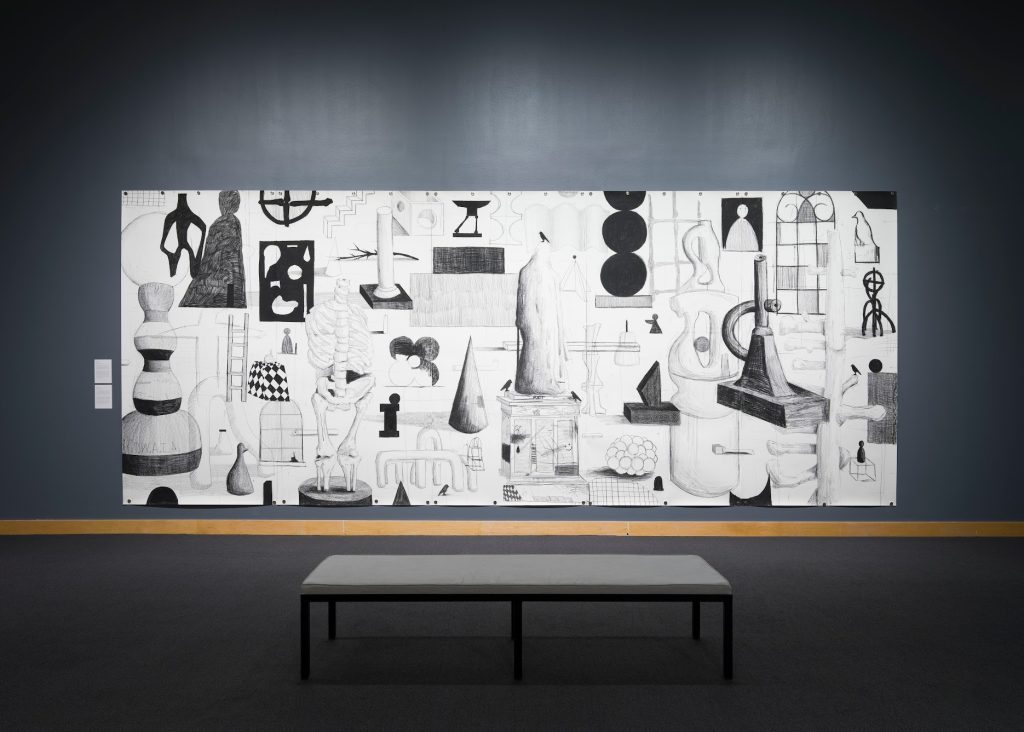
The enormous canvas The World as I Am may well be the best example of ur-TYPOE: a visual autobiographical tour through his subconscious—from a jumbo skeleton to an omnipresent raven to an Escheresque staircase to nowhere—playfully confounding our sense of scale and perspective.
And so it goes for the rest of this exhibition. Whether miniature or massive, flat or sculpted, TYPOE’s art is consistent in its eccentricity, his imagination often running amok but somehow finding its way back to visual baselines, like anchors in a recurring dream. Having admired images of TYPOE’s work in the past, I expected more color and whimsy in his solo museum debut. Instead, we get to swim in his mostly black-and-white id, where the water remains surprisingly warm and inviting.
TYPOE GRAN: “Anatomy of a Practice” runs through Oct. 11 at Boca Raton Museum of Art, 501 Plaza Real, Boca Raton. Admission is $16 adults and $12 seniors. Call 561/392-2500 or visit bocamuseum.org.
For more of Boca magazine’s arts and entertainment coverage, click here.