It’s a familiar place, this jury room in Palm Beach Dramaworks’ visceral production of “Twelve Angry Men.” Familiar because, yes, if you’ve reviewed theatre for enough years as I have, you’ve seen the show before; last night was my fourth experiment with playwright Reginald Rose’s compassionate paean to the American justice system.
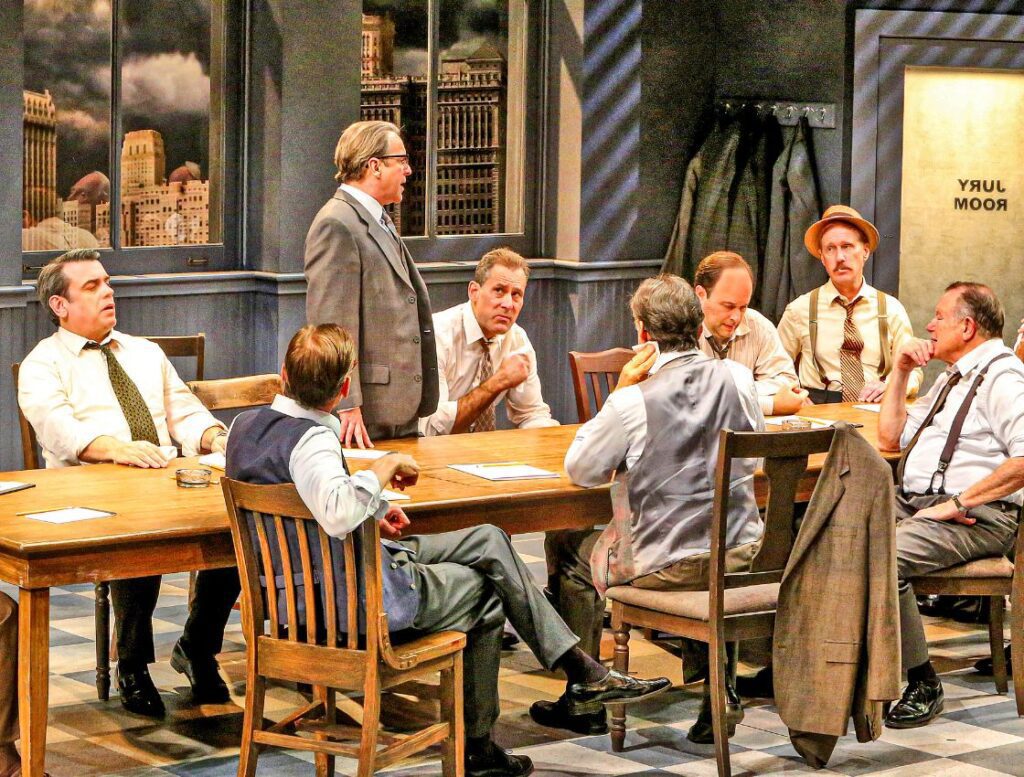
But the scenic design, by Viktor A. Becker, also exudes the lived-in quality that defines so many Dramaworks sets. I’ve never been inside a jury room, let alone a jury room in New York City in 1954, but I have no reason to doubt the accuracy of Becker’s perfectly nondescript space, with its dingy particulars: water cooler, restroom, broken fan, and three overhead lighting fixtures that, in a wonderful detail, include one burned-out bulb. The faded tile floors could use a wash, if not a complete remodel. The wooden chairs look uncomfortable, hard—as hard as most of the men sitting in them. For 12 people, the quarters are tight, even claustrophobic.
In short, it’s a place nobody would want to spend a sweltering afternoon with a bunch of irascible strangers, and as the play commences, the space begins to adopts a symbolic as well as literal function, somewhere between group therapy experiment and the existential prison of Sartre’s “No Exit.”
This is where the 12 jurors, white men in well-fitting suits and ties and representing a cross-section of class, age and temperament, will spend 110 uninterrupted minutes, as they decide the fate of a Black teenager being tried for the murder of his father. You probably know the plot’s basic contours, so I won’t belabor them here; suffice it to say that the case appears, at the play’s outset, to be an open-and-shut guilty verdict, with 11 jurors ready—some of them even eager—to convict. Only Juror No. 8 (Tom Wahl) expresses doubts, and he’ll spend the entirety of the show attempting to sway his fellow-jurors, while puncturing fresh holes in the prosecution.
Rose’s script has lost none of its punch, wit or resonance since its 1954 debut, but having seen enough rote renderings of “Twelve Angry Men,” I credit Dramaworks’ carefully chosen cast and creative team for this lacerating and enormously moving rendition. I’ve buried the lede long enough: This production will tower over the remainder of this theatre season as one of its crowning achievements.
The cast is populated by the region’s finest actors, all of whom embody their characters with depth and distinction—not an easy task given the inherent limitations of introducing 12 personalities at once. As Juror No. 11, an immigrant watchmaker, David Kwiat ultimately personifies the American ideal with an impassioned defense of democracy. Michael McKeever, in suspenders and bow tie, is spot-on as the meek and nebbish Juror No. 1.
We’ve seen Jim Ballard play many patrician men of privilege, but his turn here as a hunched-over, working-class joe is just as convincing. Gary Cadwallader’s Juror No. 4 is a master logician, the most effective mouthpiece for the prosecution, and unflappable until the very end, while Dennis Creaghan’s Juror No. 9 is folksy, plainspoken, patient—a man of few words but with insight to spare.
Then there are the ids. Because I’ve never seen Dramaworks Artistic Director Bill Hayes act before, his performance as the hotheaded Juror No. 3, whose opinions are informed less by the facts of the case than by his own fractured relationship with his son, is by definition a revelation. You can almost see steam piping from his ears for half the show, and his climactic breakdown brought me to tears, in a way no other production of “Twelve Angry Men” has, not even the Broadway tour.
The play’s other twin volcano, Rob Donohoe’s openly racist Juror No. 10, is one of Rose’s signature creations, and I went into the play bracing for the character’s bilious rant toward the end of the show. But I was unprepared for the disarming impact of it. Spewing hatred with lunatic abandon as he desperately searches the room for affirmation, Donohoe’s outburst is positively bone-chilling, a deep and unforgettable dive into the rotten heart of white supremacy.
J. Barry Lewis’ direction is masterful, all the more so for the challenges involved in staging a 13-character play. Whether fanning themselves, wiping down their faces, pacing the room, staring out the windows or making their ritual rounds to the bathroom and water cooler, every action is deliberate, precise, careful and revealing. Dialogue overlaps when it needs to for added verisimilitude, always capturing the cadences and tics of real life. And you may notice the extent to which the play’s founts of anger, Donohoe and Hayes, tend to naturally isolate themselves from the group, staking out pariah positions on the farthest corners of the stage—Lewis’ expression of their gradual rejection by their fellow-jurors.
The question of why to restage “Twelve Angry Men,” a well-ridden warhorse of the American theatre, during a Dramaworks season otherwise populated by works of a more recent vintage, will be answered once you see it. That answer, for me, is available between the lines of Donohoe’s harrowing monologue, and how frighteningly similar these words, written in 1954, jibe with some of the verbal diarrhea emitted by the previous occupant of the Oval Office. While “Twelve Angry Men” was in rehearsals, this former president hosted an avowed white supremacist and a virulent anti-Semite at Mar-a-Lago, a one-minute drive from Palm Beach Dramaworks.
“Twelve Angry Men” is not some museum piece about a less enlightened time. Dramaworks reminds us that this play, like much great literature, still captures the scariest tremors of the zeitgeist.
“Twelve Angry Men” runs through Dec. 29 at Palm Beach Dramaworks, 201 Clematis St., West Palm Beach. Tickets cost $84. Call 561/514-4042 or visit palmbeachdramaworks.org.
For more of Boca magazine’s arts and entertainment coverage, click here.