From alligator-eating snakes and venomous fish to poisonous toads and New Yorkers, Florida is the land of invasive species. Over the last century, creatures have swam, slithered, crawled—or, in many cases, been delivered—to the Sunshine State, wreaking untold havoc on our communities and native ecosystems. Many of these invasive species have no known natural predators, save for one: Us.
To learn more about some of the state’s top offenders, we tagged along with expert hunters to see how wildlife specialists are getting a handle on Florida’s invasive species epidemic.
Raising Cane
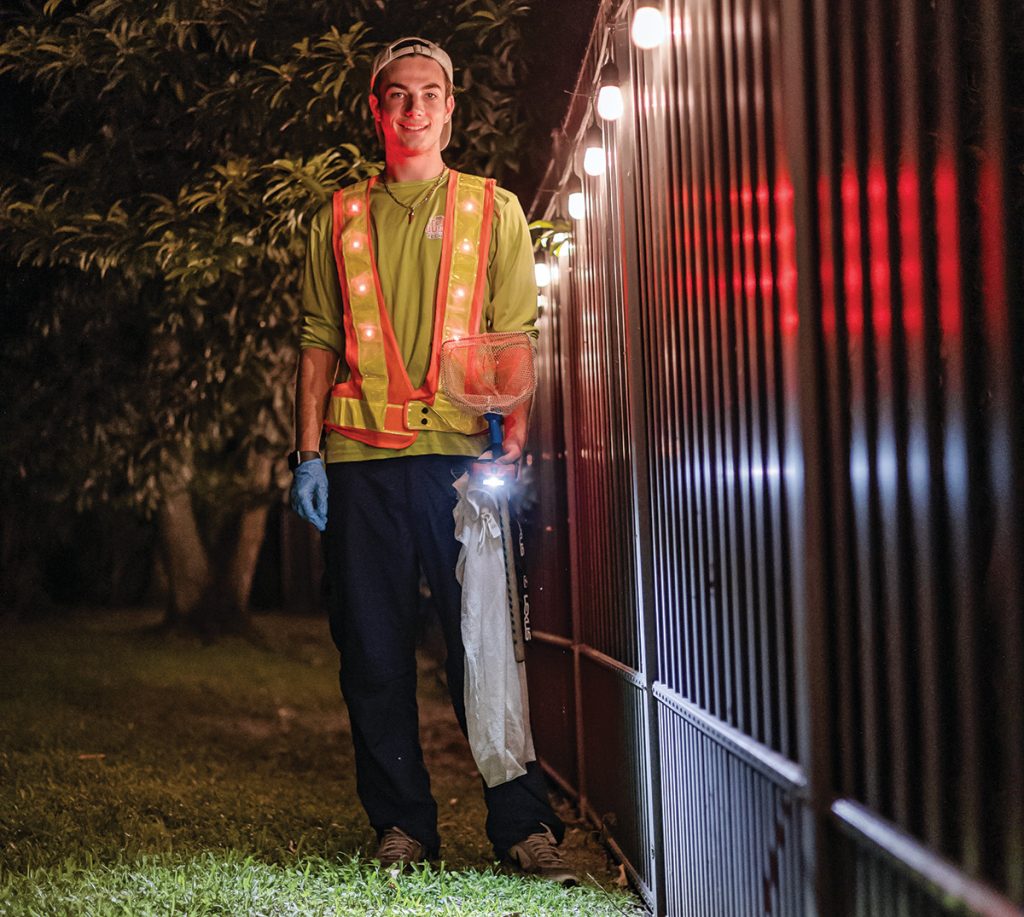
The first rule of hunting cane toads, Austin Tilford says, is you’ve got to have a good eye.
As we walk around a posh West Boca neighborhood, lit only by the occasional street lamp and porch light, Tilford stops five feet from a grassy roundabout. He slowly approaches, stoops and scoops up a greenhouse frog, the size of a thumbnail. “My eyes are just tuned for looking for toads and frogs,” he says, and places the frog back in the grass.
Tilford has been hunting cane toads for six years for Toad Busters, a company that specializes in exactly what the name suggests. I joined Tilford on a nighttime hunt, when the cane toads are most active. “At nighttime they come out to feed and breed, and that’s when we put a hurting on them,” says Tilford.
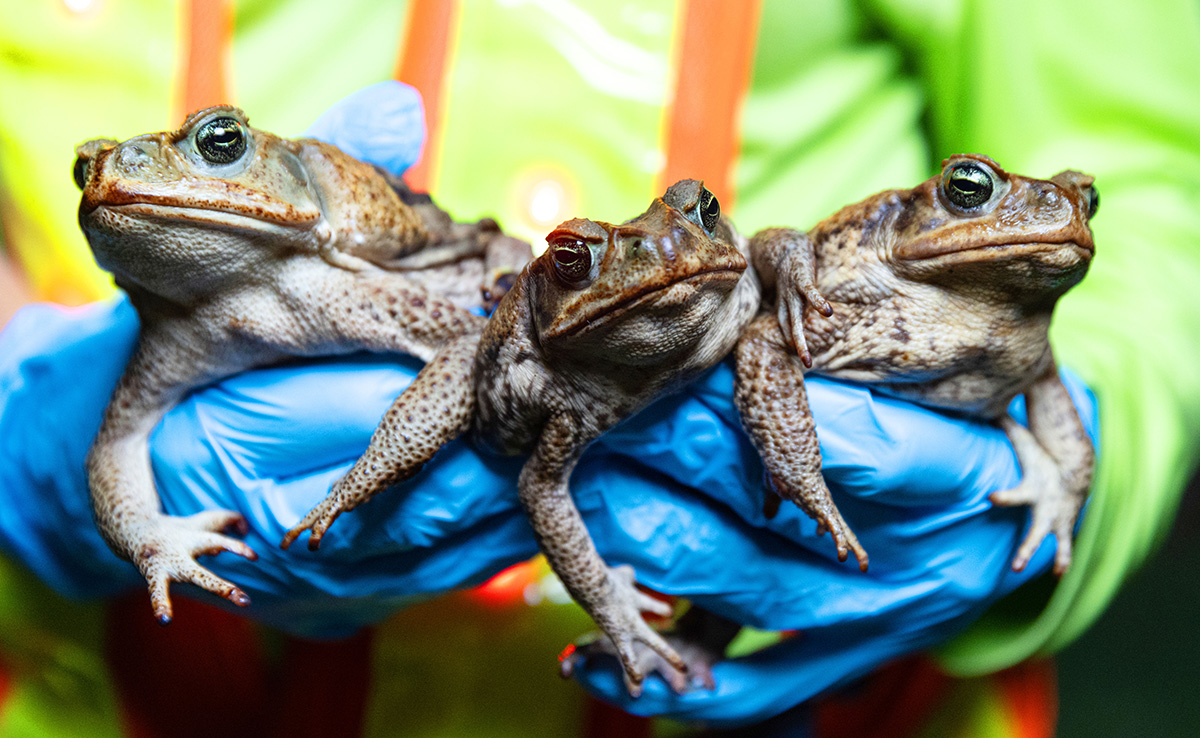
Cane toads, also known as bufo toads, were introduced in South Florida to prey on another invasive species, the cane beetle, that was wreaking havoc on sugarcane fields in the early 20th century. “Beetles climb stalks, and these toads are very ground-oriented, so it was kind of a giant failure,” says Tilford. “Next thing you know, they were eating everything else other than the beetles.”
For pets, an encounter with a bufo toad can be deadly—the toxin it secretes when threatened can kill a full-size dog in as little as 15 minutes. These stakes make the hunting of cane toads all the more important to Tilford.
“Our pets are everything to us,” he says. “We treat them like family. So when a traumatic experience like that happens, most people aren’t ready for their dog to be convulsing, seizing, vomiting and foaming from the mouth.”
With nothing to prey upon them, cane toads also pose an existential threat to native wildlife. “A lot of these areas that the bufo toads have now claimed used to have quite a lot of native species,” explains Tilford. “The bufo toads over-compete them for food and breeding opportunities, and it kind of butts the native species.”
The toads, which Tilford says he has seen grow as large as dinner plates, prey on anything they can fit their mouths around. “I actually have caught bufo toads eating the craziest things,” Tilford says. “I caught one eating a chicken bone, with no meat on it. It was eating just the bone, and it was the size of the toad.”
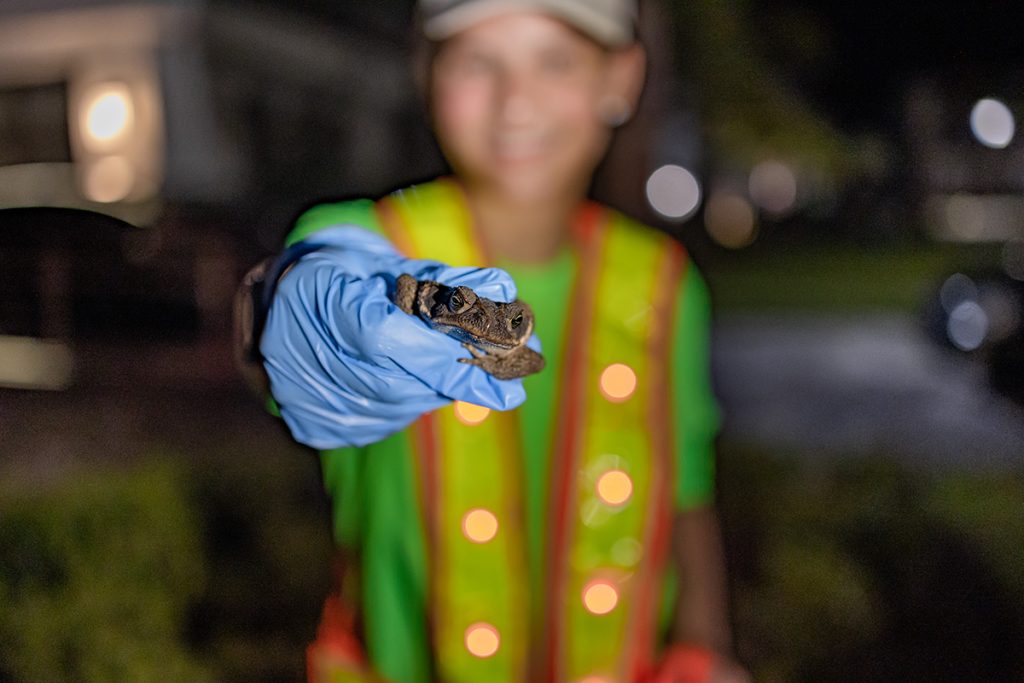
The removal of bufo toads is fairly low-tech; Tilford carries a netted bag and spots them using a high-lumen flashlight. To pick them up, he wears gloves that prevent the transmission of bufotoxin, which in the most extreme cases can result in death in humans.
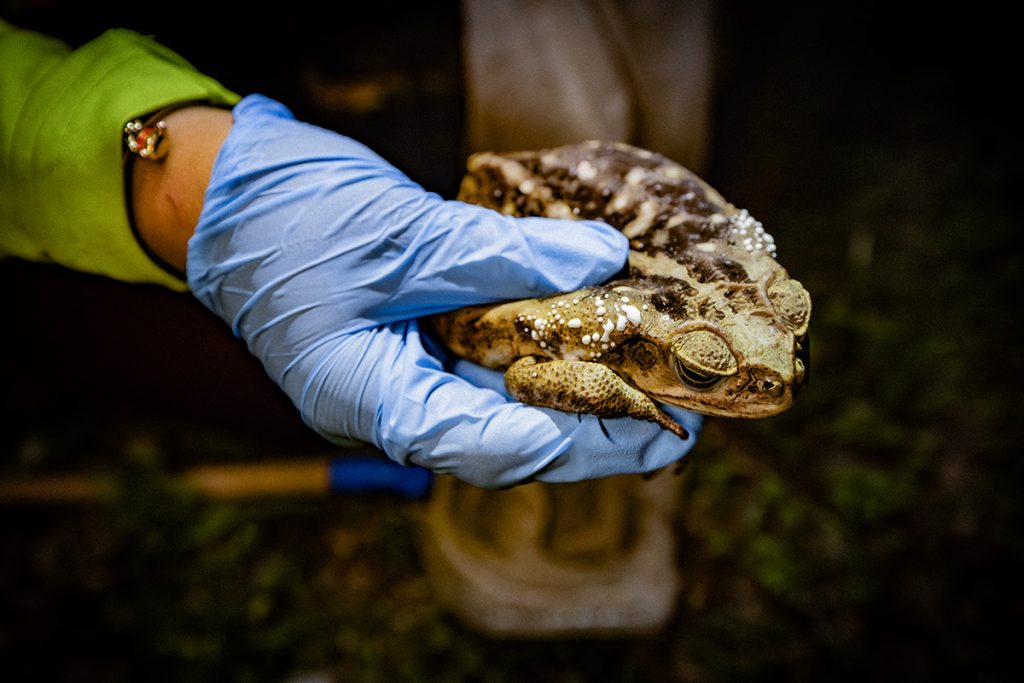
Our hunt took us through lush backyards and along ponds—prime areas for bufo toads to spawn. Tilford peered behind bushes, under dripping air condition units that the toads use to cool off, and near lights that attract insects that they prey upon. After about an hour with no sightings, it seemed we would be leaving empty-handed—a testament to Toad Busters’ mesh fencing installed on properties throughout the neighborhood to keep the toads out.
As we’re driving out of the neighborhood, Tilford is mid-sentence when he pulls the truck to a dead stop. He quickly retrieves a plastic bag and bolts out the door, stopping 10 feet away and scooping something off the road. I go out to inspect the quarry—a bufo toad the size of a palm. I touch its back through the plastic bag, rigid and cool in the night air.
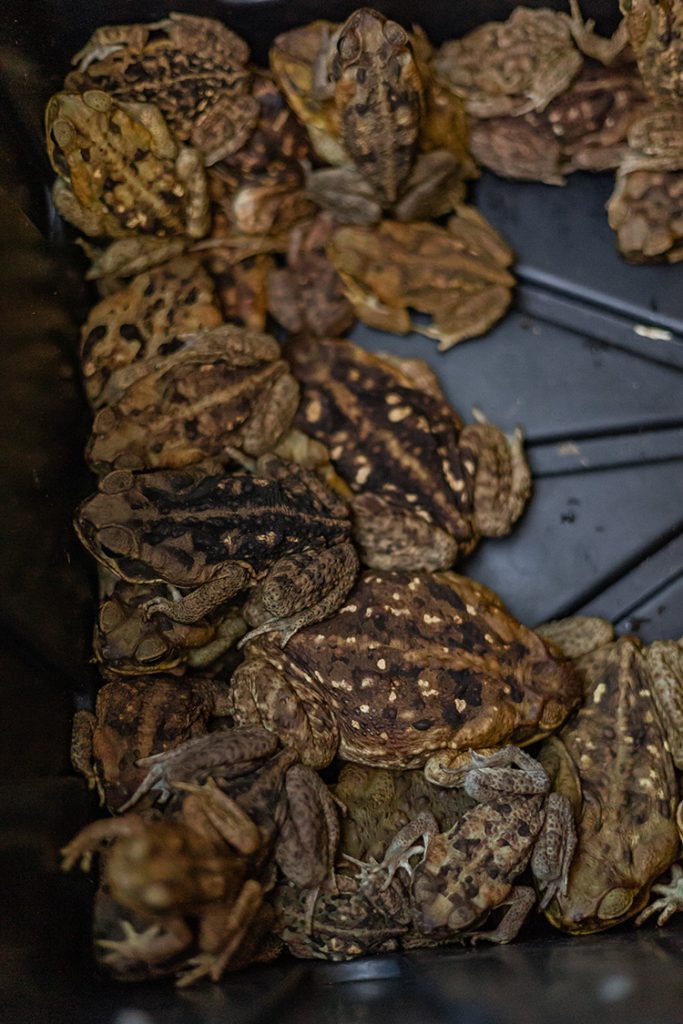
To dispose of the cane toads, they are sprayed with a benzocaine solution that sedates them before being placed in a freezer, where their body temperature lowers until the toad is euthanized. It’s an unpleasant business, but a necessary one to restore ecological harmony.
“When we come out and we perform this service, we give these people peace of mind,” explains Tilford. “A lot of my clients, once the native species come back to the property, they’re extremely happy, and the bug populations fall, and they don’t have to worry about their dogs, and it kind of balances things out again.”
Who You Gonna Call?
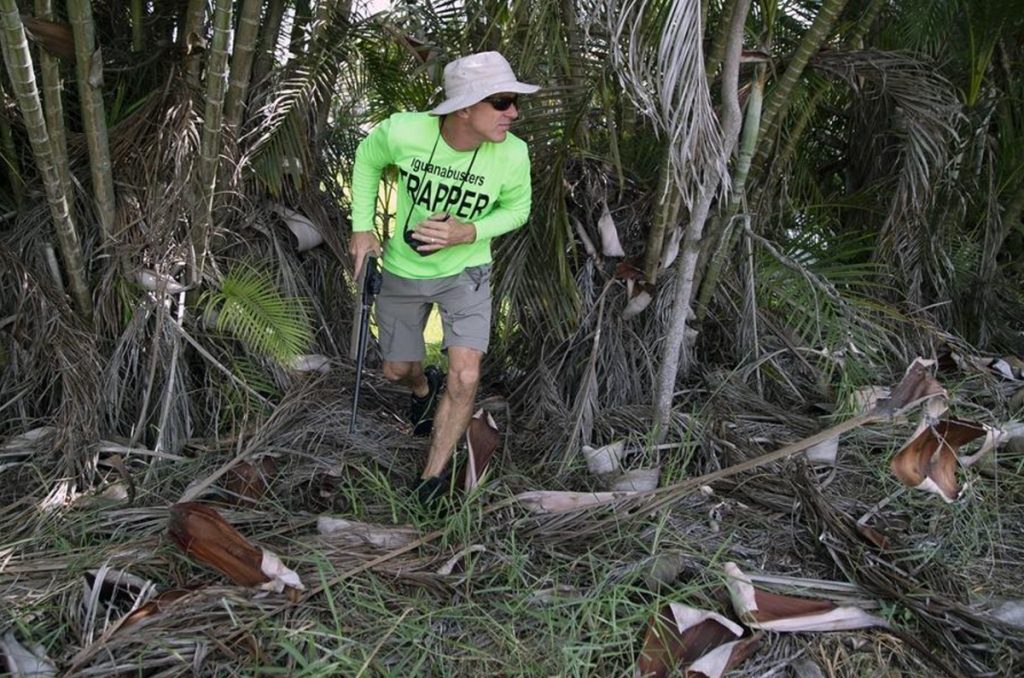
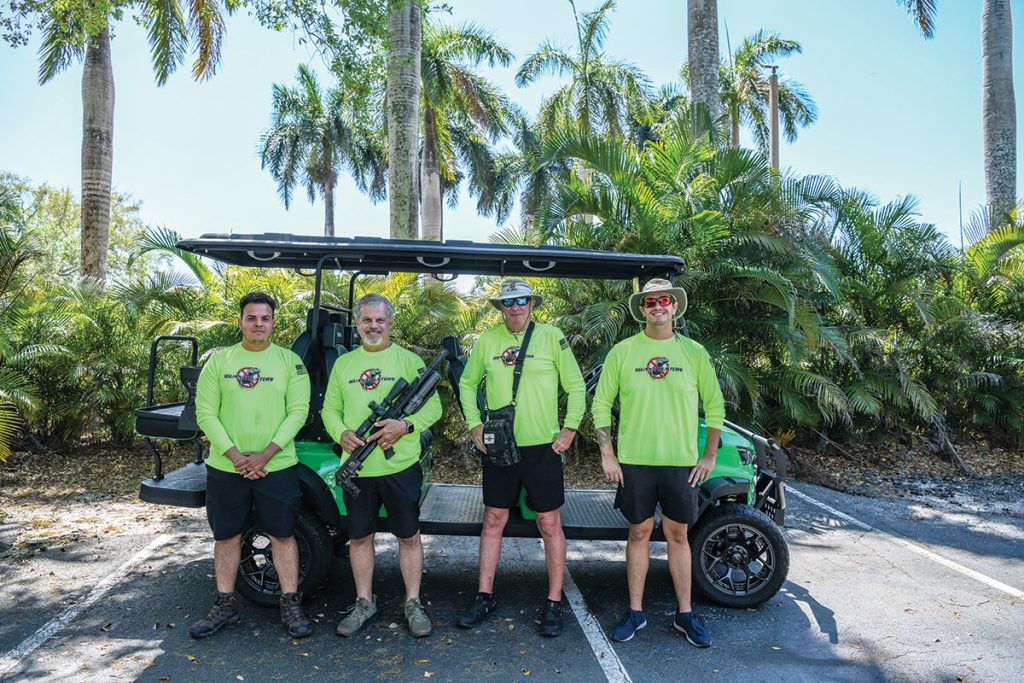
“We go into some communities, and it’s like Jurassic Park,” says Steve Kavashansky, owner of Iguana Busters. But as we ride along the cart path of a local golf course, waving to the curious golfers as they gawk at the bright-green custom Iguana Busters cart gliding along, there’s not a single iguana to be seen.
“This is what happens when we’re too good at what we do,” jokes Kavashansky. “When we first started, it wouldn’t be uncommon for us to come in here and pull [up to] 70 iguanas out a day.”
Iguanas, like many of Florida’s invasive reptiles, came to the state through the exotic pet trade. Many also arrived as stowaways on cargo ships from South and Central America. No matter how they got here, Kavashansky says, “The point is that here we are today, and we’re just overrun with iguanas, especially the further south you go.”
Iguanas have been responsible for incalculable damage across South Florida, from $1.8 million to repair a West Palm Beach dam that they burrowed into in 2019 to an iguana that fell into equipment at a Lake Worth Beach power station in 2022 and left nearly 1,500 residents without electricity. In Miami-Dade, more than $400,000 is budgeted annually to remove the invasive species—a mission that gets more complicated the longer populations go unaddressed.
“If you have iguanas, and you leave the problem alone, one female can lay up to 80 eggs,” explains Kavashansky. “If you let the problem fester, do the math.”
With prime sunning areas, waterways and enticing plant life as a food source, the golf course makes the perfect home for iguanas. “It was just getting out of hand,” says Kavashansky. “They were burrowing, they were putting holes all over the place, they were eating the foliage, they were causing damage to the sand traps, and they also caused damage to plumbing they had on the driving range,” costing tens of thousands of dollars in repairs. Today, he says we’ll be lucky to see five.
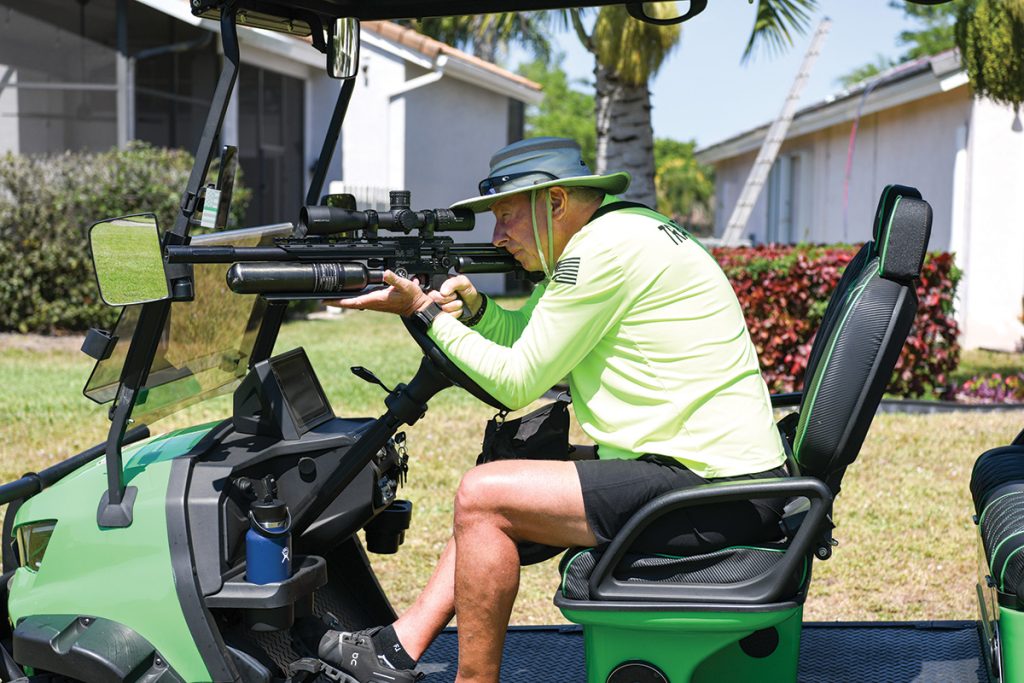
“Iguana mitigation techniques do work, but you have to stay with it,” explains Kavashansky, who uses all manner of tools to catch the resilient reptiles, including snare traps, scented oil lures and chemical repellants. But by far the most useful tool is a Swedish-made air rifle that fires a .30-caliber round at 900 feet per second.
“If you look at the iguana, there’s a circle on the side of its head that’s actually a really good aiming point,” he says. “There’s other shots we take as well that can immediately incapacitate the iguana and put it down humanely.”
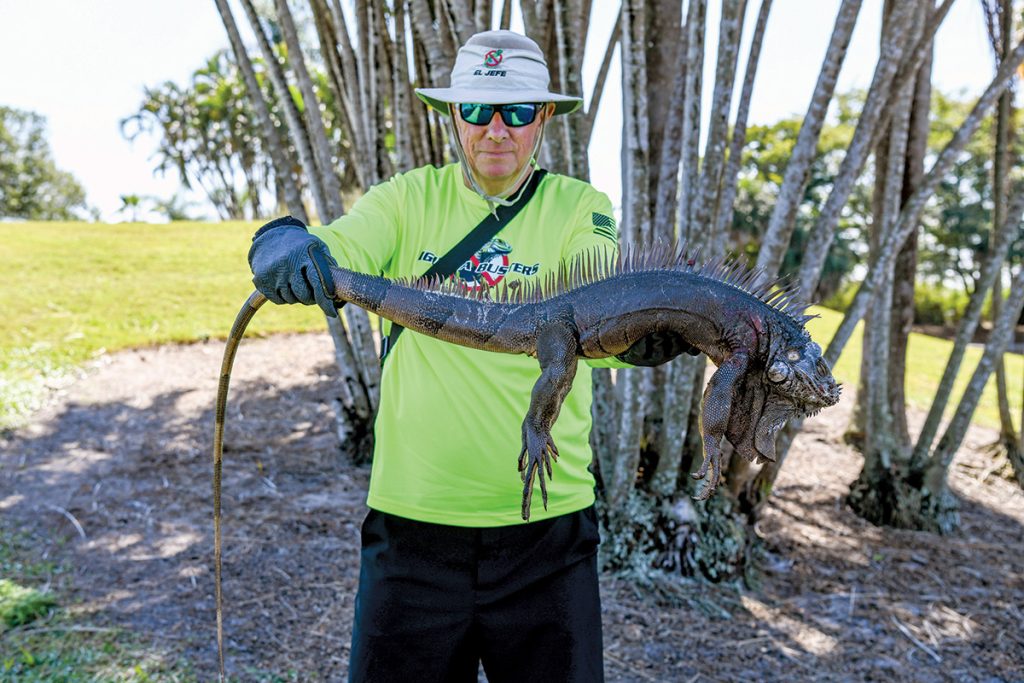
It’s being able to find that perfect shot that separates Kavashansky and his team—almost all former military, first responders and law enforcement—from the amateur iguana snatchers, like a hunter in Boca Raton in 2019 who mistook a pool cleaner for an iguana and shot him with a pellet gun. “We only take a shot if it’s safe,” says Kavashansky.
After nearly an hour on the golf course scanning treetops and sunny waterway embankments, we spot our first iguana of the day. It’s sunning itself on a berm 30 yards across a pond, just beyond the green of a hole. With no nearby golfers or structures, Kavashansky shoulders his rifle and aims. The first shot whizzes past the iguana and kicks up a patch of grass, but a quick followup shot hits true, and the iguana buckles, then goes still. We ride over in the cart, and Kavashansky puts on gloves to collect the iguana in a trash bag, then we’re back on the cart path to hit the back nine.
The removal of iguanas, as with any invasive species, isn’t for the squeamish, and Kavashansky understands that it’s a controversial topic to some. “Not everybody is down with iguana removal and mitigation, I get it,” he says, adding that, “a lot of what our job is is public education” about the necessity of removing iguanas from our communities.
Kavashansky doesn’t expect there to ever be a day where there are no more iguanas. The goal, he says, is to control the current populations. To do that, though, requires vigilance and community involvement.
“We’re in this golf course community right now, and we’ve knocked it back,” says Kavashansky. “Let’s say you’re in a neighborhood right across the road and they’re not doing anything; the iguanas just walk right across the road and come back in. And that’s how we have the problem that we have in South Florida.”
Lion Slayers
“This is literally my nightmare, what we’re looking at here,” says Nate Sorenson, peering overboard the Lion Slayer into the murky brown waters of the Atlantic. “I’d rather have three knots of current than dirt water.”
Visibility is key when hunting lionfish, a personal mission Sorenson has pursued with an Ahab-like tenacity since 2017.
“Once I saw how many [lionfish] there were and [started] learning about them, [hunting them] became like a fixation.” In 2019, he founded the Lionfish Extermination Corp., a nonprofit focused on the removal of lionfish, funded through the sale of lionfish to local restaurants, donations and a social media presence that has racked up millions of views of underwater videos Sorenson makes while patrolling the reefs.
As yet another unintended ecological disaster created by the exotic pet trade, lionfish have been responsible for the degradation of South Florida reefs and the decline of native fish populations. “A reef depends on all of the fish on that reef to keep it healthy, and lionfish wipe out those fish,” says Sorenson.
On the day that I joined Sorenson and Lion Slayer co-Captain Alex Borsutzky in Boynton Beach, we patrolled the reef fingers—a less-than-scenic section of reef at a depth of 100 feet unfrequented by commercial and hobbyist divers. “Because people are hunting them on the main reef, we rarely ever go to the main reef,” says Sorenson. “It’s the prettiest spot, but we don’t want pretty; we want lionfish … For us, to apprehend them before they come into that more admirable living space is the best policy.”
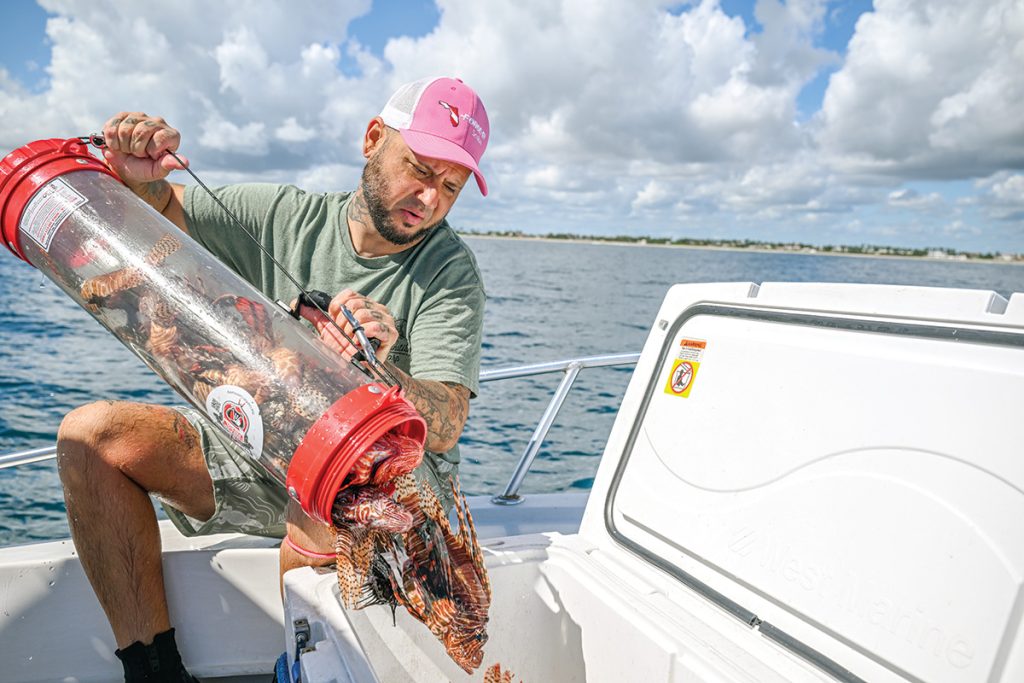
Borsutzky, unfazed by the opaque brown waters, takes the first dive. Equipped with an elastic band-propelled pole spear and Zoo-Keeper—a cylindrical containment device for storing lionfish—he commences the hunt, searching the reef for the occasional cloud of minnows that serve as an all-day buffet for lionfish.
“We’re looking for a lot of small fish that will attract the lionfish, and we’re also looking for a nice house,” explains Sorenson. “Lionfish love a posh apartment with a bunch of food in the fridge.”
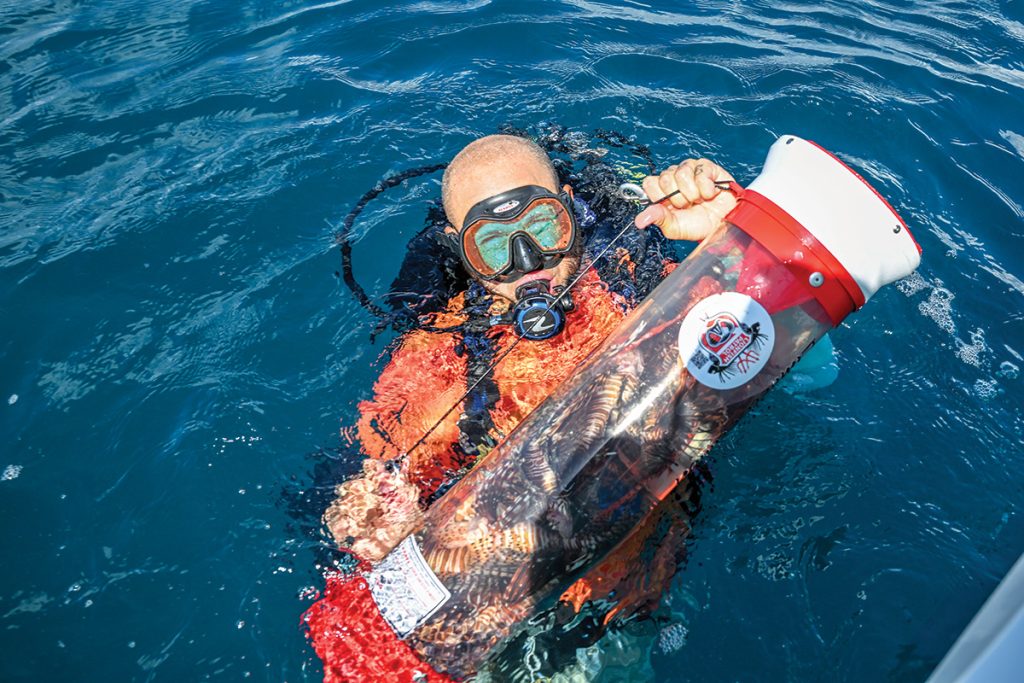
Borsutzky spends nearly an hour scouring the reef, his only trace the occasional bubbles rising to the surface and a flag buoy attached to his harness below. Finally, he surfaces, and climbs aboard with a ZooKeeper half full of lionfish. A lionfish head still hangs on the tip of his pole spear.
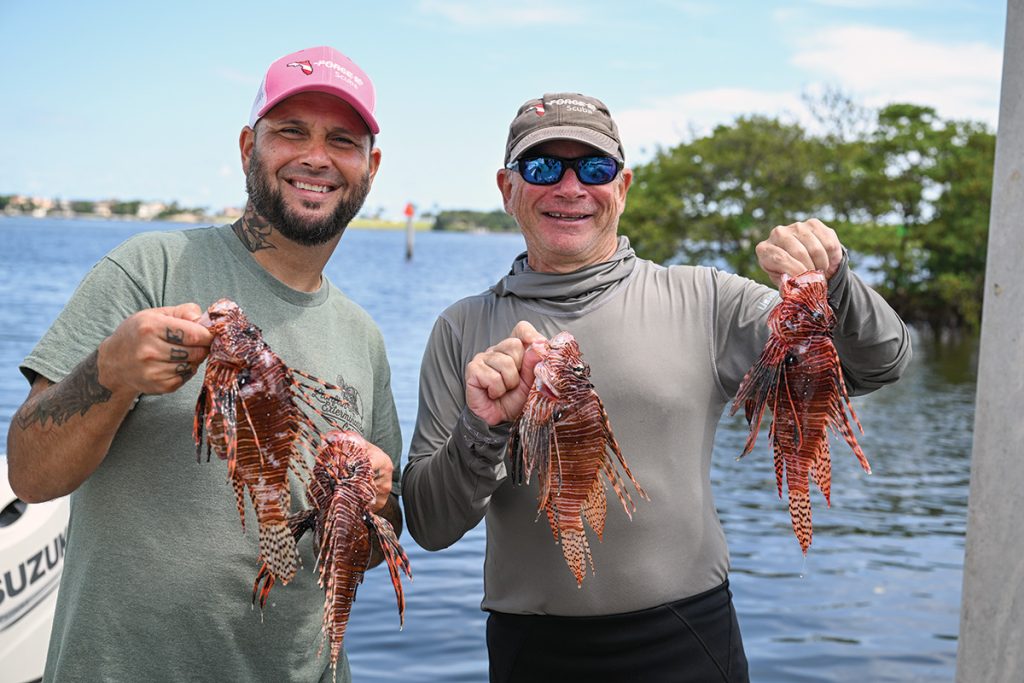
The lionfish range in size from as small as a palm to as large as a platter, but all are equipped with the ultimate defense system—18 barbs that line the spine and fins that inject a neurotoxic venom that induces severe pain and, in some cases, paralysis, in would-be predators. Of his first brush with the venom, Borsutzky says, “I was in so much pain that if a doctor came over and said, ‘we need to amputate,’ I’d say, ‘take it.’”
These barbs make it impossible for any of our native sea life to prey upon them, allowing them to reign unchallenged over the reefs, eating more than 1 million fish during their roughly 15-year lifespan. Over the course of a year, they can spawn up to 2 million eggs, outbreeding native predators like grouper and snapper. While Sorenson estimates they’ve captured more than 50,000 since they’ve been in the hunt, he doesn’t believe total removal is possible.
“No matter what we do, [there’s no way] we’ll ever get rid of them, but at least we control it,” says Sorenson. “The only way for us to fail is for everyone to stop doing this.”
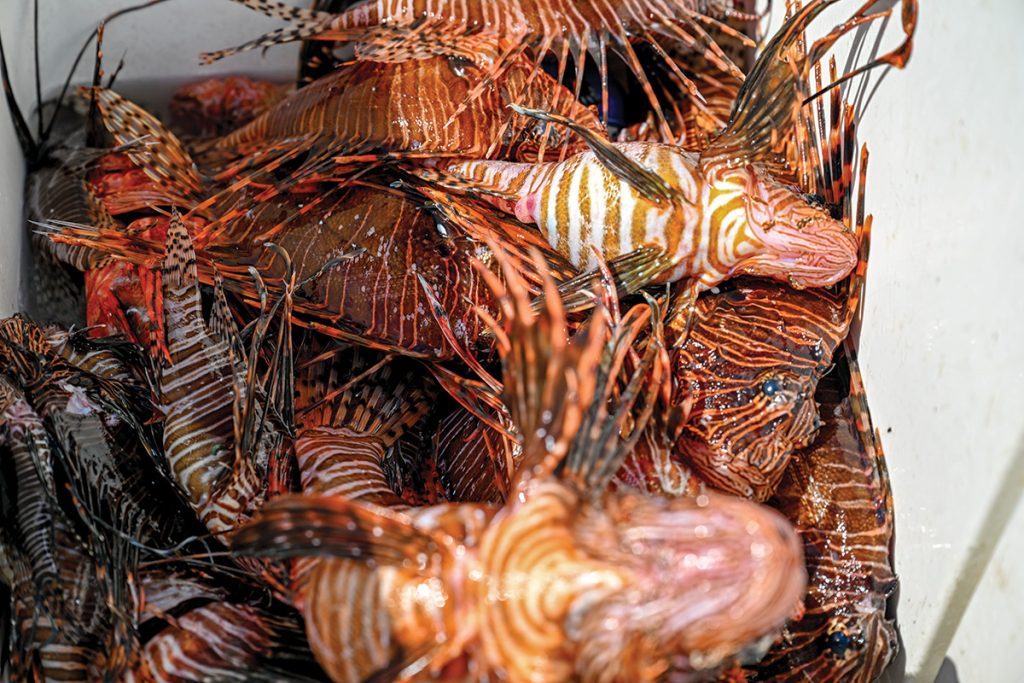
After stowing the haul of lionfish in an iced cooler, Sorenson steers the Lion Slayer for clearer waters to make his dive. We make our way north, following the reef, the water turning from a muddy brown to deep blue. Sorenson readies his oxygen tank and takes a dive, ZooKeeper and pole spear in hand. An hour later, he surfaces with a triumphant yell of “We did good.” Back onboard, he adds another ZooKeeper of lionfish to his quarry, tossing on the deck a beer can that he found littering the reef.
“Nothing is allowed on our boat except for lionfish and trash,” says Sorenson. A vegan for more than 20 years, Sorenson says, “I don’t want to cause any harm on my boat that is not lionfish-related.” While being vegan and hunting lionfish are two things seemingly at odds, Sorenson has a straightforward rationale. “That fish is a piece of trash that will poison the waters if you don’t remove it,” says Sorenson.
“In a way, [hunting lionfish] is kind of like going vegetarian. Once you find out what’s going on, it’s hard to go back. It’s the same thing with lionfish. Once you find out how terrible this problem is, it’s almost like a sense of urgency that you just have to help.”
IG: @lionfish.extermination.corp | TikTok: @lionfishextermination
Monster Hunt
“What are we looking for?”
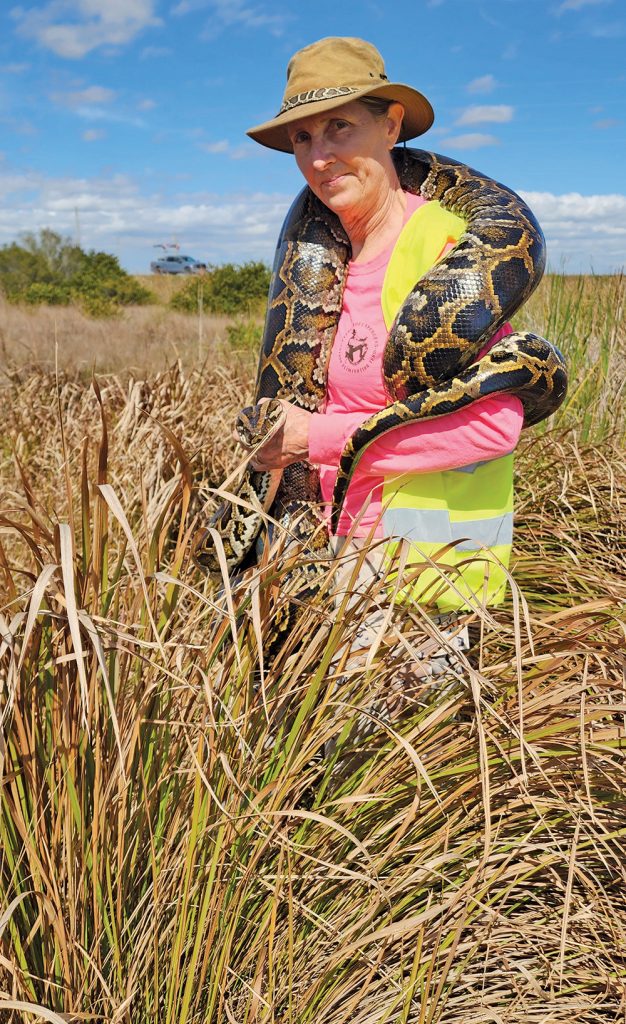
“I’ll show you,” says Donna Kalil, pulling a 5-foot bokken stick wrapped in python skin from the backseat of her truck. She walks 10 feet down the embankment of a levee and places the bokken in the tall brush. I see where she places it, and then it disappears completely, the snakeskin camouflaged in the brown and green sawgrass. “It’s a needle in a haystack,” she says.
We’re in the Everglades at a water treatment station that has no physical address to type into a GPS. Levees with gravel surfaces run alongside murky black waterways through the wetlands, where the sawgrass grows tall and thick as the humid air. I ask Kalil, a South Florida Water Management District contractor, how many pythons she estimates she’s caught. “1,052,” she answers. “I don’t have to estimate.”
Kalil has been hunting pythons for more than 20 years, after she saw a front-page Miami Herald article where a python burst in half trying to digest an alligator. “I knew there was a problem in the Everglades, and I wanted to help,” she says. In the past 20 years, she’s caught the most snakes during the Florida Python Challenge twice, and with a partner caught the largest python at one year’s event.
We’re on a daytime hunt, though Kalil prefers to hunt at night, when the python’s shiny skin reflects the lights shining from her truck stand, upon which she brings volunteers and fellow hunters to serve as spotters. “I can’t tell you how many snakes that I would have missed had I not had someone watching up top,” says Kalil.
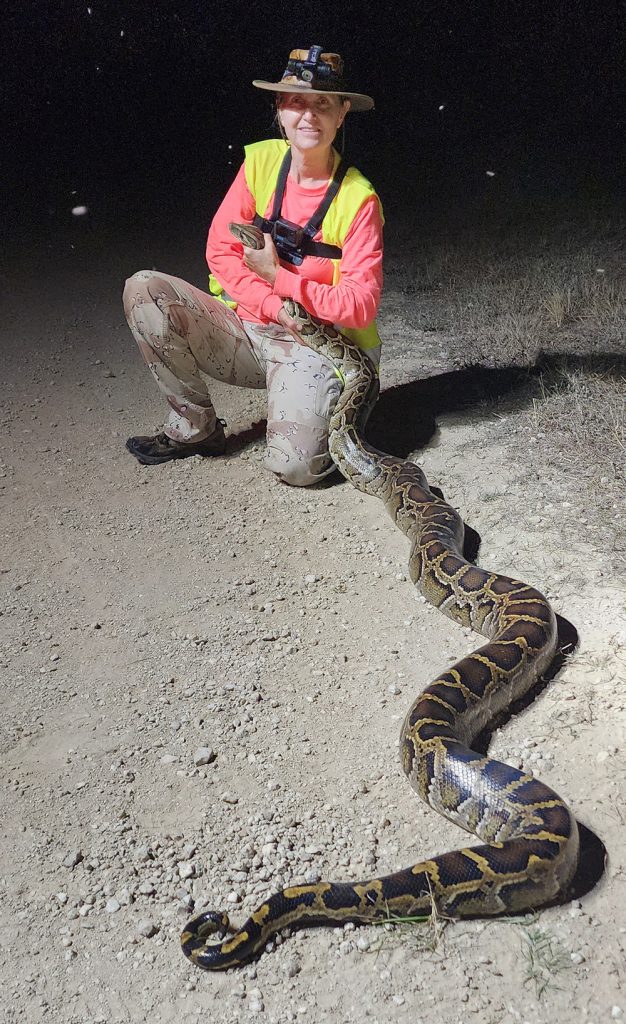
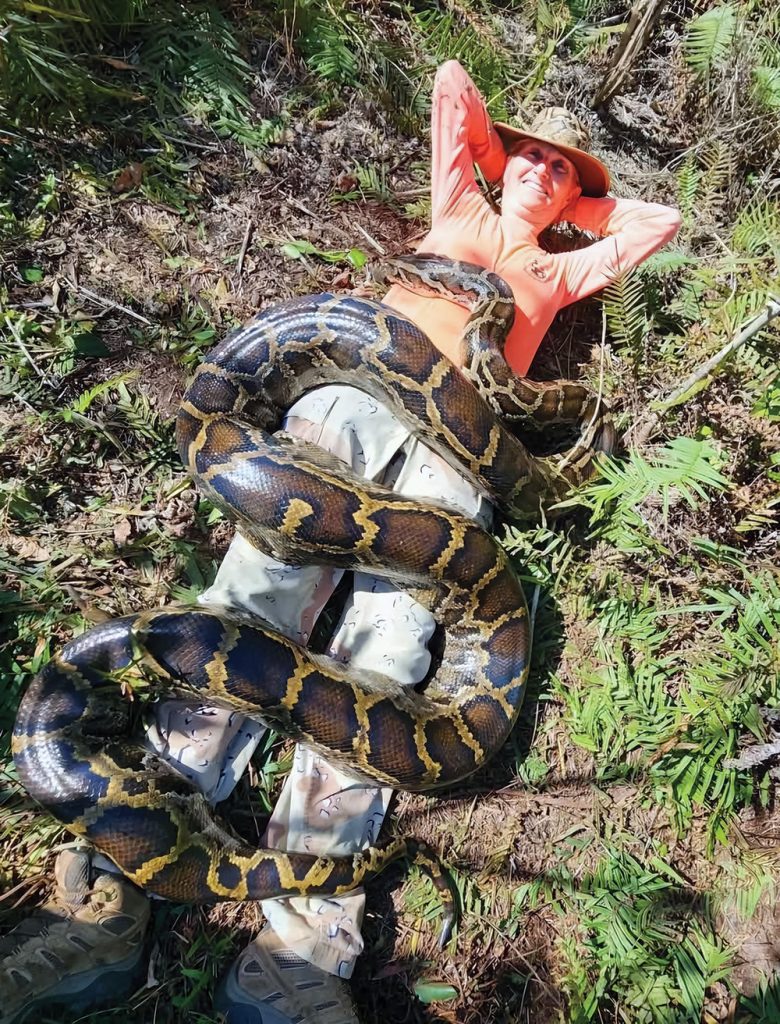
It’s widely accepted that pythons were introduced to South Florida through the pet trade, and a python breeding facility destroyed during Hurricane Andrew in 1992 only exacerbated the problem. Kalil says there’s no way of knowing how many are out in the Everglades. “On a good day, I want to say 100,000, on a bad day, a couple hundred thousand.” She says she’s pulled more than 100 eggs from a single python.
Since Kalil’s been hunting python, she’s been bitten “too many times to count,” dragged through the water on the back of a 13-footer, and thrown “like a rag doll” by a python measuring 18 feet. “When you get up to 13 to 16 [feet], those are monster fights; those aren’t pythons anymore, those are monsters,” says Kalil. “It’s kind of like wrestling a fire hose that’s on full blast, and it’s greased.” But it’s not the size of a snake that worries her.
“When I get nervous is when I see the snake, and it’s right by the water, and it can get away,” she says. “I’m really worried that it’s going to get away.”
Once a python is sighted, a war of attrition begins to subdue the snake. Whether it’s a three-footer or an 18-footer, the protocol is the same: Go for head.
“You do not want to get them around your neck,” explains Kalil. “Generally the snake doesn’t want to kill you, it just wants to get away. So it’s going to fight, it’s going to constrict; as long as you’re fighting it, that’s what it’s going to do.”
While holding the head, the goal is to keep the snake from coiling until it tires out. “Once they tire out, they have to either cool off or warm back up,” Kalil explains. “They’re like a noodle.”
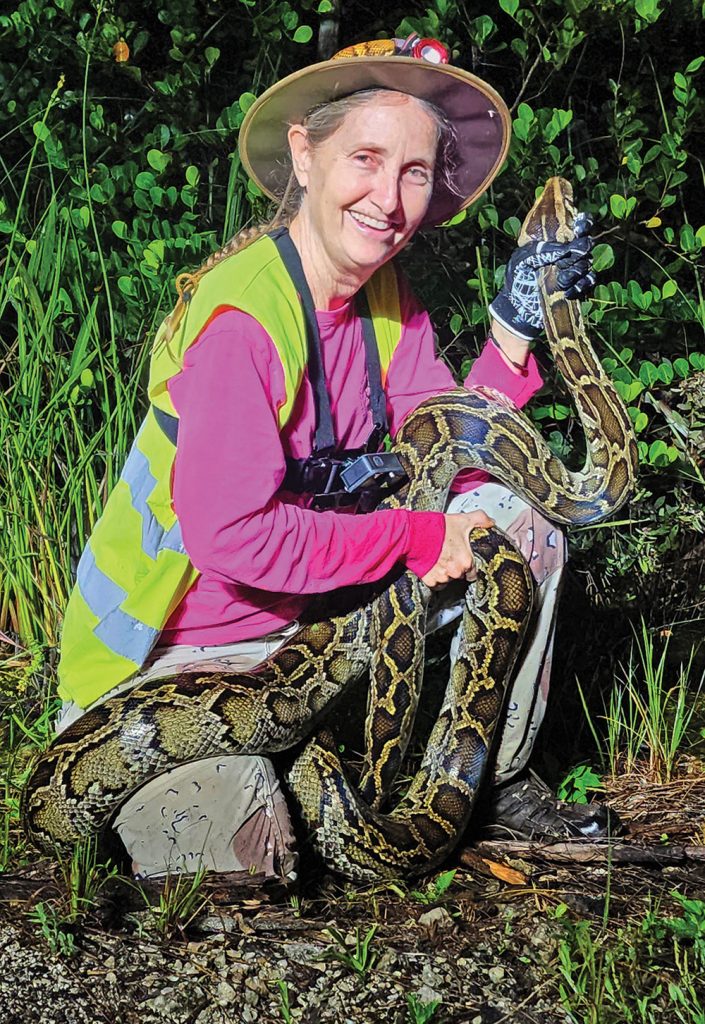
Finding them is hard, and wrestling them requires technique and finesse, but it’s at the end of the day, when Kalil has her quarry bagged, that she faces the hardest part of the job.
“I open the bag real slowly, take the head real carefully, and say, ‘I’m sorry for what I have to do, but you don’t belong,’” says Kalil, before euthanizing them with a captive bolt to the head. “You hope you get the perfect shot, and they feel nothing, lights out.”
Kalil sees the killing of pythons as a necessary evil to prevent further damage to the Everglades ecosystem, where the snakes have been responsible for an estimated 98% to 99% reduction in populations of mammals. After a long day riding along levees, scanning embankments, and walking through saw grass, we didn’t manage to find any pythons, but we did spot all manner of wildlife that are flourishing due to python mitigation efforts in the area. Passing two plump raccoons hopping along an embankment, Kalil says, “That’s why we do it.”
“I can just imagine what [a python]’s going to eat throughout its life, and so I’m saving a thousand lives by taking one life,” says Kalil. “When you do the math, that’s an easy call.”
This story is from the January 2026 issue of Boca magazine. For more like this, click here to subscribe to the magazine.