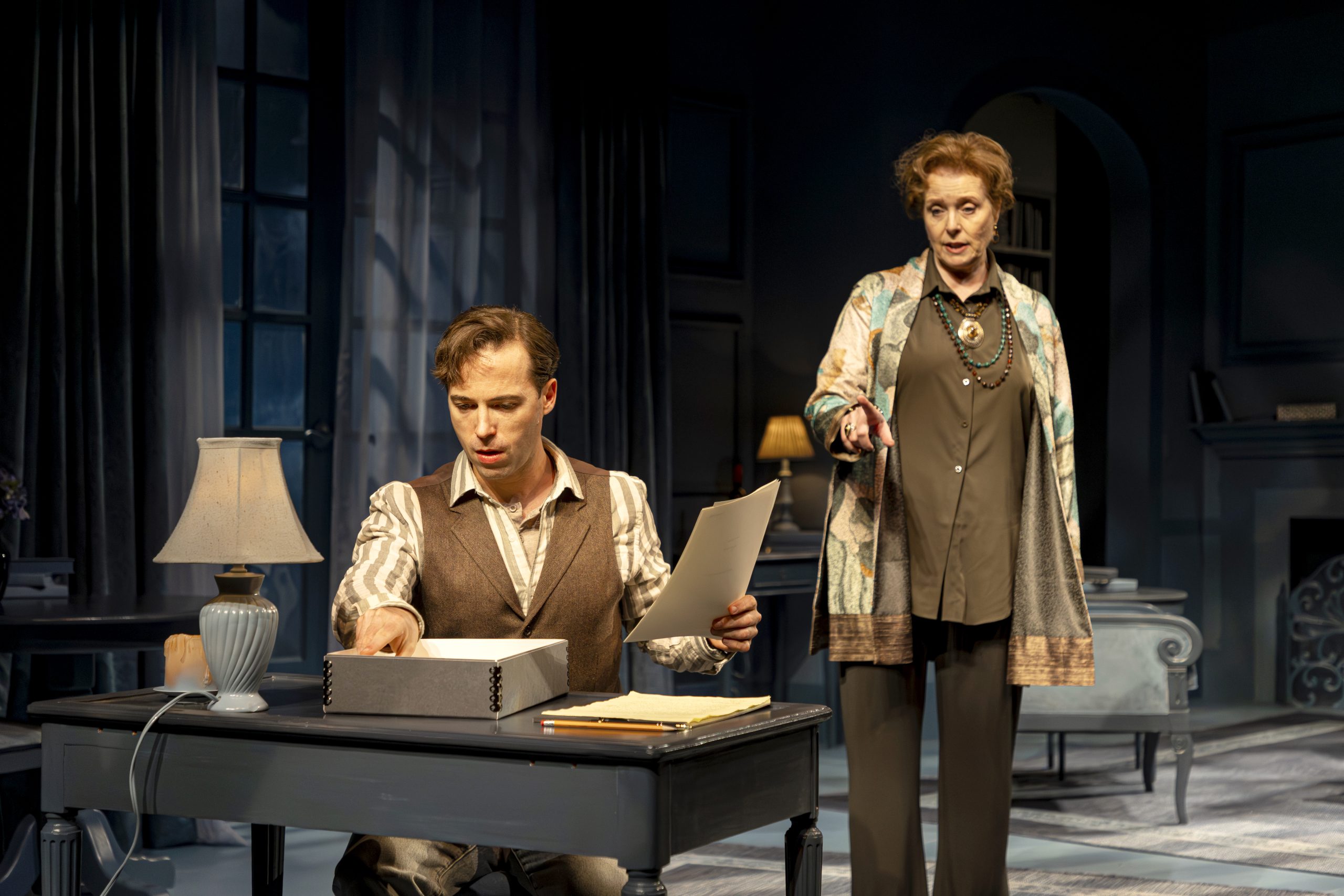
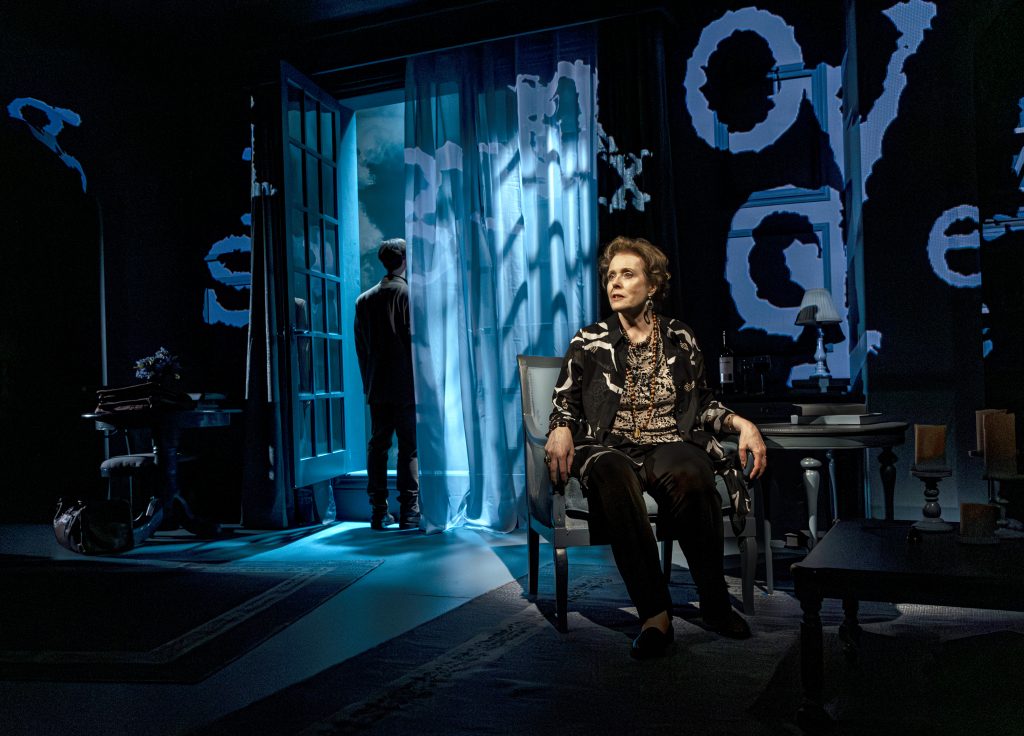
The first thing you notice is the grey. We’re in the living room of an elegant, ninth-floor Boston apartment, a space bleached of color, with everything from the walls to the chairs to the fireplace to the drapes blanketed in the vague hue of slate. This set, for Palm Beach Dramaworks’ Vineland Place, is another marvel of cohesion from designer Anne Mundell, one that serves a dual function. While it fulfills the icy character traits of its occupant, the haughty widow of an acclaimed novelist, it also forecasts the murky grey zones of Steven Dietz’s clockwork-tight script, in which truth is buried under layers of deception, and hidden calculations undergird even the most innocuous lines of dialogue.
Vineland Place, which runs through May 31, is a murder mystery of sorts, though not the traditional kind—there’s no corpse discovered in the opening scene, and no panoply of suspects with varying degrees of motivations and alibis. There are just two people talking, initially, about a job. But that’s not to say there isn’t a minefield of mousetraps laid along the way, with both characters, at various points, detecting and stepping into them.
“I don’t believe in ghosts,” asserts Victoria Brody (Anne-Marie Cusson), the apartment’s owner, yet Dietz’s script is haunted by at least two of them: Her spouse, writer Fenton Brody, who fell from their living-room window six months earlier while in the final stages of completing his long-overdue second book; and Fenton’s mother, who met a similar fate many years earlier. Victoria has enlisted the services of a young writer, Henry Sanders (Ross Cowan), a literary podcaster and modest scribbler, from whose perspective the drama unfolds.
Addressing the audience at the outset of the play, Henry says he has responded to an employment opportunity that requires “a particular set of skills and extraordinary discretion.” A longtime admirer of Fenton’s one completed novel, he is to finish the great author’s much-anticipated sophomore epic, mimicking Fenton’s signature voice. If he can execute the task in the 10 weeks before the tome is due to the editors, six figures await him.
Henry is a bit like Sunset Blvd.’s Joe Gillis, a hungry and cripplingly curious writer accepting a shady assignment from a character in the landed gentry. But Victoria is certainly no Norma Desmond. She doesn’t survive on manufactured delusions but on a byzantine structure of elisions and revelations, all timed with the precision of a five-dimensional chess clock.
Dramaworks’ production of this fairly old-fashioned cat-and-mouse thriller is swift—culminating in a riveting 75 minutes with nary a second of bloat—and grandly entertaining, at times cheekily so. In their perpetual battle for one-upmanship, there’s a lot of Colombo-esque “and just one more thing”-ing exchanged between the characters, in ways that nobody outside of detective television ever speaks but that fits Dietz’s slyly self-aware tenor.
Cowan skillfully transforms, over the course of the one-act show, from a middle-class naif almost trembling in the face of extraordinary wealth and influence—if you look closely enough, he even gulps at the right times—to a verbal sparring partner on equal turf with the Machiavellian Victoria. Cusson, ever erect and clad in statement jewelry from costume designer Brian O’Keefe, offers a master class in subtle control, seldom letting her character’s guard down. And even when she does, we’re left to wonder if her momentarily ashen complexion is genuine or another calculated ruse.
While Dietz’s script plays with a familiar generic form, Dramaworks’ production team elevates the material in novel ways, beginning with its tactical use of projected letters, each of them appearing with the clack of a typewriter key and swimming in an alphabet soup across the set. Sound designer Robertson Witmer composed moody, unsettled piano interludes to be played beneath the characters’ fourth-wall-breaking confessions to the audience, enhancing the story’s growing cloud of tension. In my favorite effect of the production, a scene lit only by faux-candlelight allows the actors’ shadows to tower above them like in the grand old days of German Expressionism, their silhouettes mirroring the power dynamic playing out below.
There is talk, midway through the play, that Fenton ended the written part of his unfinished book with an ellipsis, the only such figure of speech in the entire manuscript, suggesting more to come. Fortunately for the spectators of Vineland Place, Dietz does not leave us hanging, closing the book on his myriad mysteries while sending us out with plenty of time for dinner.
Vineland Place runs through May 31 at Palm Beach Dramaworks, 201 Clematis St., West Palm Beach. Tickets cost $95. Call 561/514-4042 or visit palmbeachdramaworks.org.
For more of Boca magazine’s arts and entertainment coverage, click here.