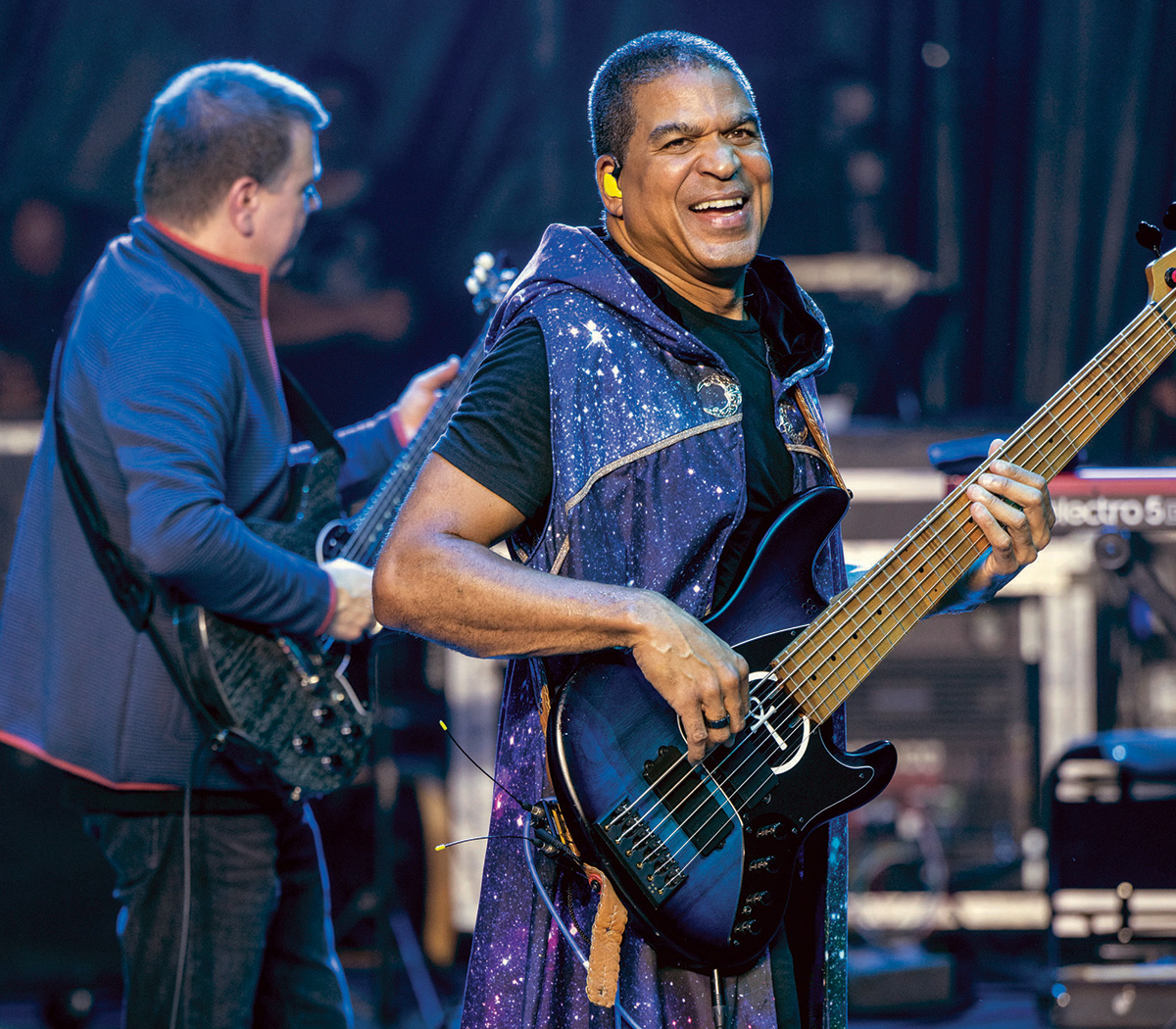
Trying to pigeonhole Oteil Burbridge is a fool’s errand. From the beginning of the bassist’s professional career, in the late ‘80s, he had been cross-pollinating so many genres that critics didn’t know what to make of him. Reviewing a 2005 album from his quintet, AllMusic’s Scott Yanow wrote: “the music of Oteil & the Peacemakers is certainly impossible to classify. Is it jazz, blues, fusion, rock, pop, R&B or a jam band? Actually, it is all of the above … this set will drive musical purists crazy but should delight those who enjoy all of these different styles of music being played in a very different way.”
For Burbridge, this eclecticism was by design. The Washington, D.C. native grew up with a brother, the late Kofi Burbridge, who had developed perfect pitch by age 7. “He was doing super-heavy jazz and classical stuff by the time he was 12,” Oteil recalls. “I grew up with that, and with my dad’s absolute love of music. It was his religion, and he was very against organized religion; music was his chosen passion, to the point of being a religion. He was into all types of music—European classical, Indian classical, every American type, gospel, jazz, blues, country, bluegrass, funk, R&B, soul.
“So I was ready for The Grateful Dead, because I was used to diving into so many different worlds.”
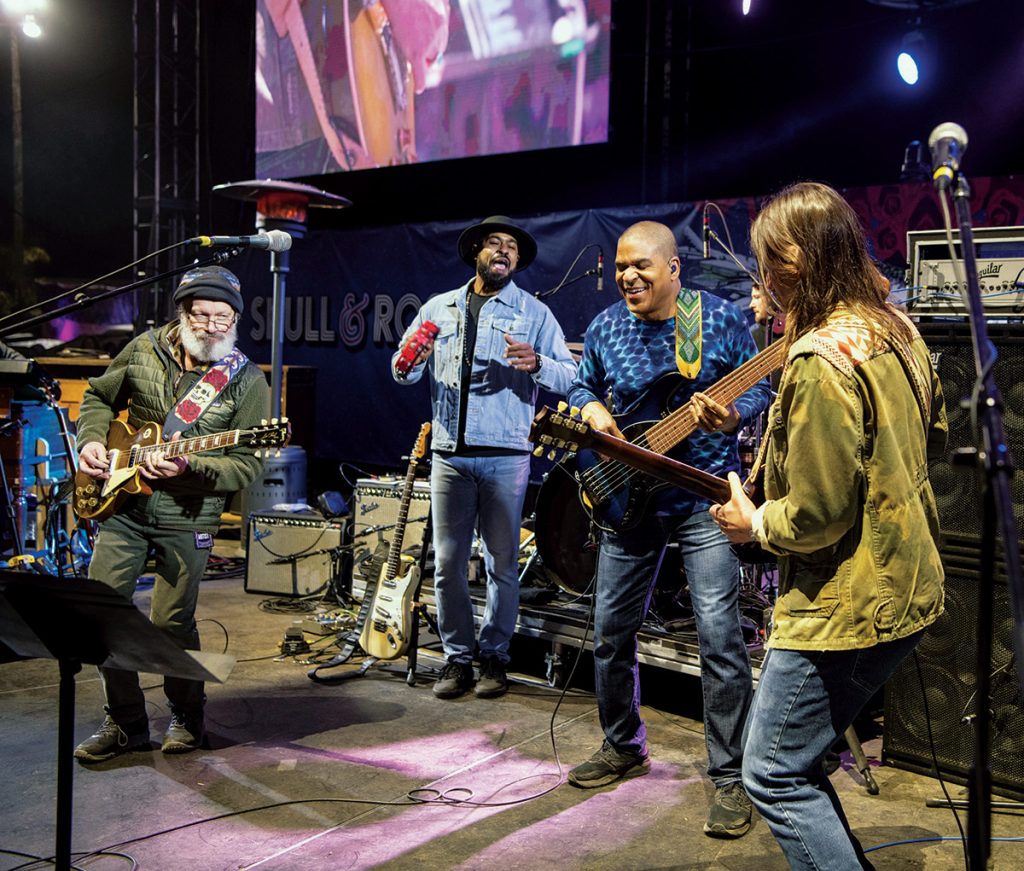
Burbridge, who in 2020 ranked as the 64th best bassist of all time per Bass Player magazine, may be the quintessential “musician’s musician”—a groove merchant and improvisational wizard who played with The Allman Brothers Band from 1997 to 2014, and Tedeschi Trucks Band from 2010 to 2012. He’s a founding member of Dead & Company, the current iteration of The Grateful Dead, and joined the band on its 2024 and 2025 residencies at the Sphere, the extravagant 20,000-seat multimedia venue in Las Vegas. His latest solo album, Lovely View of Heaven, is a suite of newly arranged ballads by the Dead’s Jerry Garcia and Robert Hunter, recorded while in the throes of grief for numerous friends and family members.
These days, Burbridge lives in Boca Raton with his wife, visual artist Jess Burbridge, and he occasionally gigs at The Funky Biscuit and Crazy Uncle Mike’s, in addition to touring with other projects, many of them Dead-adjacent. He loves Boca’s fl atness and warm climate, adding, “I live barefoot or in flip-flops.”
When Dead & Company recruited you in 2015, were you a full-on Deadhead by that point?
Not at all. I had learned some of the music because I had played in a trio with Bill Kreutzmann, one of their drummers. I think I learned my first 15 or so Dead tunes, but I hadn’t really dug in. There’s hundreds more. And at that point, it was the ballads that really killed me. That’s what hit me in the face with the skillet with The Grateful Dead—“China Doll,” “Standing on the Moon,” “Morning Dew,” “Comes a Time,” “High Time.”
You wrote the arrangements for “Lovely View of Heaven” while dealing with a lot of grief. Why is music so healing?
That’s the question for the materialist me to ponder. I know why it heals, because of spirit. But to a materialist, what am I doing, actually? To a materialist, music is just specific numbers in combination of frequencies coming out of a speaker. But why would it make someone cry?
This just gets back to our consciousness. … When I was a teenager, the only thing that made sense to me was music. I dove into it deeply, and I kept diving, and I’m still diving. And the crazier the world gets, the more I dive. Your spirit needs it, man, because otherwise you’ll go nuts.
The Dead recently lost two more of its founders, Phil Lesh and Bob Weir. Do you see yourself as one of the stewards of this music, to keep it alive for future generations?
Absolutely. Every day, people come up to me, and they say two things: “I’m so sorry, Oteil,” and, “Please keep it going. Don’t let it stop.” And I tell them, there’s no way it’s going to stop. Don’t you worry about a thing. But it does bring it home to me that they see me as responsible for doing so, and I’m deeply honored.
What is it like to play the Sphere?
In the Sphere, if you look at pictures, we’re so small you can’t even see us. We’re like ants. You feel kind of insignificant. Which is great, because not everybody’s just sitting there staring at you the whole frigging time. … I feel like the organist at The Phantom of the Opera movie in the old days, where you’re just the music for the movie.
Does the fact that Dead & Company doesn’t tour all year give you a better balance between family life and your other projects?
Yeah, and I had kids late, too; I had my first kid at 50. I don’t want to be on the road all the time. I’d like to be on the road as little as possible. If I had money to retire already, I’d probably be doing a house gig here, like five nights a week, and not going on the road at all.
This story is from the May/June 2026 issue of Boca magazine. For more like this, click here to subscribe to the magazine.