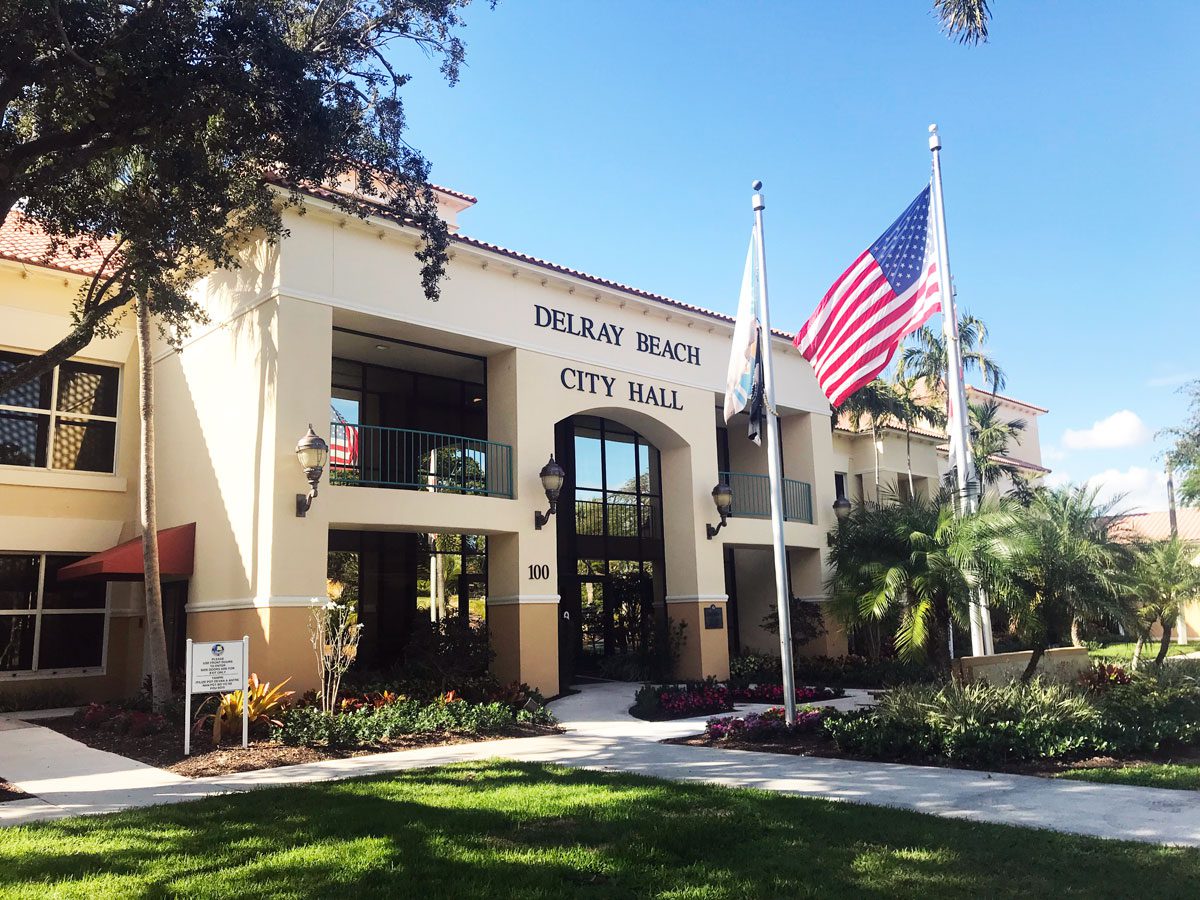
In contrast to Boca Raton’s crowded ballot, Delray Beach will hold just one election on March 10.
Three candidates are competing for the open Seat 2 on the city commission; former Commissioner Rob Long chose to run for the Florida House, a race he won, rather than seek a second term. Without opposition, Seat 4 incumbent Commissioner Angela Burns won another three-year term.
Delray Beach does not hold runoff elections, so whoever gets the most votes—even if it’s not a majority—will win. In alphabetical order, the candidates are:
- Andrea Keiser, a land-use lawyer
- Judy Mollica, a Realtor
- Delores Rangel, who worked for 27 years in the city manager’s office before retiring in 2023

Andrea Keiser
A 12-year resident of the city, Keiser says, “I’m the most qualified,” based on her 15 years of running a small legal practice in the city and a record of local and regional community involvement.
In addition to service on the city’s Housing Authority Board, Keiser has received appointments to the Early Learning Coalition of Palm Beach County and the Childcare Licensing Advisory Council for Palm Beach County. She also is chief operating officer of the private preschool Primrose, a venture she got into through one of her clients.
Of City Manager Terrence Moore, Keiser said, “It’s hard to give an opinion,” because she hasn’t had much contact with him. “I like [Police] Chief Hunter. He’s always professional.” Moore named Hunter to that post.
Of Old School Square, Keiser believes that neither the city nor the Downtown Development Authority (DDA) should operate it. “It’s not their strong suit.” The commission should not have “thrown a grenade” in 2021 by abruptly ending the lease with Old School Square Center of the Arts.
Acrimony has broken out during recent commission meetings, especially between Mayor Tom Carney and Commissioners Juli Casale and Thomas Markert. Keiser said, “I don’t want to throw the commission under the bus, but we are supposed to be role models. I don’t believe in humiliation.”
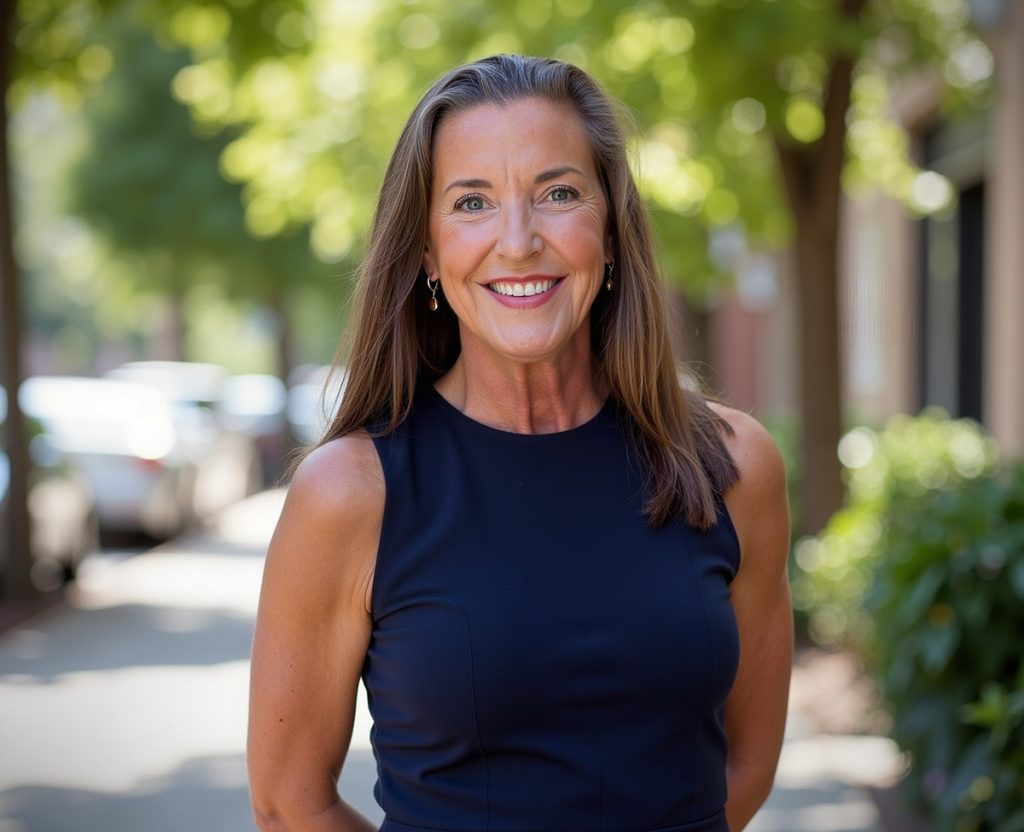
Judy Mollica
Her “community knowledge,” Mollica says, makes her the best candidate.
She serves on the Planning and Zoning Board, which reviews development projects before they get to the commission. Outside of direct city roles, Mollica is a former Rotary president and volunteered at the Volen Center.
Mollica is a founding member of Friends of Delray. Its website says the group is focused on “accountable government, sensible growth and civic pride.” Mollica said Friends of Delray grew out of the commission’s abolition of the appointed Community Redevelopment Agency board in 2018 after the item hadn’t been on the agenda.
Moore is “good for the city,” Mollica says. “It’s not the commission’s job to run the city.” She would like to bring “change on the dais.” She “kind of likes” the idea of requiring four votes, not the current three, to fire the manager.
Carney has criticized the DDA for what he calls poor financial management, even securing a state audit of the agency. Mollica said, “There’s nothing wrong with making them transparent with their budget.” She also would prefer that a new non-profit take over Old School Square.
“Nothing was handed to me,” said Mollica, who has the police and fire endorsements. “I earned everything through determination and perseverance.”
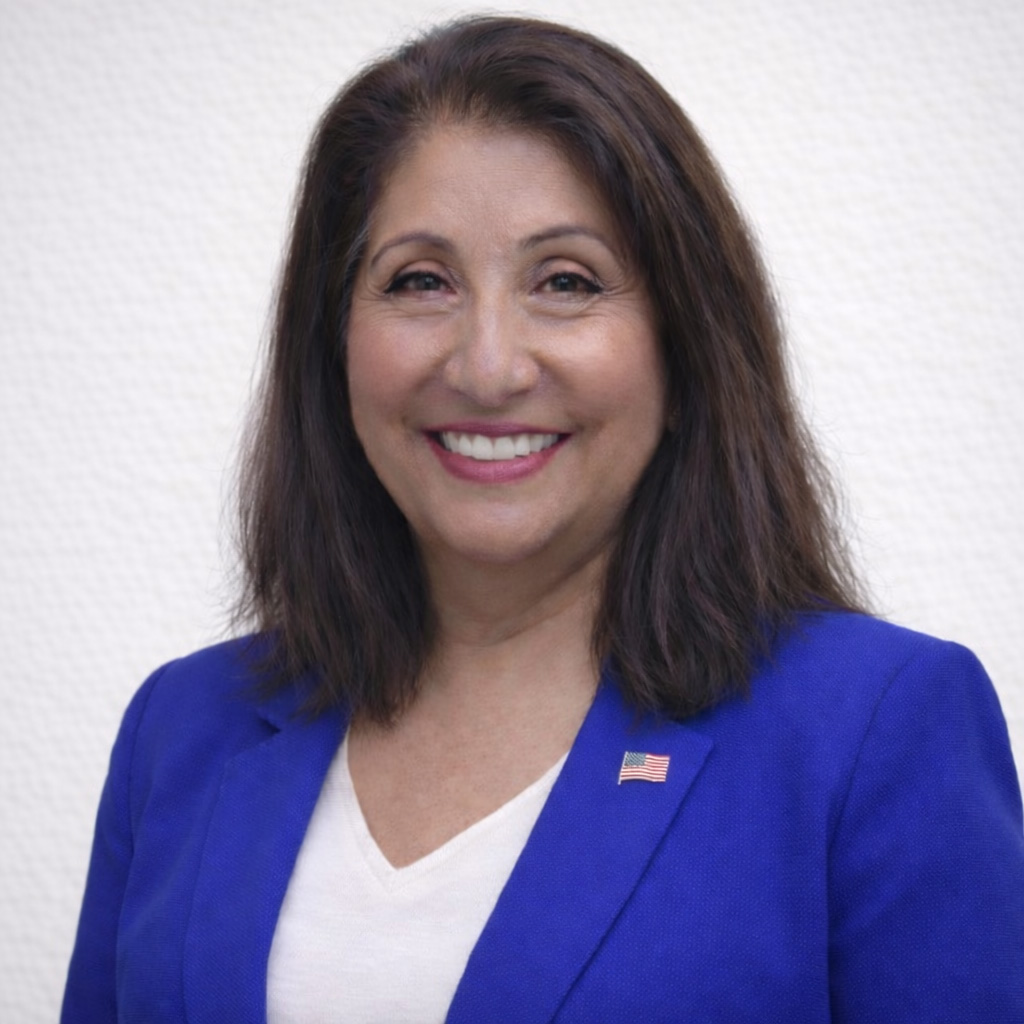
Delores Rangel
She has been in the city longer than any candidate, having moved with her family 59 years ago. Referring to her nearly three decades in City Hall, Rangel said, “I have the institutional knowledge. I will have no learning curve.”
Noting the “very passionate” behavior by some commissioners, Rangel said, “I would bring balance.” Working in the manager’s office meant dealing regularly with commissioners. “I had to get along with others.”
Rangel recalled that for the first 17 years, she worked with one manager—David Harden. Over the last 10 years, she worked with nine, including the interims.
Moore, Rangel said, “needs to be more assertive.” She first said that, under Moore, the city has made progress on projects that “were in the hopper when he came” in 2021. As we talked, though, Rangel acknowledged that Moore has “a good team” and that he deserves credit for advancing projects—the water plant, golf course renovation, public safety improvements—that had stalled during all the management turnover.
Like Keiser and Mollica, Rangel wants a non-profit to run Old School Square. Of the DDA, she said, “There are things they could tighten up on” financially.
“This is my city,” Rangel said. “My heart is in [this campaign] 100 percent.”
Analysis
None of the candidates wanted to identify with Carney or individual commissioners. If that holds, the result is unlikely to change the dynamic on the dais. Long was a strong supporter of Moore and frequently clashed with Casale.
Boca City Council certifies an operator for Mizner Park

The Boca Raton City Council on Monday certified the potential next operator of Mizner Park.
As I wrote last week, a consortium wants to acquire the leases from Brookfield Property Partners, which has run Mizner Park for eight years. Council members, acting as the Community Redevelopment Agency, only had to determine that the consortium has the financial resources to meet the lease obligations and that the principals have no criminal records.
Though StepStone Group would hold the majority interest, Boca Raton-based CP Group would run day-to-day operations. CP Group began as Crocker Partners, the private group in Mizner Park’s public-private partnership.
Deputy City Manager Jorge Camejo oversees downtown. “We’re kind of excited,” Camejo said, about the prospect of new management. If the acquisition closes, Camejo said, it will bring back people and entities that had “a significant role” in creation of Mizner Park three decades-plus ago.
Despite criticism of Mizner Park by some candidates, it still generates about $5 million a year in rent and serves as Boca Raton’s public square. Camejo reminded everyone that the alternative to Mizner Park would have been a big-box retail complex like the updated Pompano Square Mall.
Councilman Marc Wigder called Mizner Park a “jewel” and said of the consortium, “I hope they can shine up the jewel a little bit more.”
Save Boca rails against city council destruction of banyan trees
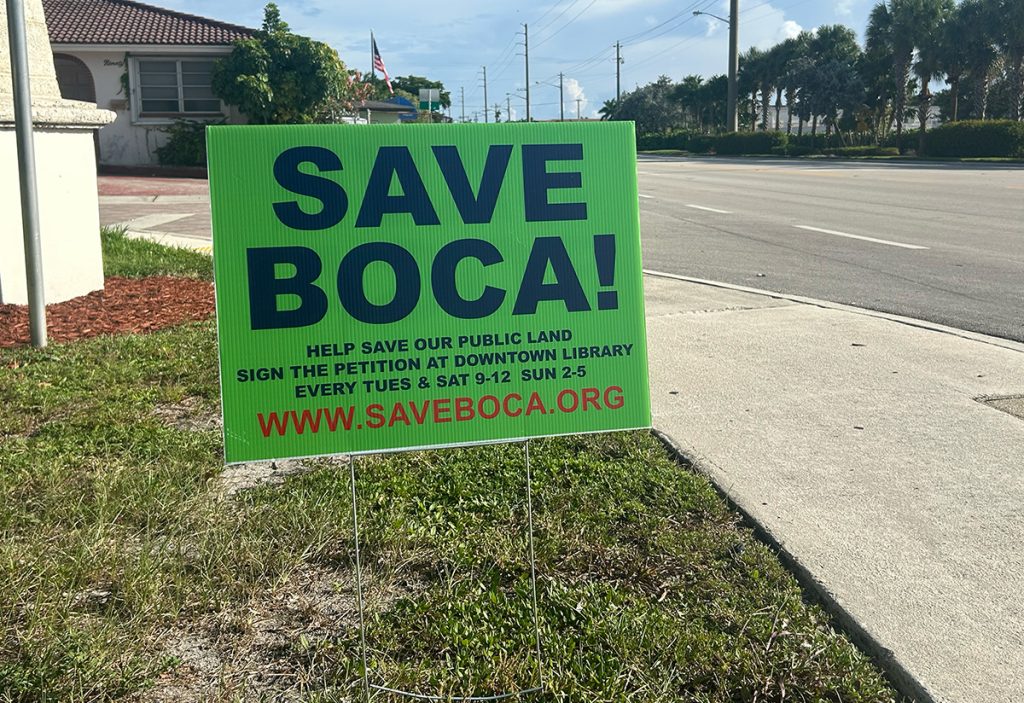
Nine days ago, Save Boca issued one of its typically hyperbolic emails. This one scolded the city council for voting unanimously to approve the “destruction” of banyan trees to make way for construction of a downtown apartment complex called Modera.
Last July the council unanimously approved Modera. It will have 306 units. The project will be 12 stories and 131 feet tall, replacing a low-rise office building.
As for trees, the staff memo reported that the developer consulted an arborist, who said the banyans could not be moved. The developer did move two mahogany trees. In addition, the developer will plant new trees along South Dixie Highway and Southeast Third Street, which will have wider sidewalks.
The city did allow a reduction in parking for Modera, from 538 spaces to 468. City planners agreed with the technical variation because many of the units will be smaller, meaning the project will have fewer cars.
Finally, when Modera came before the council—acting as the Community Redevelopment Agency—on July 14, no one spoke against it. Information about the trees was there for any member of the public to see. (A note, banyan trees are invasive; their root systems can damage pipes and driveways.)
It’s election season, and any development project is fodder for a political ad. Save Boca claims that its candidates will stop development that has “gone too far.”
Modera aligned with downtown development rules that voters approved. Council members can’t reject projects just because they don’t like them. And in 10 years, the tree canopy may be greater.
Save Boca’s confusing messaging
Speaking of Save Boca, members were out again last weekend collecting signatures for a petition to supposedly guarantee a vote March 10 on the Terra/Frisbie project. Yet they also had boxes of T-shirts asking people to vote no on the vote they claim is in jeopardy. Why?
Boca Raton City Council to again discuss free-standing emergency rooms
The city council had been poised tonight to return to the issue of free-standing emergency rooms.
On the agenda was a proposed ordinance—which Vice Mayor Fran Nachlas sponsored—to define where such facilities could go. Boca Raton has none, but the Planning and Zoning Board in 2025 approved one for a roughly one-acre site just east of the Boca Raton Innovation Campus (BRiC.)
After BRiC challenged the approval, citing potential traffic problems, the council overrode the board in April 2025. Since then, groups of speakers have urged the council urging to allow these emergency rooms not physically attached to hospitals.
Under the ordinance, free-standing ERs could have gone in commercial areas and the central business district. They would have to be operated by a hospital and could not abut single-family neighborhoods and school zones.
Though the Planning and Zoning Board recommended that the city allow the ERs in areas zoned for light industrial, the ordinance did not. So, ironically, the project that started this debate could not have gone at that location.
On Monday, though, Nachlas asked to postpone discussion for two weeks. Sentiment seems to be that light industrial areas should be acceptable. Nachlas denied that the city is trying to keep out free-standing ERs. Nachlas said she wanted to avoid having to “rein in” facilities that wind up in poor locations.
Council members approved the delay.
Boca to discuss increasing proof-of-residency requirements for candidates
Also on the agenda is a proposal to increase proof-of-residency requirements for Boca Raton candidates.
The city requires two documents; this ordinance would raise the standard to three. Among the accepted documents are utility bills, proof of a homestead exemption, leases and driver’s licenses. A staff memo notes that the new standard is “only slightly more stringent” than getting a library card.
In addition, though, the ordinance seeks to align Boca Raton with state law about which precincts voters can use. Under the proposal, if a candidate has cast a ballot outside the city during the year before the qualifying period, “such voting constitutes objective evidence of claimed legal residence at that non-city location” and would make the candidate ineligible.
The memo does not say what prompted the proposal. City Manager Mark Sohaney said Monday that it came from Mayor Scott Singer. I’ll have more after the meeting.