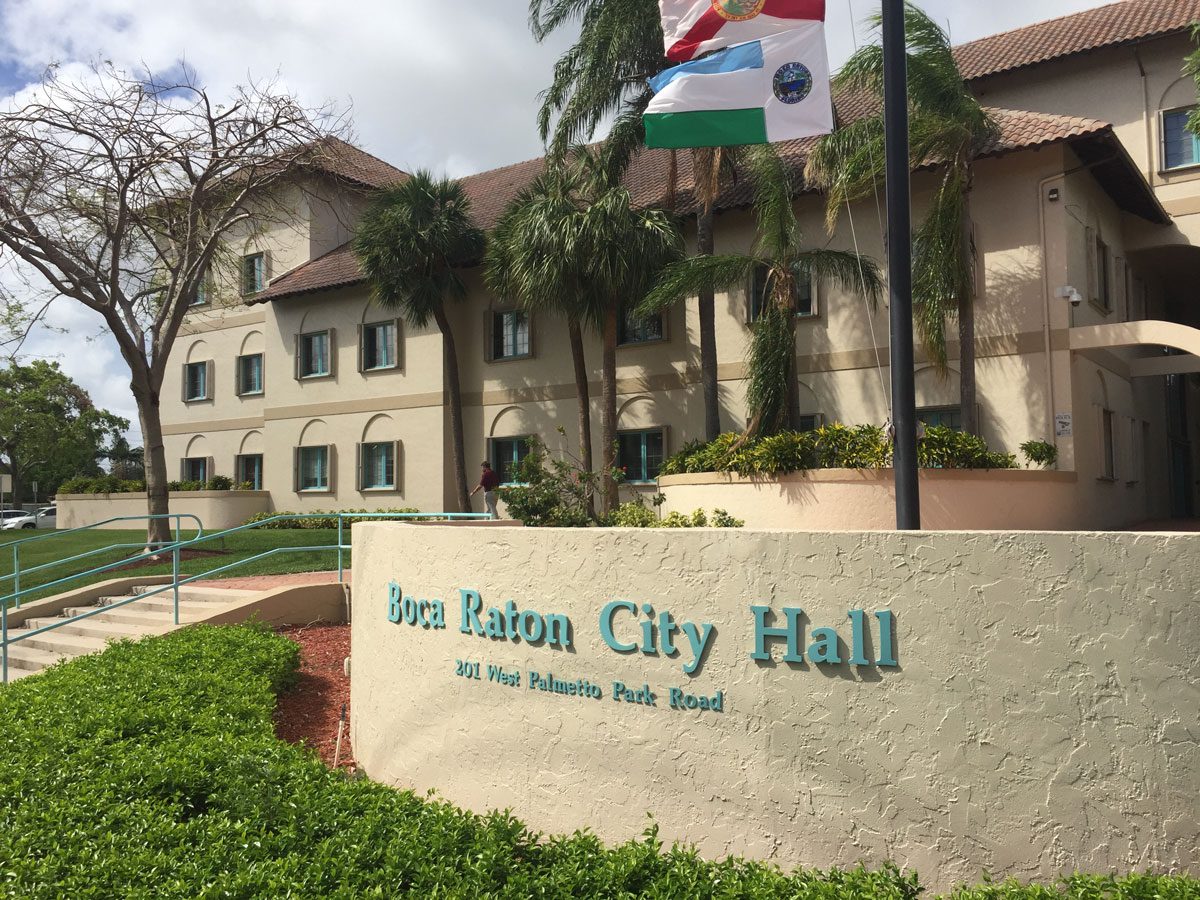
The new Boca Raton City Council will have its first big test as it considers a budget for the next fiscal year.
The council met for its first budget workshop meeting last Thursday, sooner than the usual July start date for budget discussions. This extra time, staff says, is to bring new council members—Jonathan Pearlman, Stacy Sipple, and Michelle Grau—up to speed on the budget development process and ensure there are no surprises when the final budget is approved by the Sept. 30 deadline.
The proposed citywide budget is nearly 12% lower than last year—totaling $747.6 million—with the decrease owing to a reduction in transfers and use of reserve funds. The operating budget increased slightly, up $7 million from last year to a total of $567 million.
The budget would make no changes to the city’s millage rate of 3.66, but it would hike residential rate for fire-rescue from $155 to $224. The increase, staff says, is to add staffing at Station 8. Currently, the station is the only in the city that doesn’t have constant, 24/7 staffing. The long-overdue increase in personnel would bring Station 8 to the same level as other city stations.
The city’s general fund budget would increase from $256 million to $276 million. Fire-rescue would make up the biggest portion at $87.7 million. Police is just behind at $84.9 million. A total of 22 staff positions will be added for fire-rescue, totaling $3.9 million. These include 12 firefighters, four lieutenants, four emergency medical service captains, a budget analyst, and a vehicle technician.
Roughly one-third of the budget will go toward capital improvement projects (CIP)—something Councilmember Jonathan Pearlman took issue with.
“We need to start examining the budget across the board, including and especially the CIP budget and thinking about what are the nice-to-haves and what are the have-to-haves,” he said.
Capital outlay is higher this year because of several needs that have come due. Example: The biggest item in the CIP budget—nearly $26 million of the $236 million—is upgrades to Boca Raton’s wastewater treatment facility. These upgrades would put the facility in compliance with state and federal regulation, which would qualify it as a have-to-have expense. Another $14 million is budgeted for water treatment facility improvements. These facilities treat drinking water.
Like the water and wastewater treatment facilities, the rest of the CIP projects are uncontroversial—$10 million for railroad crossings, $11.5 million in critical infrastructure improvements, $5 million for roof replacements, etc. Perhaps unsurprisingly, one project in particular came under fire from Pearlman—Memorial Park.
The proposed CIP budget for Memorial Park is $7.5 million. Per a presentation by staff, “The scope of work encompasses a comprehensive review of current spatial utilization, structural integrity, and mechanical systems” for the “strategic rehabilitation and enhancement of core civic buildings, specifically targeting City Hall, the Community Center, and the Singing Pines facility.”
As usual, Pearlman brought up the March election to make his point—specifically the $190 million police station that voters rejected.
“Residents across the city were angered by the fact that the city had spent $560,000 on these plans,” he said, referring to the money spent on the architectural firm that designed the station.
“Now we’re talking about potentially $7.5 million on design and engineering plans” he said, without a “shovel hitting the ground.” He called the $7.5 million figure “outlandish” considering the proposed property tax reform bill that voters will approve or reject in November. The tax reform bill—which if approved would go into effect next January—would not impact the 2026-27 budget.
While the $7.5 million is budgeted for “design and engineering,” it covers tangible upgrades to climate control technologies, ADA accessibility improvements, and architectural restorations across the 30-acre area that includes infrastructure, utilities, and recreational facilities.
“It does seem like a big number, but when you disperse it over the 30 acres [of that area], there’s a lot of city infrastructure that’s pretty long in the tooth,” said Public Works & Engineering Director Zach Bihr.
The budget is preliminary and subject to change. Furthermore, no funds can be spent without council authorization.
Boca City Council weighs use of AI
During budget discussions, Councilmember Michelle Grau floated the idea of the City implementing artificial intelligence (AI) into city operations.
Among the tasks Grau said AI could improve efficiencies were contract reviews, identifying inconsistencies in budget documents, assisting with grant research, streamlining public records and customer service response times, automating routine tasks, and more.
Boca wouldn’t be the first city to implement AI tools in city operations, but these tools aren’t always accurate or efficient.
What most refer to as AI—software like ChatGPT, Claude, Google Gemini, etc.—isn’t really “artificial intelligence.” They are Large Language Models (LLMs) that recognize patterns in language and form statistically likely responses based on relationships between these patterns. They do not “think” or “reason;” they associate.
The problem is that these LLMs are often incorrect. They produce “hallucinations”—outputs that are false or misleading—an issue for AI tools that will be used for residents seeking information. This has already happened in New York City, where an AI chatbot that was intended to help business owners navigate the permit process encouraged users to break the law.
The council agreed to look into ways to responsibly integrate the technology.
Boca Raton Fire Rescue implements whole blood program
The City of Boca Raton’s Fire Rescue Service will now begin carrying whole blood in a specially-equipped Fire Rescue EMS vehicle.
Because of the logistical obstacles to carrying blood, only about 2% to 3% of EMS agencies in the country have a whole blood program, according to the National Highway Traffic Safety Administration. A supply of whole blood allows first responders to treat patients suffering from traumatic injury in the field, instead of waiting until they are transported to a hospital.
“Administering blood in pre-hospital environments is a critical intervention that can significantly improve patient outcomes,” said Fire Chief John Treanor in a press statement. “Boca Raton Fire Rescue is now equipped to perform this vital procedure, enhancing our service delivery to those we serve.”
Boca receives grant for Jeffrey Street railroad crossing
The City of Boca Raton this week received a $2 million federal grant that will go toward the creation of a public street crossing over the Florida East Coast Railway tracks that will link Northwest Second Avenue and Federal Highway.
The project provides a new east-west connection for not only drivers and pedestrians, but first responders as well. The road will likely also help with congestion on Yamato Road, the nearest road that crosses the tracks. The current Northwest 28th Street railroad crossing will be closed and replaced by the new crossing.
The project will break ground this November and is scheduled for completion near the end of 2027.
Correction
In a post two weeks ago I wrote that former Boca mayoral candidate Mike Liebelson did not mention Florida’s home insurance rates when discussing affordability during public comments made at a city workshop meeting on the proposed tax reform bill. That was incorrect; he did cite insurance rates as contributing to housing costs.