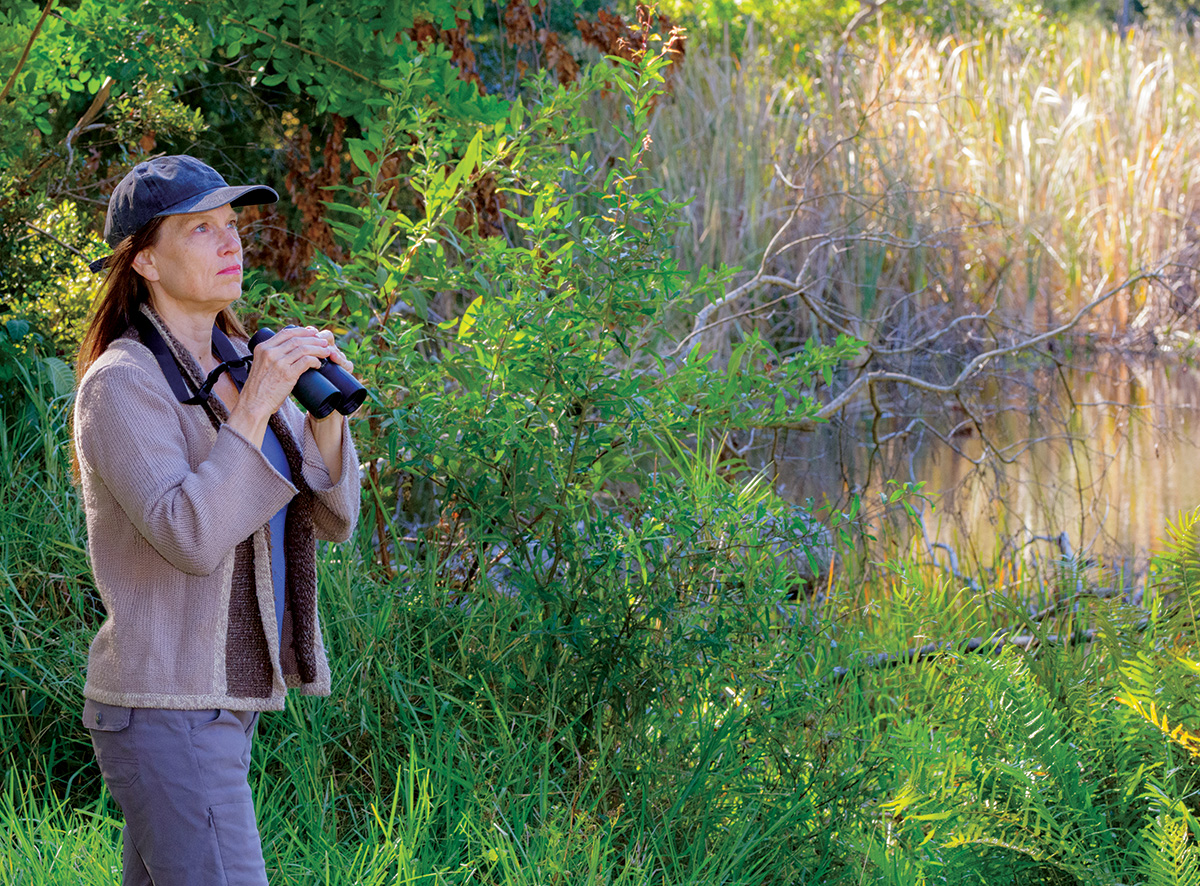
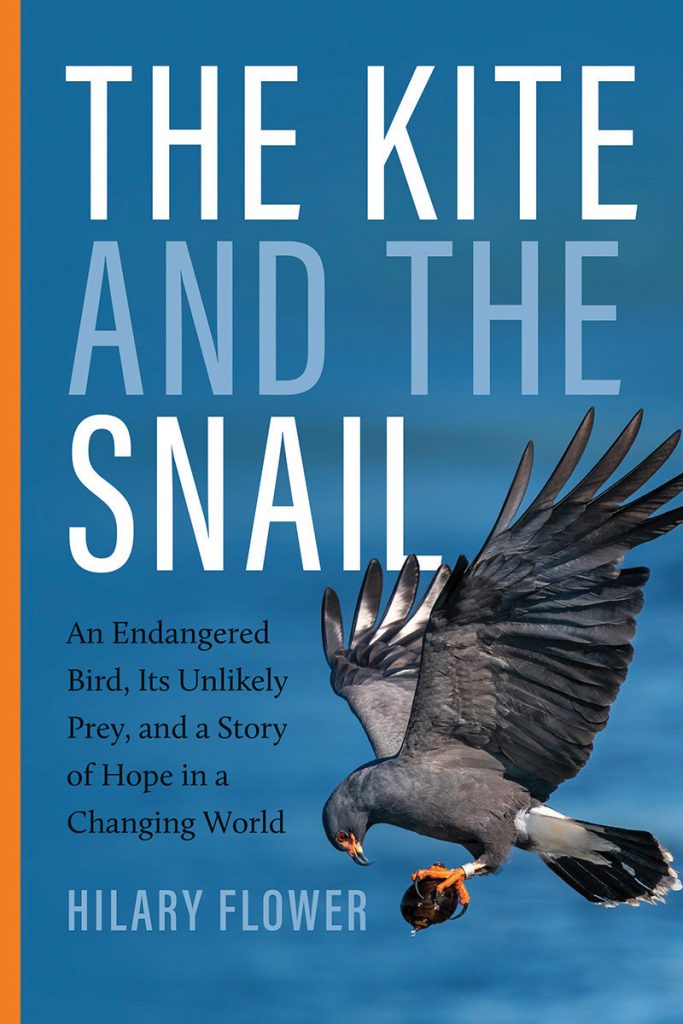
Hilary Flower’s latest book, The Kite and the Snail, sounds like a lost Aesop fable, and it exudes a similar sense of wisdom and purpose.
The kite in question is the Everglade snail kite, a bird of prey whose only U.S. presence, until very recently, was in Florida. Its titular companion is the apple snail, the kite’s primary food source, which feeds on freshwater periphyton historically found in the Everglades.
For millennia, the Everglades were the ideal ecosystem for this circle of life: Snails consumed the periphyton, kites ate the snails, and both species flourished. But as water-level controls and habitat destruction in the Everglades transformed the historic river of grass, native snails gradually disappeared, and so did the region’s namesake bird.
The snail kite made the country’s first list of endangered species in 1967, after its numbers plummeted to as low as 25 individuals. Flower, an ecohydrologist (someone who studies the interactions between water, organisms, and their shared environments) and associate professor of environmental studies at Eckerd College on Florida’s Gulf Coast, writes that she saw her last snail kite in the Everglades in 2013.
But The Kite and the Snail (University Press of Florida) is not a despairing text. On the contrary, its subtitle, “An Endangered Bird, Its Unlikely Prey, and a Story of Hope in a Changing World,” speaks to the guarded optimism of her research, buttressed by fi rst-person experiences in wetlands such as Palm Beach County’s Grassy Waters Preserve and Loxahatchee Slough Natural Area, and copious interviews with experts in kites, snails, conservation, and Florida eco-politics.
“It’s not fundamentally a bird story,” Flower says. “Although it’s told through the lens of this bird, it’s a much bigger story. It’s about Florida, and what Florida we want, and the two Floridas rubbing up against each other, and fi nding our future and our values.”
The book’s 200 pages contain scores of revelations that speak to the snail kite’s remarkable adaptability. For one, snail kites are among the 1% of bird species that engage in ambisexual mate desertion—meaning that in declining habitat, while one partner cares for its nest, the other leaves its tenuous home to search for more appropriate foraging grounds. When native apple snails began to dwindle as a food source, the kites underwent rapid adaptation—bigger bills, longer leg bones, heavier body weight—in order to feast on an invasive South American snail species five times larger than the native snail. “The snail kite story was one of these rare instances where an invasive species is saving an endangered one,” Flower writes.
“If we can get the Everglades healthy again, and we have the native snail, we don’t need the invasive snail. But for now, the snail kite would tell us, ‘I do need that invasive snail, or I would go extinct,’ and the invasive snail needs hydrilla [an invasive aquatic plant that has caused ecological damage in the Everglades.—Ed.].”
Flower embarked on The Kite and the Snail during a recent sabbatical from her St. Petersburg college, after learning that, unlike with panthers and manatees, nobody had written a snail kite book. “The snail kite is this endangered raptor, but it’s so tightly connected to the hydrology,” she says. “I realized that it would unite my research interests with the broader implications. And I realized I would learn so much. … I saw parts of Florida I didn’t know existed.”
The reader discovers these places—Grassy Waters emerges as a Goldilocks zone where the snail kite and native apple snail continue to coexist—along with Flower, who writes with a journalist’s attention to detail and an enthusiasm that’s infectious to the lay reader. For Flower, it was important that the book’s audience reach beyond the scientific community. “I wanted to be able to engage my friends and people in Florida in general, in a conversation about what’s really happening with our conservation,” she says.
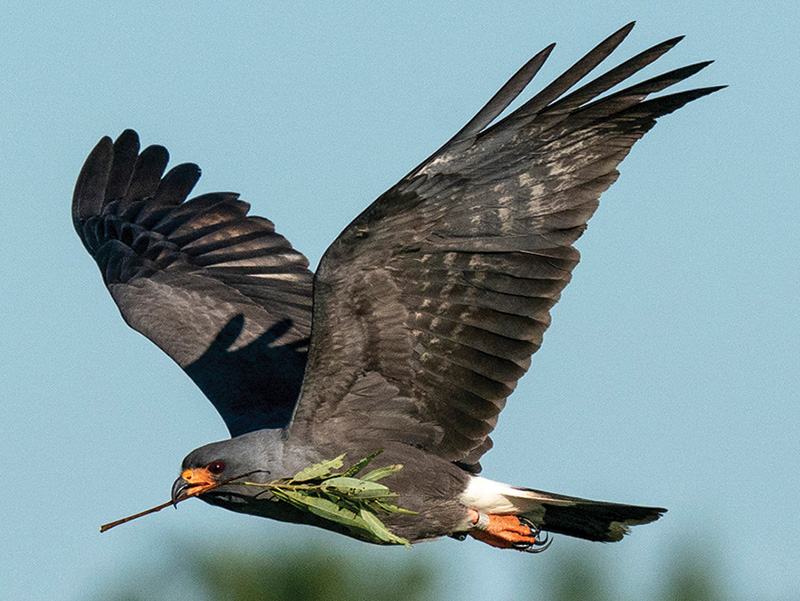
According to the National Audubon Society, the snail kite population dropped to 2,000 in 2025. Flower describes the bird, despite its relative rebound, as occupying “this razor’s edge of being exquisitely vulnerable, because if the invasive snail has a couple years where it doesn’t have a population boom, the snail kite population will tank.
“And at the same time, they are just phenomenally adaptive. If a farmer floods their pasture, and the invasive snail takes off, the snail kites will find it and have an incredible nesting year. And if it’s not going well, the next year they’re going to be somewhere else. They are just so aware of conditions in Florida and how to exploit that to make babies. They’re ahead of us. … We need to be looking to the future too, so that we are making changes now that will make us more resilient for what’s coming.”
This story is from the May/June 2026 issue of Boca magazine. For more like this, click here to subscribe to the magazine.