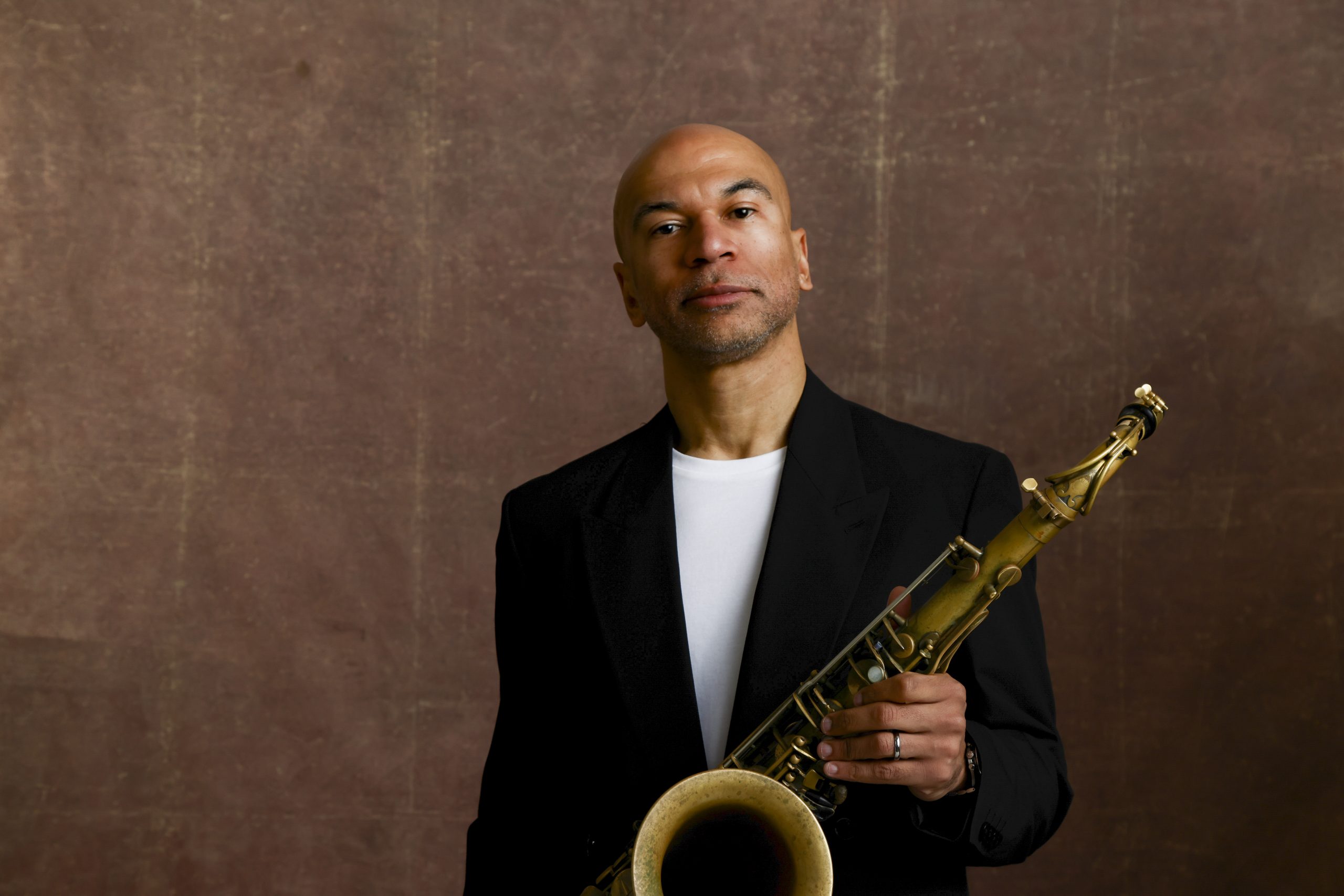
It is rare indeed for a contemporary jazz artist of Walter Smith III’s caliber to perform in humble Delray Beach—and it serves as an ongoing testament to Arts Garage’s commitment to the genre that he’ll be alighting here next week with his trio project.
A Houston native currently living in Massachusetts, where he chairs the Woodwind Department at Berklee College of Music, Smith is one of the leading tenor saxophonists of our time, a composer and player both rooted in jazz’s traditions and dedicated to exploring its adventurous fringes. The 45-year-old post-bopper has released 12 albums as a leader, performing with such star sidemen as Joshua Redman, Christian McBride, Jason Moran, and Dave Holland. The last three of his LPs have been released on Blue Note, the most important of all jazz labels, including his latest, TWIO II, a vibrant selection of reimagined standards.
TWIO II, featuring Joe Sanders on bass and Kendrick Scott on drums, also welcomes saxophonist Branford Marsalis and legendary bassist Ron Carter on select tunes. The album, which released earlier this month, has met with rave reviews. I spoke with Smith via Zoom in advance of his April 4 performance at Arts Garage.
In 2018, you released the first TWIO album. Why the unusual spelling—TWIO instead of TRIO?
I don’t know—sometimes just to make it a little different, if everything is Walter Smith Quartet, or Walter Smith Trio, or something like that. I think it is cool to have a name for it, because then it separates it from all the other ones. But it’s ridiculous, though.
This is the second TWIO album. What separates your approach to this particular project, as opposed to other albums that bear your name?
When you’re playing standards, obviously it’s music that I didn’t write, and when you’re preparing for an [original] album, I guess a large part of that preparation is the writing process and then editing and reworking, and then trying to get to something which you never really complete by the time you record it. Usually the songs get distilled and become more definitive as you get to play them live over time, but the bulk of the process is focused on that, at least for me.
And then something like this is not at all focused on it, because I’m not writing anything. I’m learning songs that I’ve always wanted to learn, because maybe they fit a certain space that is not represented on the set list for the album. So it’s more about just exploring, listening to a lot of recordings, the actual practicing part of learning the songs, learning different versions, and learning to play over them. So it’s more, I would say, saxophone-driven on something like a trio thing than it is on something that’s involving original music.
How do these songs change or evolve when you take them on the road night after night?
We just finished six nights in New York at the Village Vanguard, and for those sets, we had a guest every night, and I noticed how I played differently depending who the guest was. Like Joe Lovano was there one night, and just from us playing a little bit before the gig, I played so different than when Chris Potter was there. And I think it affected the way that the band played as well—just the precision or the looseness of how we approached the songs, how we did the intros, what set list we even went with, and then the arrangements.
Help me understand how improvisation works with your groups. Is it similar to the improv theater concept of one person introducing an idea, and the rest of you picking up and riffing off that, and then you presenting your own ideas for your colleagues to accept, in a full-circle sort of way?
Sure, I think that’s one part of it. What we’re dealing with mainly is layers. So that’s happening. But within that happening the way you just explained it, there’s also the melody of the song, which we are all maybe using as the North Star; that’s like the top of the echelon. So we’re kind of doing the thing you said, but always going back and referencing the melody and then form. There are certain things that happen in every one of the songs that we chose that are a little bit quirky, or maybe there’s a moment where it comes together on a certain beat, and that is also in there. So at any moment, that could supersede everything else.
I think the ethos is that improvisation, usually, when people think about it, it’s like, if there’s saxophone player, they’re standing in front, they’re playing, it’s a solo, that kind of thing. But for us, we’re thinking about everybody standing in a straight line; we’re all contributing to the sound of the group, rather than making it so much about people taking turns.
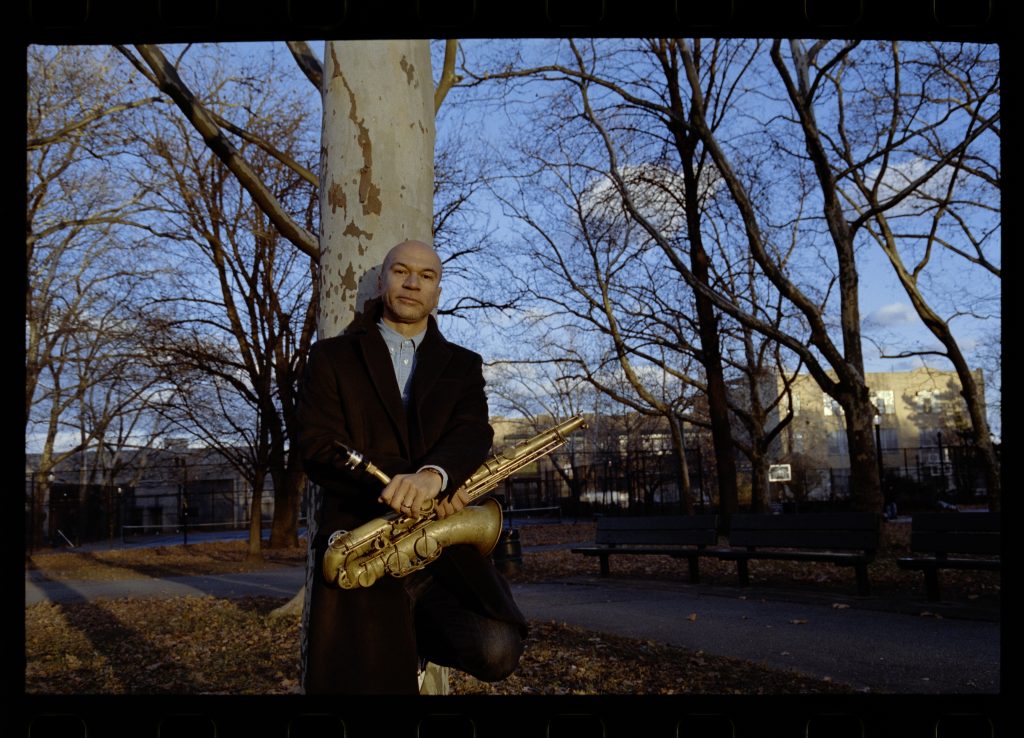
You also feature some of the living legends of jazz on this LP, Branford Marsalis and Ron Carter. How did you bring them in, and then decide where their talents could best contribute?
Going back to the original music, I think I’m usually looking for 45 to 50 minutes of music. And for that, I will write probably about 12 to 15 songs for the session, knowing that somewhere around nine or 10 will be what it ends up being. For this, I have a set list of like 50 songs, and we just played them all, and then picked what worked. The session with Ron and Branford, we redid some that we had just done in trio with Joe and Kendrick, but their talents are beyond being me, like, picking a specific song for them to play on. It was just like, oh, let’s do these seven, eight songs. And then when Branford got there, his were scripted, because [with] those, I wrote one and then we had an arrangement for another one. But outside of that, it was just, let’s just play and see what sounds good.
You’ve got Harish Raghavan on bass for this tour, instead of Joe Sanders, who recorded on the album. Does the presence of someone new learning the music change the songs as well?
Absolutely, and so the part of this album that made me want to do it again is not so much playing standards, but it’s about being able to open up the Rolodex to include different musicians in the tours. Now, Harish is an exception, because I do play with him a lot in my own bands. But the specific songs are not so important. The type of songs that we’re going to play is kind of the goal. There’s no rehearsal needed, because everybody knows a ton of these songs. It’s the foundational material. So just showing up and then talking through: “Hey, what fast stuff do you like to play? What do you like to do in this kind of vibe?” And then having them bring their personality into it. So Harish replacing Joe will, like you said, create a whole different thing.
I don’t think I go into any of this with expectations. So in that way, you kind of see what happens, and see where it can take you and what can be different about it than what we would normally do.
This is your third release for Blue Note, the most important jazz label of all-time. How has being a part of that major label infrastructure elevated your profile?
That’s an interesting question, because I don’t know the answer to it. I haven’t felt anything different. I think mostly because I’m old already—I’d already had, like, seven or eight albums. I think if I’d started there, I would have seen a difference, like when I would leave the label, of how it would play out. But I do think the difference for me is that there are people that take you seriously in a way that, just because they love everything that the label stands for, when they see that you’re associated with it, it gives them confidence to like the music in a way that maybe they would not have before.
And I also think there’s a certain section of the listening public that just listens to whatever Blue Note puts out. Just for me, in how I’m moving through the world and doing concerts and doing all this stuff, I don’t know what the difference is, but I know that there’s something out there happening.
Smith’s trio performs at 8 p.m. April 4 at Arts Garage, 94 N.E. Second Ave., Delray Beach. Tickets cost $65.50-$70.50. Call 561/450-6357 or visit artsgarage.org.
For more of Boca magazine’s arts and entertainment coverage, click here.