
Ninety-eight manatees have been killed in 2016 to date. This is notable since the US Fish and Wildlife Service wants to take them off the Endangered Species List and down-list them to Threatened, and Governor Rick Scott has eased boat speed restrictions in some Florida counties. Keep in mind that even though responsible boaters will follow posted manatee zone speed limits, others will not, thus the manatees will possibly incur injuries or death from boat or boat propeller strikes.

Granted, manatees can often be difficult to see in the water. My visit at Manatee Lagoon, an FPL Eco-Discovery Center in West Palm Beach, resulted in observing one lone manatee in the water, and I had to strain my eyes from the sun’s glare to see it.
When the outdoor temperatures are cooler, manatees will congregate by the Florida Power and Light Next Generation Clean Energy Center’s warm-water outflow area. Looking across the water, there was a line of buoys that marked where boats are permitted. Despite the huge yachts and commercial vessels in the area, a small boat sped across the water very close to that line. Let’s make a human-manatee connection.
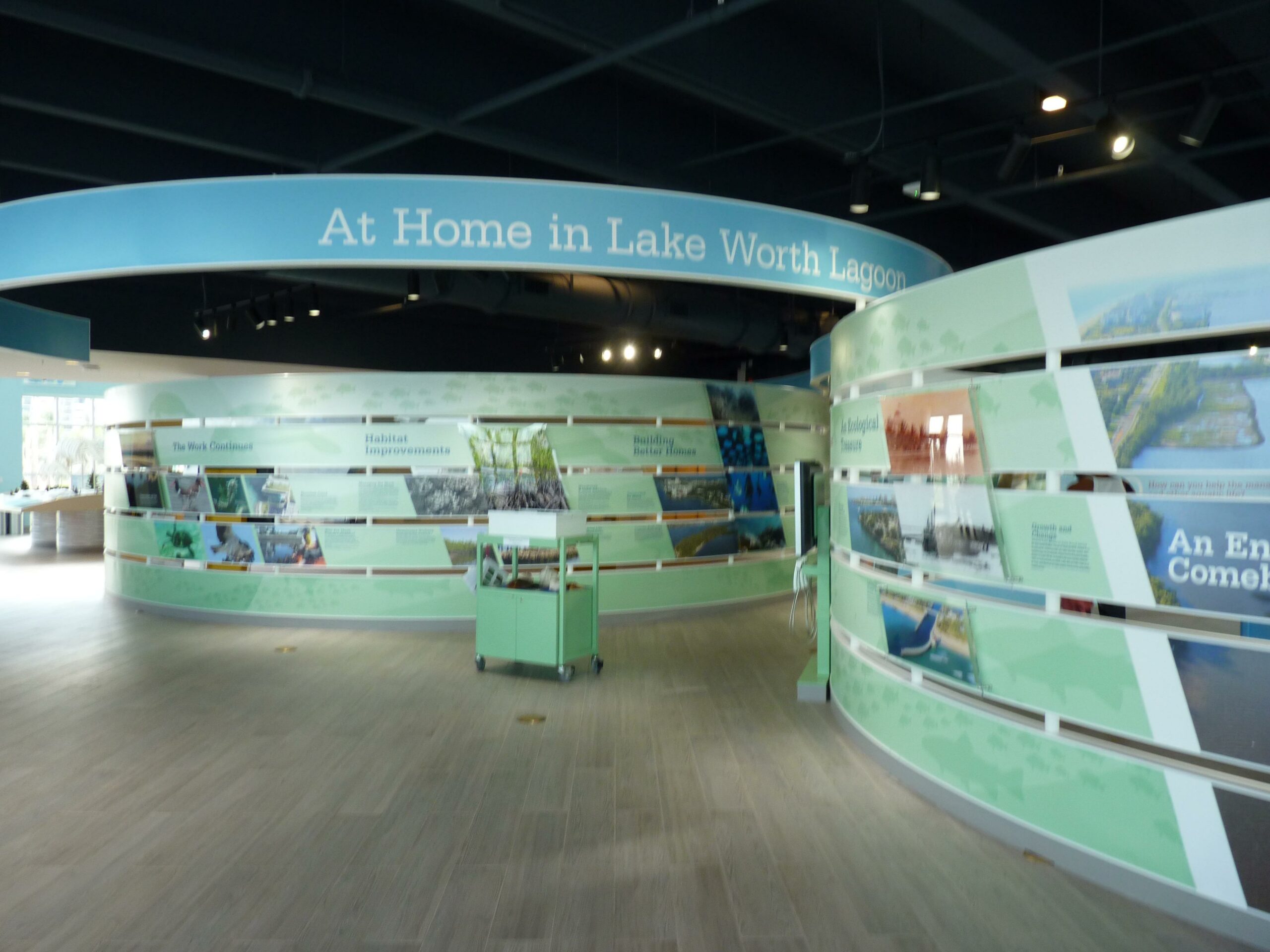
Manatee Lagoon is a state-of-the-art information center with a long, almost wrap-around walkway at the water’s edge. Visitors can stand by the rail and look into the water for manatees. Inside, there are several stations which educate and inform about the manatee. Each station has a handheld receiver that allows a quieter experience for everyone in the center.

The two most fascinating stations are, one where you can pick up a large bone from a manatee and feel its weight and density, and the other, which offers the chance to listen to the different sounds manatees make, such as the sounds of mothers and calves talking to each other.
Their bones are hard and heavy, and not flexible like human bones. They break and shatter easily when struck by boats and propellers. They breathe through nostrils and have to come up for air every two to five minutes. Their faces seem to have a perpetual content look to them.
It is heartwarming to know that there are more than 6,000 manatees state-wide. These large sea cows, as they are sometimes called, with their slower-than-molasses swimming, beguiling faces, and preference for warm water, are state treasures. They are aquatic, mostly herbivorous marine mammals, which as Floridians, we should fiercely protect.
They are not to be sat upon and ridden like a carousel, as some tourists think is okay to do. They should not be blatantly ignored as some boaters do when rushing to get out into the open water. The manatee is the Florida state marine mammal. And it is still listed as Endangered on the Endangered Species List, where it should remain for the foreseeable future.
Manatee Lagoon
http://www.visitmanateelagoon.com/
6000 N. Flagler Drive
West Palm Beach, FL
Open: Tuesday-Sunday 9 AM to 4 PM (Closed Mondays)
Admission and Parking: Free
Gift shop funds go toward manatee conservation and to the Loggerhead Marinelife Center
Who to Call If You See an Injured or Deceased Manatee:
Florida Wildlife Conservation Commission Wildlife Alert
Toll-Free 888/404-3922
Please remember to never touch or attempt to feed a manatee.