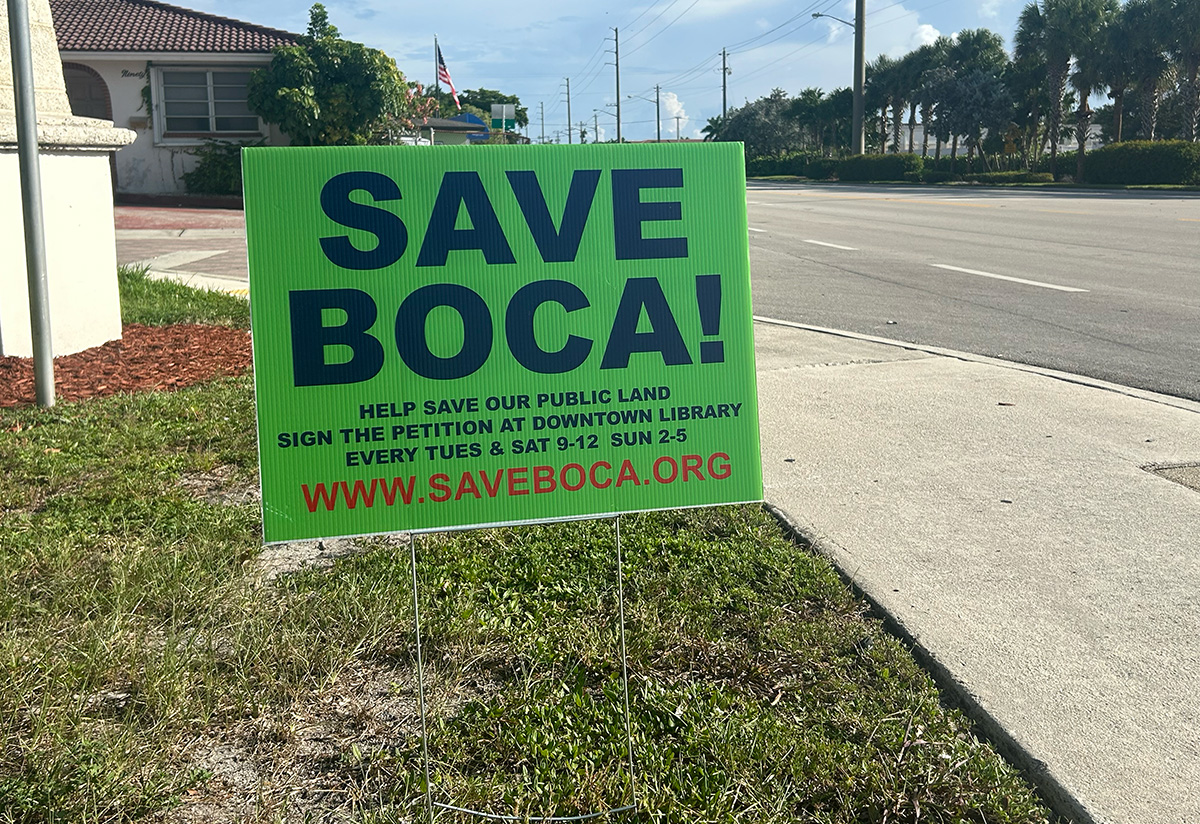
The Boca Raton City Council this week voted to adopt the amended Save Boca ordinance that will prohibit the “sale, lease, or alienation” of city-owned land larger than a half-acre without a referendum vote.
The measure passed 5-0 and represented the culmination of the Save Boca campaign launched last summer in opposition to the Terra/Frisbie-proposed One Boca redevelopment of the city’s downtown campus. In March, Boca Raton residents voted down the proposal.
Exceptions to the ordinance include lease renewals, extensions, continuations, and amendments for nonprofits, utility easements that “serve the residents of The City of Boca Raton or Palm Beach County,” the City-owned land for public facilities by the City, and the temporary use of City-owned land for recreational purposes.
The city council also approved by a 4-1 vote (Councilmember Yvette Drucker was the lone “no”) to put the language from the Save Boca ordinance on an upcoming ballot for voters to approve or reject its addition to the city charter.
The city has until March 2027 to put the issue before voters. If voters approve the change, another referendum vote will be required to undo it.
The question of Boca’s police station
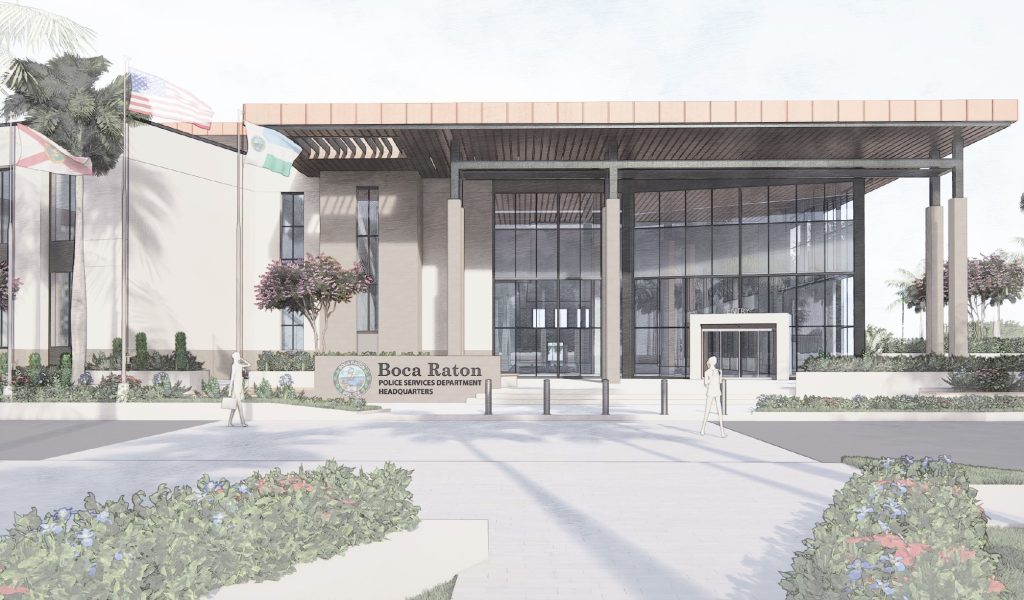
A new Boca Raton Police Station was not on the agendas of this week’s City Council regular or workshop meeting. Councilmember Jonathan Pearlman brought it up at both.
The construction of a new station for the Boca Raton Police Department, while unrelated to the Terra/Frisbie proposal, was swept up in the wave of anti-development sentiment that decided the city’s March election and was voted down by residents. Pearlman made it clear this week that the future station should remain tied to the development of the downtown campus.
At Monday’s workshop meeting, City staff presented the timeline for the City’s Request for Proposal (RFP) for the redevelopment of the downtown campus. The decision to move forward with an RFP was made due to Pearlman’s skepticism toward the Treasure Coast Regional Planning Council, a not-for-profit resource for local governments seeking guidance in the development process. Pearlman argued the City should seek a private consultant firm through an RFP.
Pearlman asked during the presentation—which detailed a six-month, resident-driven process that would begin in August and end with final design recommendations for the downtown campus—why the police station was not part of the RFP.
“There could be an RFP,” Boca Raton City Manager Mark Sohaney replied, but the consultant that the city already retained for the project has already done much of the heavy lifting. The consultant, ADG, delivered the plan—which was rejected by voters—after extensive collaboration and feedback from the police department.
“Before there was any architecture, drawing, or actual size of building contemplated, there was this foundational work around the space needs analysis and functionally what the department—not what Public Works or what I think—but what the police department thinks is going to be needed to protect the community for the next 30-plus years,” explained Deputy City Manager and CFO James Zervis.
Pearlman, however, balked at the $190 million price tag. He came prepared with a full presentation on the cost of police stations in other cities, blindsiding the rest of the council, which was unprepared to discuss the matter.
Referring repeatedly to the proposed station as a “Taj Mahal,” Pearlman argued that, “All of the residents are on board,” including the police station in the RFP, citing—as he often does during meetings—the March election results.
Mayor Andy Thomson pointed out that that’s not necessarily the case.
“The voters spoke loudly when they said what they did not want to have happen with our downtown government campus,” said Thomson. “But that didn’t necessarily illuminate anything that they did want.”
Per the Palm Beach County Supervisor of Elections, 14,122 residents voted against the Terra/Frisbie deal, while only 9,733 voted against the police station. The vote for the police station was much closer than the Terra/Frisbie vote—55% to 45% versus 75% to 25%.
Pearlman went on to argue that the reason for relocating the police station to its new proposed location on Spanish River Boulevard was that it would be displaced by the Terra/Frisbie One Boca development. This notion was quickly corrected.
“That was an operational decision,” to relocate, said Zervis. Members of the police department had in fact first suggested moving the station to a more central location years before the city began accepting bids for the new downtown campus.
Vice Mayor Michelle Grau—who won office as part of the Save Boca slate—argued for an “autopsy” of the March election results to find out why the police station was voted down. She agreed with city staff that the police station project move separate but parallel with the downtown campus project.
While it was decided that the station would be discussed at the city’s next workshop meeting, the topic came up again during Tuesday’s regular meeting—once again by Pearlman, who again criticized the price tag. When it became clear that no one else on the council shared his concern, he went on the attack.
Pearlman referenced an April 22 “presentation” led by Drucker and attended by members of city staff and various architects and engineers, and alleged that slides of the presentation revealed plans for a transit-oriented development at the 7.8 acres east of Northwest Second Avenue—the site that was the subject of Terra/Frisbie’s proposal that includes the police station.
Pearlman says he finds the current scope of work “very concerning” given Drucker’s presentation.
Drucker explained that as vice chair for the county’s Metropolitan Planning Organization, she was “asked to do a welcome, not a presentation, a welcome to members of our community and our county, welcoming them to our city and explaining our first TOD, which in fact is Mizner Park,” said Drucker.
“You ran on lies, you ran on a lot of misinformation, and you are not going to sit up here and accuse me or staff,” she said.
The presentation was created by the City’s Development Services department and included slides that showed past transit-oriented developments in the city. The downtown campus area was included in a slide as “a visual aid for discussion on the history of the City’s planning efforts related to transit-oriented development in that area,” per a City representative. The slide included no plans for future development.
With no consensus to delay the RFP, it will move forward as scheduled. Mayor Thomson, after playing peacemaker, reminded Pearlman that scopes of work can be revised.
Boca moving fast to address aggressive drivers
During public comment at city meetings over the past few weeks, Boca residents have complained of aggressive driving in their communities. At Tuesday’s meeting, Sohaney let residents know their concerns have been addressed.
Within the past few weeks, Boca Raton Police have “implemented enhanced, targeted enforcement efforts,” per Sohaney. These include additional patrols, enforcement of speeding hot spots, and “wolf pack” operations that have brought officers in from other agencies to patrol certain areas.
The results: More than 800 traffic stops, and more than 1,100 warnings and citations issued. Sohaney said that 150 tickets were issued on Tuesday alone this week.
“My message to the residents is: We hear you,” said Sohaney. “Enforcement is increasing. The message really is ‘slow down in Boca Raton.’”
Progress on finding new Boca Raton police chief
Sohaney also reported on Tuesday that the City has begun interviews for its new police chief this week from a pool of eight candidates. They expect to have a selection by June.
With the firing of Boca Raton Police Chief Michele Miuccio in March and the resignation of Interim Chief Elizabeth Roberts in late April—she left for a job in the private sector—the department lost two officers at the command level within a month. There are currently three vacancies at the command level—chief and two assistance chiefs—that are being filled by current personnel. Seth Dubinsky is serving as acting chief.
Per a representative from the City, “Acting Chief Dubinsky, in coordination with the City, has made strategic adjustments to ensure responsibilities are covered, priorities remain on track, and the department has clear direction.”
Boca Raton police issue statement on recent “swatting“calls
Last week, Boca Raton was inundated with a series of “swatting” calls—prank calls made with the intention of drawing a heavily armed police response. This week, the Boca Raton Police Department issued a statement.
“While we do not wish to cause alarm, we want to reiterate that all reports involving potential threats to public safety are taken seriously. When these calls are received, officers will continue to respond and conduct a thorough check for suspicious or criminal activity.
“Identifying the source of these calls is difficult, as these calls are often traced back to foreign countries, and the callers tend to use a VPN (virtual private network) to mask the identity and exact location of the call. These investigations are extensive and time-intensive, and we are committed to pursuing those responsible for these calls to the fullest extent of the law.”
Boca Raton Downtown Task Force gets a stay of execution
The Downtown Civic Engagement Task Force proposed by Mayor Thomson and voted into existence by a 3-1 vote was set to be potentially repealed at this week’s city council meeting. Then it wasn’t.
At Monday’s workshop meeting, Thomson argued that there is “still merit” to the idea. He urged the matter to be tabled until a consultant for the downtown campus redevelopment is found. The consultant can then weigh in on whether the task force is needed.
Since any consultant is likely to survey the public and hold listening sessions, it’s hard to see why a task force would be needed. Pearlman, however, had a different reason for opposing its creation, arguing that it would “create division” in the community.
Both Grau and Drucker agreed on tabling the task force discussion. An ordinance to repeal the task force was removed from Tuesday’s agenda.