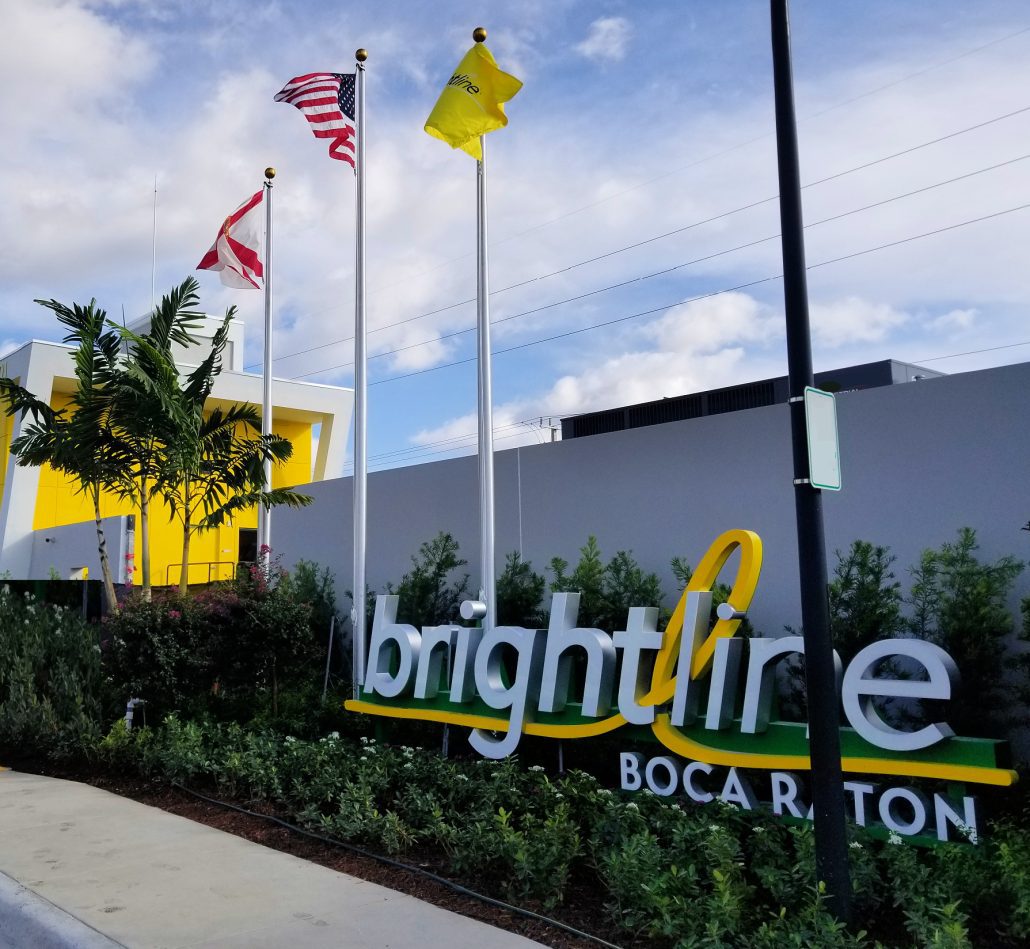
Deputy City Manager Jorge Camejo’s main responsibility is downtown Boca Raton. During a recent meeting, Camejo said people need to stop referring to it as the “Brightline station” and instead call it “a train station.”
Practically speaking, though, only Brightline trains use the station. But one can understand Camejo’s comment, especially since Brightline has become part of the debate about the proposed Terra/Frisbie redevelopment project.
Without the station, the project would not be able to obtain the density for private projects near the station under the designation “transit-oriented development.” In theory, proximity to the station would mean less traffic, as people take the train rather than their cars. Thus, higher density is allowed.
But would that shift happen? And would Brightline be around for the next few decades to make that happen?
The second question is a recurring one. It came up again last month after S&P Global—formerly Standard & Poor’s—downgraded Brightline’s credit rating. The company worried that Brightline won’t be able to meet a $1.2 billion loan payment next January without raising fares dramatically.
Brightline never has made a profit since beginning service in 2018. Despite opening its South Florida-Orlando run, Brightline lost $549 million in 2024. According to news reports, it lost almost $180 million during the first nine months of 2025.
Brightline just sold its Fort Lauderdale station to raise cash. In January, the company named a new CEO, a veteran of high-speed rail in Europe.
Boca Raton residents got good news in October, when Brightline cut fares and doubled the number of stops. Those cheaper fares, however, contributed to the company’s financial problems. Only much higher revenue, S&P Global said, can stave off default on the tax-exempt bonds Brightline got from the Florida Development Finance Corp.
Brightline’s Boca Raton station opened in late 2022, after the city contributed $10 million toward the parking garage. Another $7 million could go as early as next year toward a second platform on the east side of the tracks, to increase capacity and compel Brightline to add stops.
During city council discussion, many speakers touted the station as a “game changer.” They claimed that it would bring people to Boca Raton who would not have come otherwise.
Has it? There’s no way to tell. Brightline doesn’t track ridership by station. Mayor Scott Singer, who initiated discussions with the company, once claimed that the station “already has exceeded expectations,” but he provided no metric to support that claim.
Opponents of the Terra/Frisbie project have cited the many deaths from Brightline trains. Though all investigations have found no issues with train operation or safety features at crossings, S&P Global cited potential legal settlements as one reason for its downgrade.
On Monday, a Palm Beach County judge set a trial date for between April 20 and May 29 in the lawsuit resulting from a death at the Southwest 18th Street crossing in Boca Raton. The family of James Ostrowski claims that negligence caused Ostrowski to think that he could cross the tracks safely. Brightline counters that Ostrowski had been “issued warnings” and “recklessly attempted” to cross in front of the train.
In addition, a former conductor has sued Brightline in federal court. Darren Brown claims that he was involved in multiple fatalities—WLRN documented eight—and that the company did not take steps to prevent them and did not help Brown, who said he suffers from PTSD.
Even if Brightline left, Camejo said, a new coastal commuter rail service—complementing Tri-Rail to the west—could use the station. But talks about such a West Palm Beach-Miami service have stalled over a bridge in Fort Lauderdale. Brightline also has been sued by Florida East Coast Industries, which owns the corridor, over discussions with local governments about such a service.
Even if voters reject the Terra/Frisbie plan, the Brightline question will remain for any alternative plan. Would it be designed to capitalize on the station or finally justify it?
Mizner Plaza goes back to Boca P&Z Board
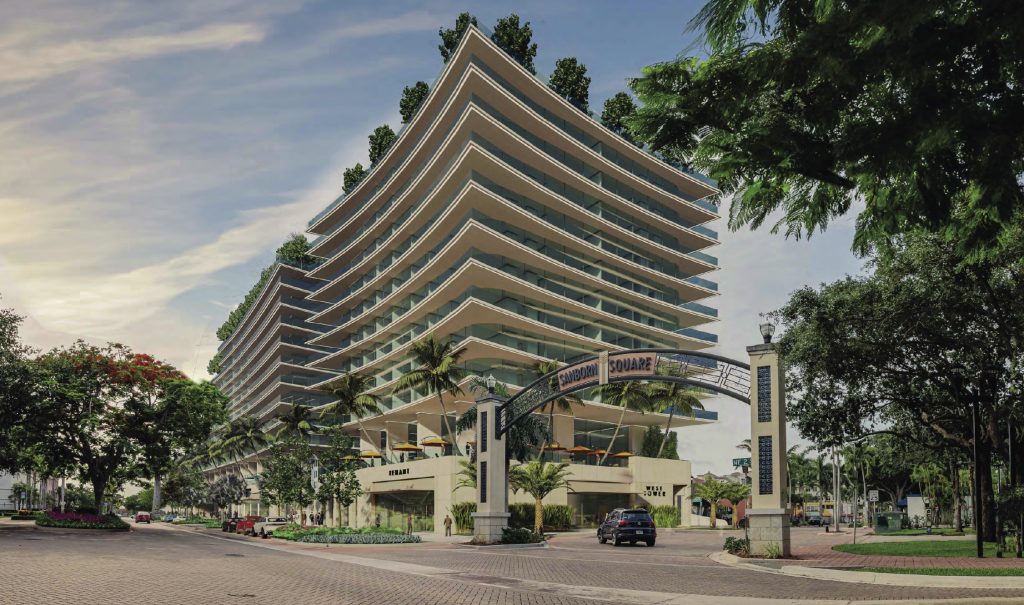
Mizner Plaza goes back to the Boca Raton Planning and Zoning Board at tonight’s meeting.
The proposed luxury hotel for just south of Mizner Park got a recommendation of approval from the board in September. Since then, however, the developers—James and Marta Batmasian of Investments Limited—have dropped plans to buy a tiny, adjoining city-owned lot along Mizner Boulevard. That change led to small modifications and a new application.
To review, the rooms would be in two towers, each roughly 140 feet tall. There would be two levels of underground parking. The project would include 18,000 square feet of restaurant space and 12,000 square feet of other retail, all on the first two floors of the towers. The project would occupy two parcels on Northeast Second Street that are home to a one-story retail strip and the downtown post office.
As the staff memo notes, the Batmasians seek a technical deviation that would allow them to provide 328 parking spaces rather than the required 557. As they did previously, the Batmasians argue that downtown parking standards are “outdated” and their number is more “realistic.” In two years, the city will update the downtown development ordinance.
Residents of the Tower 155 condo south of the site opposed the project in September, saying that it would overwhelm the area. But the memo points out that the alley between the site and Tower 155 would be widened from 10 feet to 20 feet, allowing two-way traffic, and the project would make Northeast Second Street safer. City planners again recommend approval.
Terra/Frisbie has offered to include space for a new post office. If the project fails and the council approves Mizner Plaza, there are no other plans for a replacement post office.
More Save Boca misinformation
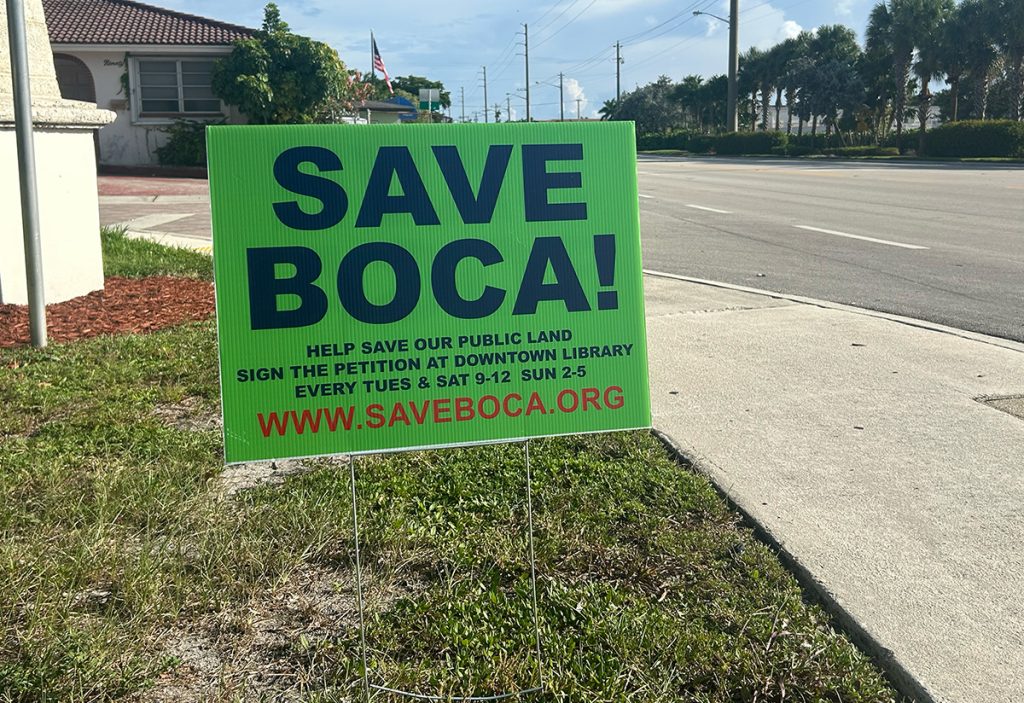
Speaking of the Terra/Frisbie project, Save Boca continues to mislead voters by claiming a link between the project and the proposed police station on Spanish River Boulevard.
An email this week listing the group’s warnings if voters approve the project included this one: “We Will Lose Our Main Police Station Downtown.” That is false.
As city officials have said repeatedly, the plan to move the station would be advancing without the Terra/Frisbie project. The station is too small and is technologically primitive. It creates a dead zone at its location near City Hall. On the ballot with the Terra/Frisbie project is voter approval of up to $175 million in bonds for the new station.
“Having a main station downtown,” Save Boca’s email says, “has always kept us safe and we stand to lose the land along with our main downtown station.” As Police Chief Michele Miuccio has said repeatedly, location does not determine safety. Downtown patrols would continue, and the Terra/Frisbie project would include a substation.
GEO Group loses at Supreme Court
Boca Raton-based GEO Group, the private prison and detention center operator, lost at the Supreme Court last week.
Detainees at GEO’s facility in Aurora, Col., had sued, claiming that GEO’s policy of forcing them to clean the facility for no pay and to work other jobs for just $1 per day amounted to unpaid labor and violated Colorado’s ban on “unjust enrichment.” Translation: GEO, they said, was cutting costs by enforcing what amounted to indentured servitude.
GEO tried to dismiss the suit, arguing that it was following Immigration and Customs Enforcement (ICE) rules. GEO lost at trial and at the appellate court. The high court affirmed both rulings, saying that GEO had to wait for the result of the trial.
The ruling was unanimous.
PBC Administrator’s pitch to replace lost property tax revenue
With the Legislature intent on imposing property tax cuts, local governments are testing ideas to make up the revenue. We just heard one of the bad ideas.
It came last week, as Palm Beach County commissioners were discussing the topic. Along with billboards, County Administrator Joe Abruzzo suggested buying lots of school-zone cameras. Violations, he said, could mean a revenue stream.
Such cameras, though, are designed to discourage bad behavior, not encourage it. With luck, saner heads will prevail if the county needs more money.