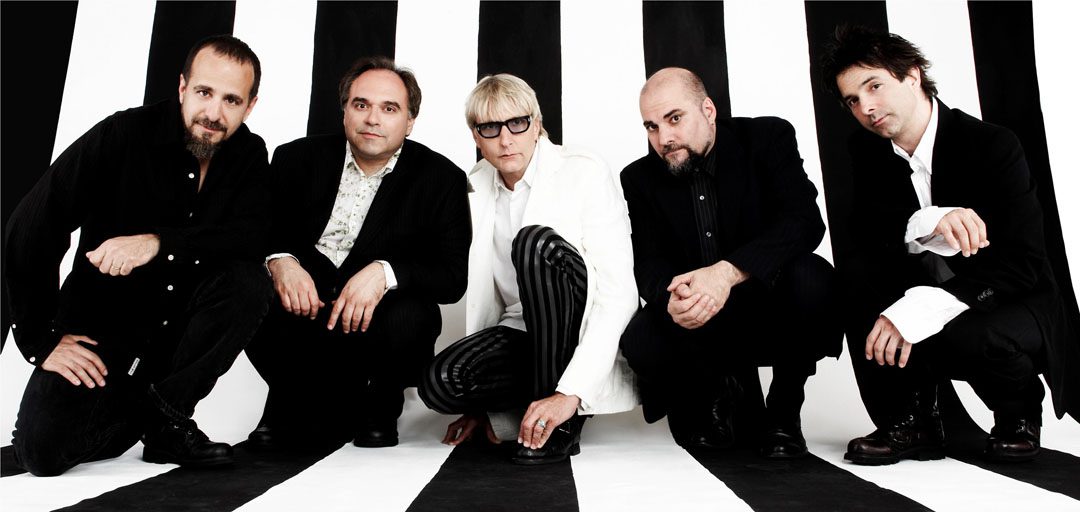

When David Letterman called the members of the CBS Orchestra into his office last year and announced that he would be retiring in May 2015 after 22 years of the “Late Show,” Will Lee (pictured in white) extended his hand and thanked the talk-show host for what he describes as “a great ride.”
In Lee’s case, that’s putting it mildly.
The only musician outside of Paul Shaffer to work with Letterman for the duration of his reign on late night—the bassist was an original member of “The World’s Most Dangerous Band,” the group that rocked the 12:30 slot with Dave during his genre-bending tenure with NBC (1982-93)—Lee has spent the past three decades in four-string heaven.
Along with taking the Letterman stage more than 6,000 times, Lee has done session work on hundreds of albums with artists ranging from Streisand and Cher to Mick Jagger and Billy Joel. He’s released his own albums, including the current “Love, Gratitude and Other Distractions.” He’s jammed alongside rock royalty as part of the Shaffer-led “house band” at the annual Rock-n-Roll Hall of Fame induction ceremonies.
And he’s one of the founding fathers of a group that Rolling Stone called “the greatest Beatles cover band without the wigs.” It’s in that capacity that Lee returns to Fort Lauderdale with The Fab Faux for a Feb. 21 gig at Parker Playhouse.
The group, which includes Jimmy Vivino from Conan O’Brien’s show, as well as Rich Pagano, Frank Agnello and Jack Petruzzelli, launched in 1998 intent on performing songs that The Beatles never played in concert (the band left the road for good in 1966). Its uncanny live renderings of complex studio songs from albums like “Abbey Road” earned the Fab Faux both critical acclaim and a devoted following—including in South Florida, where the band (which is doing “Rubber Soul” in its entirety on Saturday) has been making yearly appearances.
The son of a jazz singer and jazz pianist, Lee grew up in Huntsville, Texas listening to Miles Davis and Cannonball Adderly. But, like so many teens of that era, The Beatles would rock his world. Lee, 62, talked about that, playing with Paul, George and Ringo, his final days with Dave, and much more with Boca Raton.
Inasmuch as playing with the CBS band has been an amazing gig, you seem like you’re having the time of your life when on stage with the Fab Faux. Is it wrong to suggest that being more in the forefront with that band is liberating for you?
Musicians talk a lot about “paying dues.” I’ve never paid a due. I’ve always enjoyed playing so much that no matter what was going on, I felt that was THE place to be. That’s the feeling I have when I play. I’ve always been able to bring that to the Fab Faux, for sure. It’s triply exciting to be on stage with this band playing that music.
What was it about The Beatles’ music that inspired you in ways that other music of that time didn’t?
The impact was so powerful. You’re listening to the radio and in the middle of these sort of [same-old] tunes being played around the clock, here comes, “I Want To Hold Your Hand.” And it’s the most different thing you’ve heard in your life. You don’t even understand it at first, but then you start listening more and more and it’s unbelievable. And it changes the face of pop music, like overnight.
The funny thing is that if you were to ask The Beatles, they would have said they were doing their version of the American music that they were being influenced by. Which is hard to believe.
There are dozens of Beatles tribute bands. When you were putting the Fab Faux together, how did that influence the direction you wanted to take it?
That very thing, for the longest time, was what kept me from ever wanting to do a Beatles band. The first thing that comes to mind when you think of a Beatles tribute act is four guys wearing wigs. And that’s not anything I was interested in.
But then I heard Rich Pagano play, our drummer and singer, and I thought wouldn’t it be fun to bring The Beatles’ records to the stage with this guy. … The music itself on those later tracks is so intriguing that I felt it would be a fun challenge to bring all those elements to the stage. And in order to do that, you can’t have four guys. You need at least a fifth for the extra textures and percussion and keyboard parts.
Then it became: There are all these great songs we can’t do because we don’t have horns and strings. If we wanted to keep going with the idea, we had to get real players. We didn’t want to be a “track” act; four guys standing in front of a huge soundscape of pre-recorded whatever. So we added a cello. A real trumpet player for the solo on “Penny Lane.” Next thing you know, we had a horn section and a string section. … Another way to not make money.
As you started delving into those later studio albums, did the idea of bringing the songs to life become more and more daunting?
We did it one song as a time, so we didn’t get so intimidated by the whole catalog right off the bat.
I remember after we figured out [who would be in the band], we were all in my apartment. I wanted to hear what everyone [brought to the table], so I said let’s see what we sound like on “Because” (off the “Abbey Road” album). We assigned each other the vocal parts to match the range of our voices and we also [assigned instruments].
Jimmy drew the short straw by sitting by my keyboards, so I asked him to pick out the keyboard part. It’s in a weird key, so Jimmy has a lot to focus on. Because he sat in that chair that day, that’s what he still does on that song. That was the first tune we learned—and it still kicks our butts.

What songs give the band the most trouble as far as delivering them live?
Hmm. I can only think of, you know … all of them.
Can you put into words what it was like to play with George Harrison, and for a few songs, Ringo, at Royal Albert Hall in the early 1990s?
That ended up being George’s last gig under his own name. It was part two of the Harrison in Japan thing he had done with Eric Clapton’s band. This particular night his bassist wasn’t available, and I got the call.
The phone message on my machine was, in this authentic Liverpool accent, “This is George Harrison calling. I’d like to steal you away from that television program if you can come and play with me for an evening.”
I ignored the message because I assumed it was my brother doing his George impression, which he does so well. So I called my brother and said, “That was a great George you left on my machine.” He goes, “What are you talking about?” When I finally called the next morning, George wondered what took me so long to call him back.
When I found out that night that Ringo was going to sit in with us on the two encore songs—“While My Guitar Gently Weeps” and “Roll Over Beethoven”—I was so excited that I actually cartwheeled onto the stage. For the longest time, I felt like such an idiot [for doing that].
A bunch of years later, I ran into Dhani Harrison [George’s only son], who spotted me from across the room at some event. He ran over and gave me a big hug. I go, “You remember me?” He goes, “Oh yeah! You played with my dad and you did that cartwheel onto the stage. My friends thought that was so cool.”
It was like I had gotten a reprieve.
You also played with McCartney at the 9/11 benefit show in New York. What was that experience like?
There was a rumor going around that Paul was going to need somebody to play bass on the songs that he was going to play keyboards on. … I was never formally asked. At the studio complex where musicians rehearse in New York, we were in one room and McCartney and his group were in another room preparing for this benefit. I ran into an aide in the hallway and I said that if they needed anybody to play bass on those songs where Paul played keyboard that I was available.
The aide goes, “Oh, we all assumed you were just going to do it.”
It’s one of those things that when you put it out in the universe sometimes it comes back to you. In that case, it was way out in the universe for me—I was putting it out everywhere.
That night was tunnel vision for me. I was so star struck, so excited to be a part of it. When it was happening, it was like being in a state of suspended animation.
Do Ringo and Paul know about the Fab Faux?
There’s a documentary called “The Love We Make” about the putting together of that 9/11 concert. Paul had a camera crew with him that was so understated that you didn’t even realize they were there.
So that night, I went up to Paul and said, “I have a confession to make, I have a band”—knowing that he has a disdain for Beatles bands. And who can blame him. So I told him that our band focuses on the later, harder-to-perform-live stuff, the cool stuff. And at one point, Paul goes, “Do you do, ‘Tomorrow Never Knows’ (off of “Revolver”)?”
And I said, ‘Oh, of course.”
It’s not much of a story, but I had been telling people about it for 10 years. So the movie comes out in 2011, and there is this footage of that conversation between us—and it was exactly as I had told everybody. Lucky for me I’m not the kind of person who embellishes a story to death. … I didn’t have to pull a Brian Williams.
As far as Ringo, I’ve told him a couple of times—and he doesn’t care. If I told him again, it would be like me telling him for the first time. He doesn’t give a shit.
You’re down to 50-some Letterman shows. Do you find yourself feeling a bit melancholy as it winds down?
I’m not a person who dwells on the past, but this is making me reflect for the first time. At the beginning of this week, we’ll have 52 more shows to go. That’s a finite-sounding number compared to having done 6,000 shows with this organization since 1982.
I would have never quit because I’m a little too greedy for that. But I have other things I want to do. So it was kind of a relief when Dave called us to his dressing room one day and said, “Guys, I’m retiring.” … We had never been invited into the inner sanctum before. We thought maybe he was going to give us a bonus! … But he closed the door behind us and told us.
I reached over and shook his hand and thanked him. It’s been a great ride.
How involved with the music is Dave?
We have nothing to do with anything musically except our own play-on and play-offs. Dave does come up with requests every so often. Recently, he had us do “MacArthur Park” just because he had been listening to different verses of the song with his son. His son was [a little] confused … The lyrics to that song are not straight ahead; they’re like poetry.
Dave wanted us to learn it as a bumper as we’re going to commercial. But it’s a long song, and we wouldn’t have timed it to hit that last great note coming out of commercial. So Paul had us rehearse the song—we based it on the Richard Harris version—and Paul thought it sounded much better than he expected. He asked Dave if we could perform it as a featured song. I sang lead, we had a string section and it ended up being a big deal.
I invited Jimmy Webb, (the song’s original composer) who had not played the harpsichord part of “MacArthur Park” since Richard Harris recorded it. Jimmy was as nervous as a little kid. But he killed it, and it was beautiful.
You had Future Islands on last year, and Dave’s genuine reaction to that group had a direct impact on their notoriety. Does Dave get enough credit for being hip when it comes to music?
Dave is a very musical guy. He knows exactly what’s going on when something’s being played; he knows every song we’re doing. He also has an amazing amount of respect for all musicians. I noticed over the years that he wasn’t that in love with actors right off the bat. But he loved sports people and musicians.
He doesn’t have time to pick the music on the show, but when he does bring something in, he’s passionate about it.
What are your plans for after the Letterman show?
I’m producing people at the moment and still doing a lot of session work.
My wife and I would like to travel for a minute. That would be fun. We’ve had a week off here and there since 1982, but never three weeks straight. … If we’re not doing something for three weekends in a row with the Fab Faux, maybe my wife and I will go someplace cool.