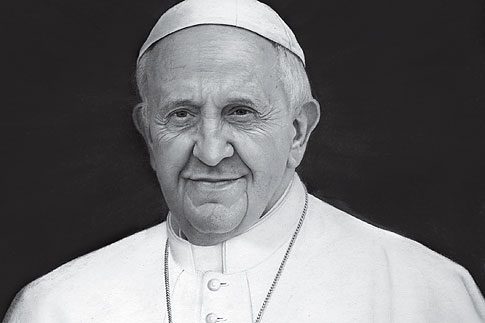
When Time asks you to design a cover for its magazine, it’s safe to say you’ve arrived. That’s what happened in 2013 when Bryan Drury, a hyperrealist painter represented by Miami Beach’s Dean Project gallery, was commissioned to paint a color image of Pope Francis for Time’s Person of the Year cover.

But the deadline was too tight for the artist’s exacting painting regimen—his portraits are so intimately detailed that he only completes about 10 a year—so instead, he submitted a graphite and charcoal print of the pontiff, gray against a black background, that in retrospect looks like the perfect image of this back-to-basics Pope: One that captures his humility, his approachability, his lack of pomp and circumstance. It is his essence.
This is Drury’s amazing talent: to capture his subjects, warts and all, and somehow penetrate their souls through the tactile physicality of their facial contours. The image of Francis is one of a dozen or so works—all the rest of them oil on wood—comprising “Terrestrial Visions,” a small but vital showcase of Drury’s paintings, currently on the second floor of the Boca Raton Museum of Art.
Aside from a couple of blazingly vivid bird portraits, his work observes people in power, from both religion and business: On one wall, along with the pope, you’ll see portraits of archbishops and Hindi leaders, Muslim scholars and influential rabbis, kabbalists and senior Buddhists. The opposite wall offers the flipside of the coin of influence, this time depicting similarly grandiose capitalists from Drury’s extended family and acquaintances.

It may take you a while to realize you’re not looking at photographs; that’s how precise and detailed a painter Drury is. You can feel every wrinkle and follicle, every dirty fingernail and wayward strand of hair, every imperfection and Botox line. “Vic” is a Charlton Heston-like figure with a titanic chest and a rugged road map of a face, a blood-red inkblot staining his front shirt pocket—an apt metaphor, perhaps, for the bludgeoning power his signature could have. His portrait of Thomas Wenski, archbishop of the Archdiocese of Miami, is jaw-dropping in its attention to minutiae, including the frayed edges of his mitre and a peak at the inside of the man’s vestments. “Isabella”—a departure from his portraits of the rich and powerful—depicts a sad, skinny, potentially pretty young woman with sleepless eyes and a bulging clavicle, blue veins visible beneath her skin.
None of the works are commissioned, so Drury reports to no one but his inner muse, giving him free reign to present his subjects without the airbrushing and color-correcting we’re accustomed to. According to Boca Museum curator Marisa Pascucci, he would sometimes subtract as well as add to his works in the process of painting them, even using some of his father’s dental tools to get it just right. It might be the only time I’ve ever viewed paintings that are more realistic than photographs. You need to see them to believe them.
***
Before you leave the Museum, you should check out another one of its fall exhibitions, “Five Videos,” an international assemblage of video work whose artists used music as a basis or a central theme.

Lise Nidraas’ “It Takes Two to Tango” is, despite its title, a still image of a Latin dancer tangoing solo in London’s ornate Rivoli Ballroom, a work that seems at once touching, inclusive (the audience could become his partner, following his lead) and haunted (is he dancing with a ghost?). Shizuka Yokomizo’s “Forever (and again)” finds the subtle differences in a repetitive concept, filming five elderly women playing the same Chopin waltz on a piano (Op. 69, No. 2), while a split screen shows vacant tableaux—a book-lined study, a verdant backyard, an empty music room—adding an undercurrent of aging and absence to the composition.
Janet Biggs’ “Fade to White” is another confluence of disparate tones, combining images from an artist’s trip to the arctic with an aria performed by tenor John Kelly against a white backdrop. The piece is at once adventurous and mournful, a lament that subtly evokes our shrinking ice caps as they die or “fade to white” from climate change. “Pictures Reframed” is a dense and lengthy collaboration by pianist Leif Ove Andsnes and Robin Rhode, who reinvent Modest Mussorgsky’s 1874 romantic masterpiece “Pictures at an Exhibition” using a combination of piano, street art and a projection wall. This one needs a lot of backstory to fully appreciate its intricacies, but the music and the art are stirring nonetheless.

Finally, saving the best and most absurd for last, Cory Arcangel’s “Cat Video” painstakingly recreates Schoenberg’s 1909 composition “Drei Klavierstucke,” a groundbreaking piece of atonal piano music, using nothing but secondhand videos of felines crawling on keyboards. Arcangel is a masterly mashup artist, and this hilarious and subversive video turns the most lowbrow form of entertainment—self-indulgent YouTube clips—into a highbrow work of avant-garde art, or vice versa.
It’s not only great to see an artist of Arcangel’s offbeat renown in the Boca Raton Museum of Art; it’s also wonderful to see a video exhibit at the museum, a rarity in recent years. I hope the museum keeps it up.
“Five Videos” and “Bryan Drury: Terrestrial Visions” are on view through Jan. 11 at the Boca Raton Museum of Art, 501 Plaza Real, Boca Raton. For information, call 561/392-2500 or visit bocamuseum.org.