Media and local dignitaries gathered at the Norton Museum of Art yesterday morning for one of the most important announcements in the history of the 74-year-old institution: the launching of the public phase of its $60 million capital campaign to renovate and expand the existing building into an elegant, eye-popping structure by 2018.
In addition to a brand-new education facility, there will be a new 42,000-square-foot West Wing and 12,000 square feet of exhibition space added to the already copious 29,000. The expansion promises nothing short of a complete Norton reboot. Hence its tagline: The New Norton.

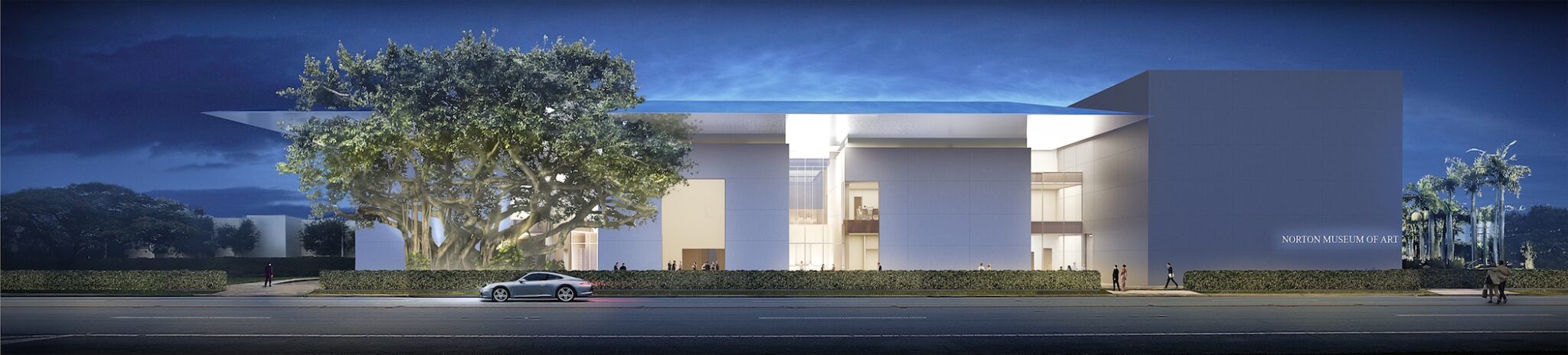
(a rendering of the New Norton facade)
“It was a discussion with [museum director] Hope [Alswang] and the trustees to have this understanding of what the museum is and to establish a master plan for the first time,” says Cheryl Brutvan, curator of contemporary art, speaking about the motivation for the expansion. “The goal is to make it a more hospitable, logical environment when you come in.”
She added, “Any exhibition is based on the space available, and the fact that we’ll have 12,000 more square feet of gallery space is significant. There are special exhibits that, whether we organize or that would come from another venue, that we can’t accommodate now. So the fact that we can be more expansive and still have that intimacy is important.”
The museum hired Foster + Partners—the esteemed London-based architectural firm whose dense catalog of diverse projects includes the Trafalgar Square redevelopment, Hearst Tower and Hong Kong International Airport—to design the new master plan, whose construction is expected to begin next year. Spencer de Grey, Foster’s head of design, spoke at a PowerPoint presentation on Tuesday morning, and he looked like he belonged in an art museum: With his neatly combed silver hair and prominent spectacles, he resembled a domesticated Andy Warhol.
“Quite a lot of our work, particularly in the early days of this project, was really getting to know and understand the building,” de Grey said. “And it is extraordinary how long it takes to really understand a building like the Norton. It is full of surprises. Every time I come here, I find something I didn’t know before. And we very much enjoy working with Hope and her team on this voyage of exploration. Because if you don’t understand the building, how on earth can you suggest changing the building?”
The museum’s areas of improvement, he noted, were its current entrance, which faces away from South Dixie Highway, and its sense of connection to the larger community. But to correct these problem areas, his firm looked to the past as well as the future.
“If you ignore the past, you’re in real trouble,” he said. “If you just stick an extension onto an existing building, it doesn’t really work. You have to understand the essence of what the original architect proposed.”
To that end, his plan reverts to the east-west axis that bisected the 1941 Norton Museum layout into roughly symmetrical halves. This means that the main entrance will once again be positioned centrally, and visibly, off Dixie. Outside, a row of hedges will flank a reflecting pool, whose tasteful fountains will be diffused onto a sleek roof made from polished stainless steel.

Inside, the entrance will lead into a Grand Hall, a social gathering place that could double as a room for entertaining. The current café, gift shop and auditorium spaces will be demolished in favor of splashier replacements, like a state-of-the-art 196-seat auditorium and a larger restaurant with outdoor dining. The sculpture garden will expand, and the forthcoming William Randolph Hearst Education Center will increase the museum’s education space by 200 percent. The current entrance space will be converted into a sprawling gallery.
Most of these developments will integrate natural light and form a more cohesive relationship between the interiors and verdant exteriors on the museum grounds—another area that could currently use improvement. And that’s not all, folks.
“At some point in the future, the [plan allows the] opportunity of building an extra new wing on the other side of the building,” de Grey said. “Because we believe that if a master plan is going to survive, it has to have room for future growth. We can’t do all the growing in one go, and then leave the Norton with nothing to do in the future. There will have to be projects after this project.”
In terms of funding this architectural dream, some of the heavy lifting has already been done. Thanks to the private phase of its fundraising campaign, it has already raised $34 million of the $60 million needed.
As de Grey’s presentation concluding to a rousing round of applause, Alswang complemented the “beautiful architecture,” voiced her excitement about raising the rest of the funds, and reiterated the Norton’s mission, and the expansion’s role in it: “You have to know that this magnificent vessel that we’re building is really in service of two things, which is great art and great education. And that’s why, when Spencer talks about the tremendous square footage gain, that’s very important, because it’s at the core of our mission—acquiring and exhibiting really outstanding art, and teaching people of all ages about the importance of the visual arts, and being a cultural center for our community, county and region. And being a leader in the nation. And we take that very seriously.”
To contribute or learn more about the campaign for The New Norton, call 561/832-5196, ext. 1116.