Boca magazine intern Guilherme De Domenico was less than effusive in his review of Christopher Nolan’s The Odyssey earlier this week, and as someone who has been an unapologetic fan of Nolan since I was a smooth-faced pre-teen with a bowl cut whose dad took him to see Batman Begins, I felt obligated to offer an alternative perspective.
I am not a movie critic. I know very little about the technical aspects of moviemaking, or what qualifies as a capital-f Film. That being said, I do know when something just works, and I can admire when an artist, whether a filmmaker, painter, or writer, just gets it. And Nolan, I think—despite deviations from the original story—gets the Odyssey and his modern interpretation of Homer’s (or whoever’s) epic just works.
Without spoiling too much (though to be fair, you’ve had thousands of years to read the poem), the story of the Odyssey revolves around the trials of the clever Trojan War hero Odysseus as he fights his way home to Ithaca through angry gods and monsters.
The first, and in my opinion, most consequential deviation from Homer’s story is Nolan’s treatment of the gods. Athena, played with heart-tugging warmth by Zendaya, is the only god we see in the film. In an early-in-the-film, late-in-the-narrative (you should know by now how Nolan treats time in his films), Odysseus laments the lack of clear communication from the gods, to which Athena responds that there’s nothing subtle about a storm or fire. In this way, the gods’ place in the narrative is as silent—and perhaps nonexistent—hands that throw our hero and his soldiers hither and yon.
It is this approach to the gods that grounds the narrative. It was, after all, not the gods that burnt Troy to the ground—which we see in brutal detail in flashbacks—it was the Greek army. Specifically, it was the Greek army through a plan devised by Odysseus, a fact that our protagonist is still wrestling with.
Matt Damon’s portrayal of Odysseus as a man tormented by his actions in the fog of war is one of my favorites of the actor’s extensive history of incredible performances. Damon’s Odyssesus is layered—a king who must see his army returned safely home, a father whose son has forgotten his face from being away at war for 20 years, a husband who understands the reality his wife faces as a palace full of suitors seek his place on the throne of Ithaca—all this while bearing the weight of being a “great man of history” whose actions he can see the results of with dreadful prescience.
Like Nolan’s Oppenheimer, there’s particular emphasis on what happens to historymakers after they’ve finished making history. In this way, The Odyssey is a thematic prequel to Oppenheimer. In both films, there’s an element of the biblical notion of original sin at play, with both protagonists seemingly naive to the long-term implications of their well-meaning actions. In The Odyssey, the emotional payoff when these consequences cohere in the third act is utterly sublime.
The supporting performances in The Odyssey lend to this emotional gravitas. Anne Hathaway is a marvel as Odysseus’ wife, Penelope, worn thin by years of longing for her lost love as she grapples with more than 100 weaselly suitors trying to claim her—and Ithaca—for a prize. Hathaway expertly navigates the extremes of hope and grief as she awaits news of either Odysseus’ return or demise. Robert Pattinson, meanwhile, is supremely punchable in his convincing portrayal of the cruel and devious Antinous, the top candidate for Penelope’s hand in marriage.
Tom Holland likewise brings his A-game to a crew of A-listers. His Telemachus is a dutiful son wrestling with the notion of taking over the kingdom of a man he’s never known as he searches for any proof that his father may still be alive. Hathaway, Holland, and John Leguizamo, who delivers a powerful turn as Odysseus’ trusted blind servant Eumaeus, are the emotional anchors of the film, each in their own way haunted by Odysseus’ absence.
The rest of the cast, including Benny Safdie’s menacing Agamemnon, Lupita Nyong’o’s guilt-ridden Helen and vengeful Clytemnestra, Elliot Page’s naive yet loyal farm-boy-turned-soldier Sinon, and Samantha Morton’s unassuming-yet-terrifying Circe, each deserve their flowers as well. While boasting only a fraction of the screen time as Damon, Holland, and Hathaway, each are unforgettable in their own ways.
The set pieces, like the cast, are equally unforgettable and made all the more imposing by Ludwig Göransson’s haunting score composed with ancient Greek instruments. The scene with Odysseus and his men in the cave of the cyclops Polyphemus—brought to horrifying life through a 60-foot puppet—is one of the most frightening I’ve seen in a blockbuster. Nolan recently expressed interest in directing a horror film, and I sincerely hope he does based on the terror and tension he conveys with the cyclops.
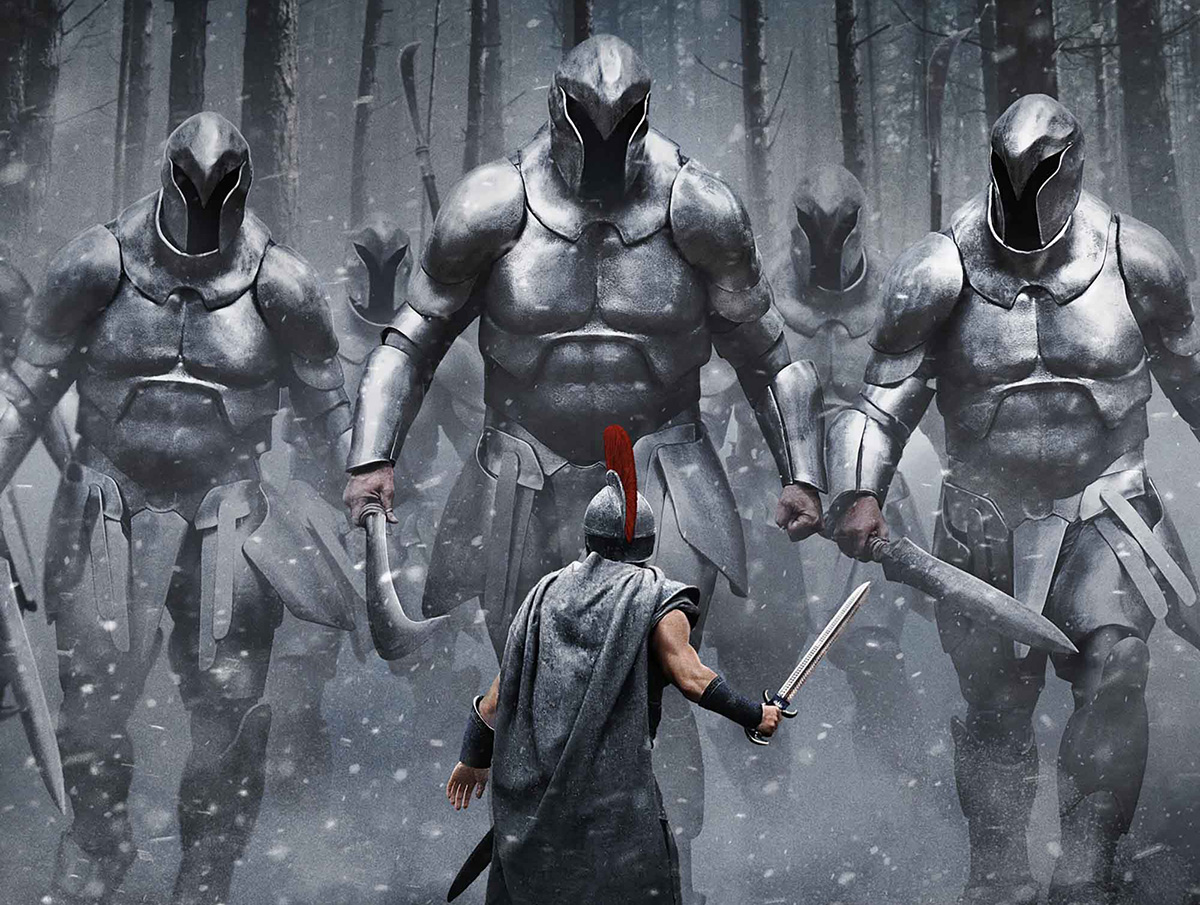
As is the case with most of his oeuvre, Nolan relies heavily on practical effects in The Odyssey. This includes the ship where Odysseus and his crew spend their time between terrors—a functional Viking longboat built by Scandinavian shipbuilders that is surely a psychic thorn for history buffs but worked like a charm for me. The Laestrygonians, who in the film wear iron armor to mirror the armored Greek hordes that stormed Troy, are brought to larger-than-life through similar practical means, with Nolan utilizing forced perspective and actors of varying heights. It’s these Herculean efforts undertaken by Nolan that do service to the grand themes he explores.
In interviews Nolan has done since The Odyssey’s release, the director has stressed the theme of “xenia” in Homer’s work—Zeus’s Law that governs hospitality and the treatment of strangers. Nolan has made a compelling case both in interviews and in The Odyssey that respect between strangers is crucial to the wellbeing of civilization.
Where Oppenheimer showed us what happens when xenia breaks down in a civilization, The Odyssey shows us the mythical original sin of civilization, the instance that civilization completely abandoned the idea of xenia. Why I feel this film just works and Nolan just gets it is because of how well he presents the importance of this very basic idea and the consequences of when it’s broken, all from the perspective of the tortured man who destroyed it.