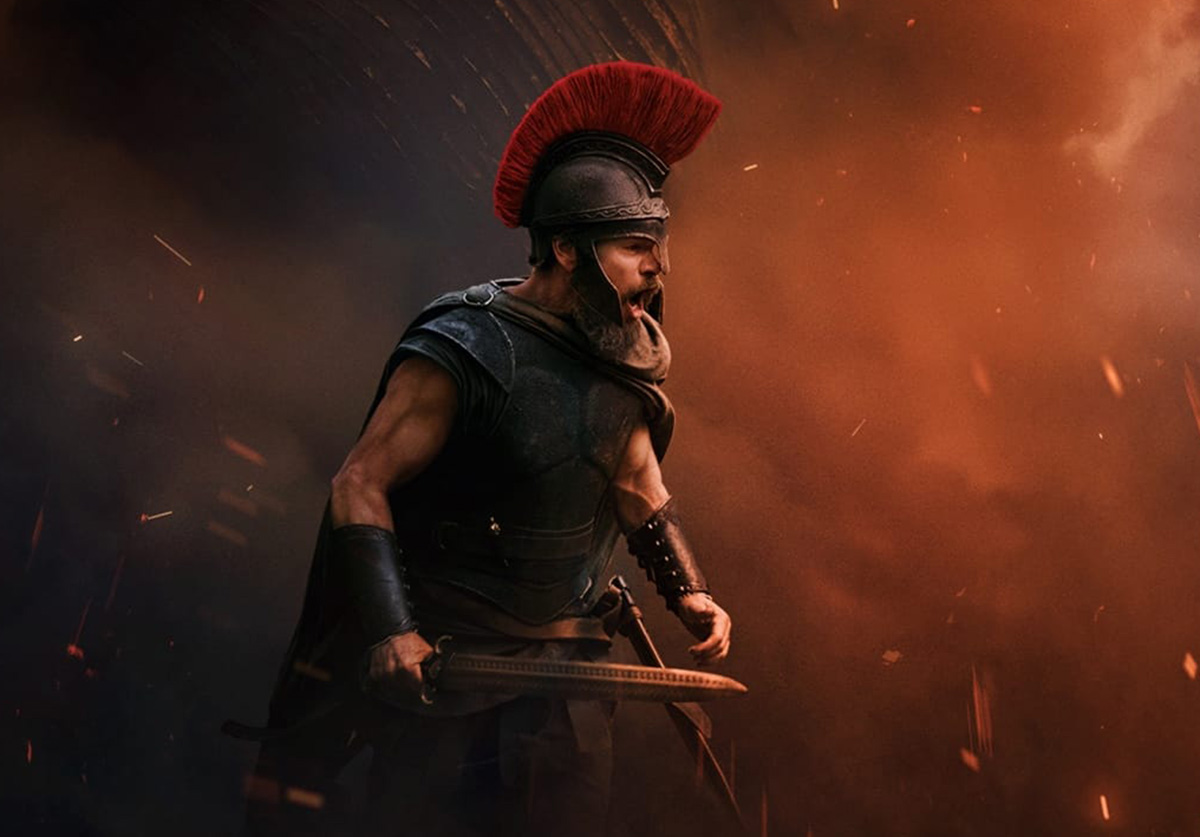
With a story as old as Homer’s Odyssey, it’s interesting to see how authors have translated the epic over centuries. The most recent by Emily Wilson opens the epic with “Tell me about a complicated man,” while Robert Fagles’ famed 1966 translation starts with “tell me of the man of twists and turns.”
Director Christopher Nolan now picks up the torch to offer his distinct view on the titular man, Odysseus.
Odysseus, played by acting powerhouse Matt Damon, goes through a 10-year journey home to the island of Ithaca after spending 10 years fighting in the Trojan War. Along the way, gods and all manner of creatures try to stop him, while his home is at risk of falling into the hands of Antinous—the top contender of the more than 100 suitors vying for the hand of Odysseus’ wife, Penelope (Anne Hathaway)—played by the ever-entertaining Robert Pattinson.
Right off the gate, The Odyssey is by far the most impressed I have ever been with a big-budget movie. The sheer dedication and hard work behind this production is worthy of myth itself, with a 60-foot cyclops puppet, an 8,800-pound Trojan horse, and an ocean-faring Viking ship built by Scandinavian boatbuilders.
In a time of CGI-dominated blockbusters, Nolan proves that the films that feel the biggest are those that are the most real. The cyclops sequence, along with the macabre visit to the sorceress Circe are cinematic moments we will be talking about for a long time.
If Nolan’s mission was to translate words from a page to a premier Imax movie theater, he succeeded with flying colors. So much so that analyzing what lays beyond the “epic-ness” at display is quite a daunting experience.
There are many reasons Homer’s classic persists even after 2,700 years. If war stories typically present the classic “war is hell” message, the central premise of Odysseus’ journey is conceptually rich: What happens after hell?
In Damon’s performance, the consequences of war come in the form of post-traumatic stress disorder. In a symbolic follow-up to his Academy Award-winning Oppenheimer, Nolan’s Odyssey is about a man coming to terms with his dark decisions and the results of being “the hero.”
Unfortunately, for a movie so brave in its filmmaking, there’s a surprising cowardice in how it translates the original text. Passages ripe for reinterpretation, specifically those that reveal the sexism of the time (such as Agamemnon’s quip “there is no trusting women” from the poem) are written out. Odysseus’s own hubris and moral ambiguity are downplayed to the point of nonexistence.
Nolan replaces words in the story but never adds anything very substantial to make his own take on the myth flourish. Moments such as the aforementioned Circe encounter have some excellent depth (mostly thanks to Samantha Morton’s gripping performance) but the point it’s making about men’s cruelty toward women is seldomly shown in the picture, much less by Odysseus and his soldiers.
That isn’t to say Nolan’s adaptation is a complete failure. Taking away the gods’ physical presence and portraying them through natural occurrences gives a nice layer of mystery to Odysseus’ journey. Ludwig Gorranson’s score is a masterclass in tension and melancholy, all achieved through authentic ancient Greek instruments.
I believe Nolan had a unique take on The Odyssey, one that uncovered the layers of Homer’s work beyond the epic scope. It just seems that he was more interested in the spectacle of the story.
In the end, Nolan’s Odyssey may not be my favorite, but that’s why different translations exist. Whether we start the story with a complicated man or one of twists and turns, the skeleton of this story has remained intact for thousands of years, and I think we will keep rearranging its bones for a long time.
See another reviewer’s take on Nolan’s modern reimagining of the Odyssey here.