Delray’s Cornell Museum of Art opened its fall exhibitions earlier this month, with the Florida Watercolor Society absorbing nearly all of the wall space, upstairs and downstairs, for its 43rd annual exhibition. This overwhelming survey of more than 100 pieces abounds in pictorial beauty, but their surface pleasures are conventional and fleeting. The exhibition that more closely reflects the current vanguard of contemporary art is the one gallery notdevoted to watercolors.

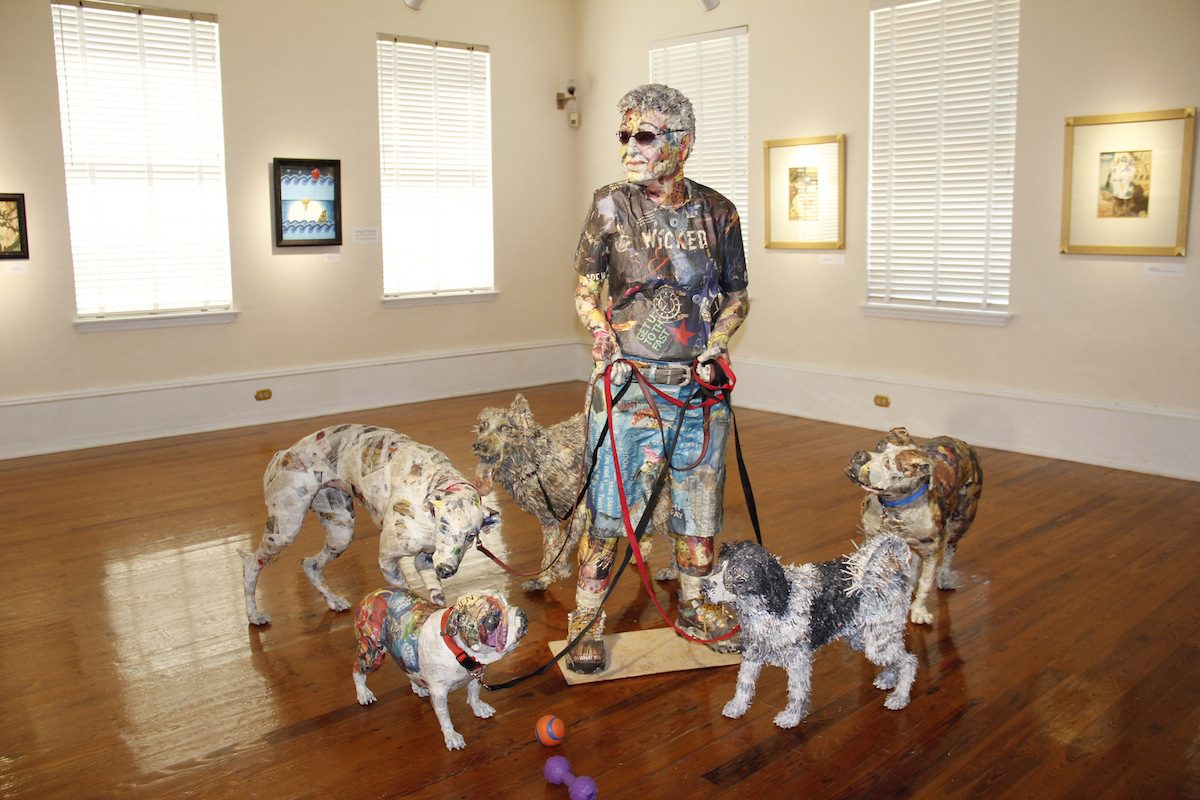
Looking for a way to extend the museum’s showcase of paper sculptor Will Kurtz’ colorful representations of New York street life—which were one of the highlights of the “Paper as Art” show this past summer—senior curator Melanie Johanson has linked Kurtz’ work to that of two other Brooklyn artists, in a fascinating if frustratingly small exhibit titled “From the Borough to the Beach: Brooklyn-Based Art.” Thus, Kurtz’ “Linda the Dog Walker” and “Church Ladies” make encore appearances following their residencies in the paper exhibition.
So does his stunning “Laid Out,” a 3-D wall hanging of a nude woman splayed across a bed, covered entirely in newspaper. As I wrote this past summer, “There’s a raw urgency to this piece, a self-reflexiveness that displays the artist’s materials, his labor and his choices right in front of us. It’s both marvelous and a call to action, seeming to say that with these everyday materials, you can create a masterpiece like this too.”
That same sense of egalitarian inspiration colors Kurtz’ additional pieces in “From the Borough to the Beach.” “Tallulah” depicts a girl in a makeshift Lilly-style dress, perched on a mini scooter and smiling up at us. She’s constructed, as usual, out of tape, glue, wood and newspaper, all of which are evident in the finished work; the process is inherent in the result, and the labor is tactile. The artist’s sense of humor and deadpan bluntness is never more pronounced than in his smallest entry in “From the Borough to the Beach,” the bluntly titled “Poor Little Mouse, Caught in a Trap.” The sculpture, presented under glass, is self-explanatory, though the mouse is a paper-clad rodent more colorful than the familiar ashen variety. It’s funny and a bit sad at the same time—not to mention characteristically Brooklyn.

A clear sense of the borough also imbues the exhibit’s second artist, Jennifer Lilya, a fashion illustrator known for her acrylic paintings of runway models. Her cleverly titled, small-scale, inevitably vertical images of leggy and stylish young women (“Instaglam,” “Nice Cream Cone”) run the fashion gamut, from sparkling formal wear to punk-rock-chic, and they usually stand in front of white backdrops festooned with colorful flourishes of pastel paint.
Contrary to first glance, these particular works are not from fashion shows. They are inspired by the street fashion the artist encounters in Brooklyn. Lilya finds the glamour while Kurtz honors pedestrians’ more earthen qualities.
Mike Cockrill, the artist rounding out this borough trifecta, is something else entirely, a cut above in both his technique and his ability to provoke. A fine artist since 1979, Cockrill is one of the most well-known artists to grace the walls of the Cornell, establishing his controversial style by subverting innocent images from the Little Golden Books series of children’s books. And in the ‘90s and beyond, he created a number of works in which children murder clowns. “I didn’t know if Delray could handle a clown-killing painting, so I stayed away from that,” Johanson says.
The pieces she selected from Cockrill’s oeuvre are unsettling enough—especially given that until recently, the Cornell was known as a pop-culture museum that ruffled few feathers. The blocky and severe oil painting “Birthday Girl” and the clean gouache “Struck Woman” both depict young females howling—at what or at whom is anybody’s guess. In the graphite drawing “Railroad Crossing,” a train bears down on a boy and girl as they scurry over the tracks ahead, injecting danger into an atmosphere of childhood innocence. In the most jarring Cockrill inclusion, “Forbidden,” two girls pause in an Edenic environment; one stares suggestively and penetratingly at the viewer, while the other pulls an apple off a tree and a snake slithers up the branch.

On the face of it, the piece shouldn’t be disturbing. It’s only when viewed through our sociological and religious filters that the painting accumulates controversy: The girl is only sexualized because our culture has deemed her so. Occasionally, Cockrill will leave in a “mistake,” such as the white paint dripping from the bottom of the girl’s top, but that only makes his work seem more unreal, and therefore more interesting.
And then the show ends, just like that, and we’re back to the placid calm of the watercolors, ushering us back into orbit. “From the Borough to the Beach” is not nearly extensive enough to do these artists justice, and I look forward to the time when Johanson will be granted free reign of the museum—presumably with the Cornell’s winter exhibition, “Language Art.”
The steps are small ones right now, but as Delray Center for the Arts ushers in a new period of leadership for both its art and theater programming, change is most definitely in the air.
“From the Borough to the Beach” runs through Nov. 16 at the Cornell Museum at Delray Center for the Arts, 51 N. Swinton Ave., Delray Beach. Admission is $5. Call 561/243-7922 or visit delraycenterforthearts.org.