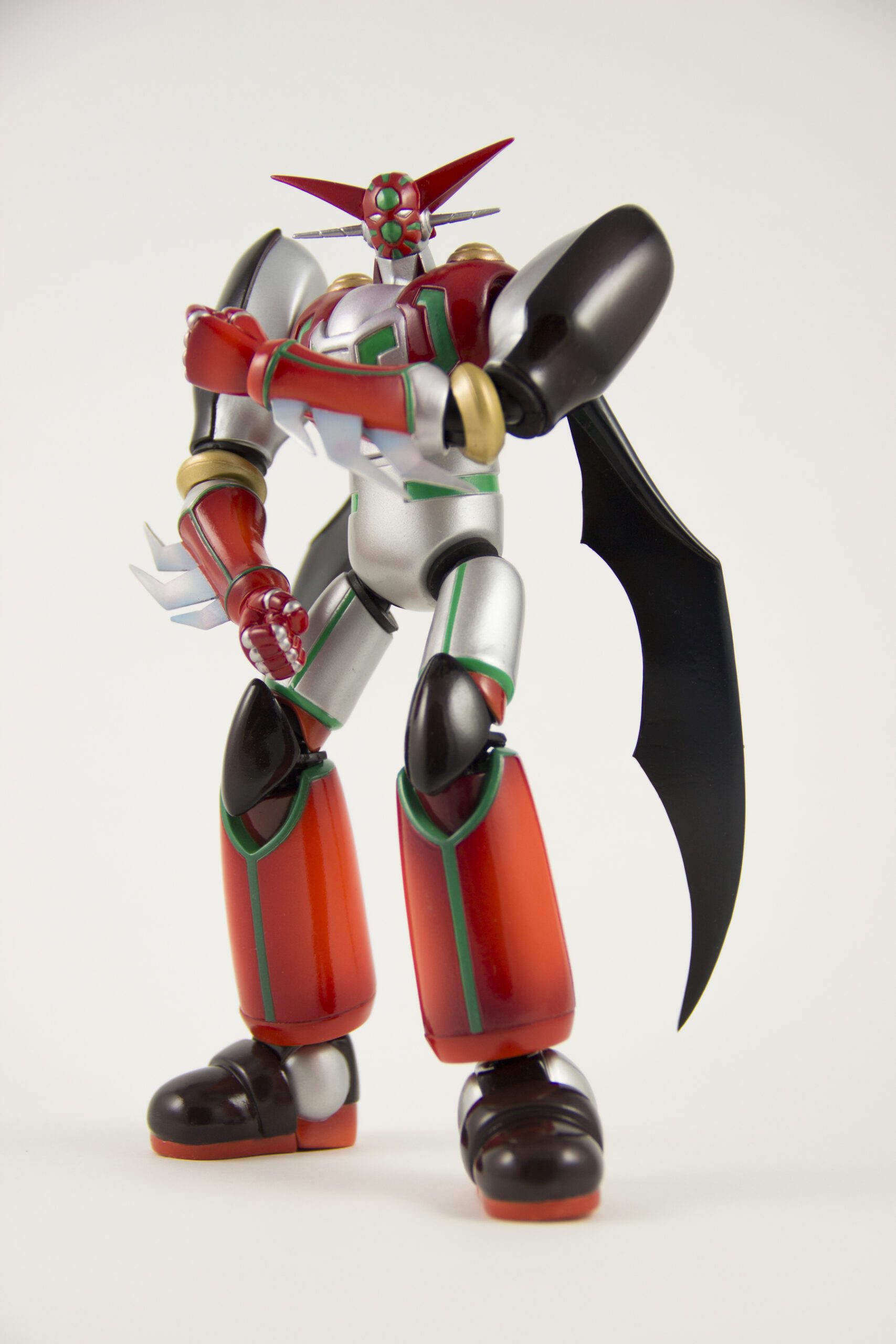
Long before the Transformers franchise became an American box-office colossus, it was a big-money multimedia empire in its native Japan. And before Transformers, this most industrious country for robotics innovation developed Gundam, and before that Mazinger Z, and before that Astro-Boy.
It’s telling that while we Americans were dressing up Barbies in the fashion of the day and sending our G-I Joes into simulated land wars, Japanese eyed the future. Their designers were imagining androids, cyborgs and mechas—cutting-edge toys that anticipated prosthetics and A.I. sentience, now considered the vanguard of futurism.

The Morikami Museum’s popular summer exhibition “Japan’s Robot Kingdom”—the two-room showcase was buzzing with adults and children, even on a Wednesday afternoon—hones in on the nation’s advances in robotics mostly through its toys. Exhibited under glass, these sleek, streamlined and compact works of art, molded from everyday plastic and metal, range from your traditional hulking Transformers and other superheroic/city-decimating warriors to the bull-shaped, weaponized Dibison and the lupine Command Wolf. The Mobile Police AV-O Peacemaker is everyone’s dystopian nightmare of a militarized police robot (it’s a good thing he’s a peacemaker!), and the two figurines of the busty, hourglass-shaped Motoko Kusanga, from “Ghost in the Shell,” touch briefly on the objectification of women that has become a stereotype of Japanese animation.

I’m sure this exhibition will feel like nirvana for fans of these franchises, but I was more taken with the real-world robots mounted center stage in the opening gallery. These anthropomorphized creatures seem more like Lucasfilm creations than actual, semi-functioning household droids, but for their time, in the ‘80s, that’s exactly what they were. The wheeled Omnibot 2000, developed by Tomy, looks like a cross between a cassette player and a vintage PC. Dingbat is diminutive and inspired by “E.T.,” and Crackbot is more heavyset and controlled by a tail sensor. Nintendo’s R.O.B. robot, designed for a couple of long-forgotten NES games, is a long-necked and short-lived tool, while the dome-headed Verbot is the most R2D2-esque of the bunch.
You can’t help but feel that all of them are looking at you: Their ocular cavities suggest sentience and personality, even if their functions were limited by the technological infancy of their time. ‘Bots can complete more difficult tasks now, of course, though I’m not sure the 200-plus functions programmed into the 6.5-inch tall I-Sobot—such as “performing a Western gunfight scene” and “imitating animal sounds”—are doing much to enhance the public good.

But my favorite piece in the exhibition, PARO, certainly is. It’s the robot most unlike the others; it looks no different from the fluffy plush animals you’d find in a 10-year-old’s menagerie. But PARO, a baby harp seal covered in faux-far, is a therapy robot. It understands a limited vocabulary and responds to words and touch, and it has been proven to reduce stress in patients and caregivers, reduce psychological effects of patients and improve their socialization skills.
A short video in the second gallery presents similar examples of robots deployed in the health care and education fields—like a robot that can attend classes for ill students. This exhibition could have used more examples like this and fewer humanoid objects of pop-culture fantasy.
The toy robots, it argues, seeped into Japan’s collective consciousness and then the world, and many of their designers went on to apply their abilities to practical, beneficial purposes. We don’t see enough of that in the exhibit.
“Japan’s Robot Kingdom” is only half-successful. Followers of anime, manga and action figures will enjoy it thoroughly, but for the rest of us, it’s largely a repetitive toy show with the potential to be much more.
“Japan’s Robot Kingdom” is on display through Sept. 13 at the Morikami, 4000 Morikami Park Road, Delray Beach. Admission is $9-$15. Call 561/495-0233 or visit morikami.org.